 Wingspan Tech



Can A Power Washer Remove Paint
Yes, a pressure washer is effective at removing old paint that has peeled, cracked, or loosened from a variety of surfaces, but it’s important to understand that it’s essentially a “surface treatment tool”, not a 100% paint removal solution.
For DIY players looking to renovate a wooden deck or fence, the key to success lies in the balance of pressure and technique. The pressure is generally controlled between 1,500 and 2,000 PSI, with a 25 degree or 40 degree spray head, so that impurities are washed away without etching the surface or damaging the wood grain. High-pressure water flow is indeed very effective against paint layers that have lost adhesion, but if the paint film is still firmly adhered to the substrate and not combined with chemical strippers, it is difficult to rely on water flow alone to fully expose the bottom.
If your house was built before 1978, you must test it for lead paint before you start. High-pressure flushing can turn lead powder into aerosol dispersion, which is very dangerous. When done correctly, pressure washing saves a lot of sanding time and creates a clean, porous, ideal bonding surface for subsequent primers and topcoats.
Re-Understanding The Role Of Pressure Washers In Paint Removal
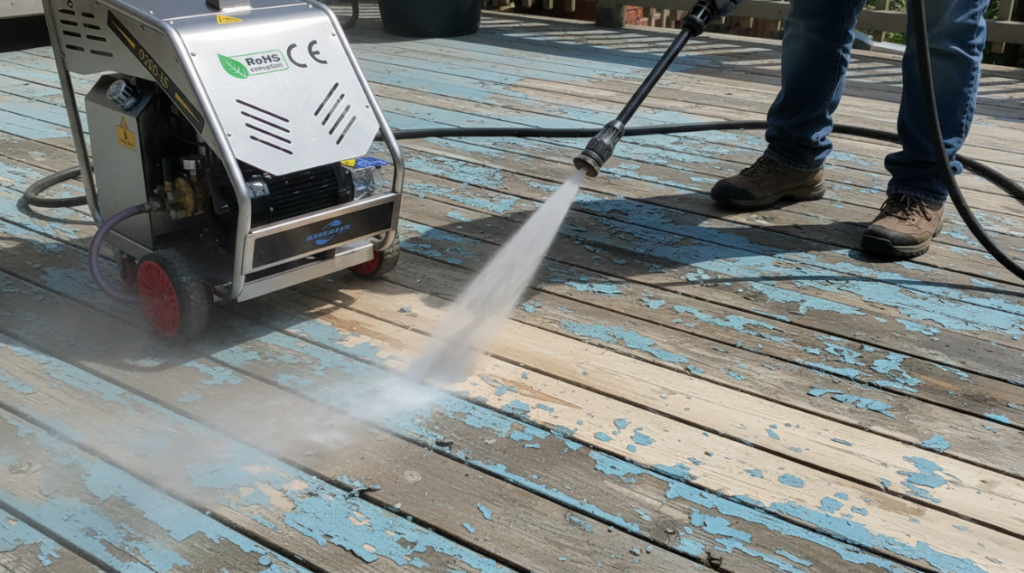
Many homeowners tend to mistake their pressure washer for a “miracle eraser”, thinking they can wipe off old paint in minutes. Its greatest use is to help you lift up paint that has failed ——that is, is bubbling, cracking, and peeling. In this way, you can lay a solid foundation for the next coat of paint. If the old paint is still firmly stuck and you have to rely on brute force to force it, you may end up with pressure overload and drive the wood or bricks under it to a pulp.
Technical Parameters
For most DIY projects with wooden decks or fences, 1,500 to 2,000 PSI is the accepted standard in the row. If you rinse softwoods like fir or pine under pressure exceeding 2,000 PSI, the wood surface will burr and even break out of deep pits. Brick or concrete can be pressed a little, but for wood, I recommend keeping it steady.
The spray head determines the striking accuracy of the water flow.
- 25-degree green spray head: This is the main tool for paint removal. Its fan is wide enough for efficiency, yet it has enough concentrated force to flush out loose paint chips.
- 40-degree white showerhead: Suitable for handling more delicate areas or flushing out freshly washed debris at the end.
O-Series High Pressure Washer 220V
The durable ceramic pump and powerful four-stage motor provide high-performance cleaning power, with adjustable pressure, support for customized voltage and power.
380V 1500Bar Water Blaster
1450 RPM ultra-high pressure water jet pump, high cost performance, suitable for 50Hz voltage. It’s a great tool for removing rust and deburring in factories.
Diesel Power High Pressure Cleaner
The pump unit is the core component of a cleaning machine or water treatment system. Composed of a high-pressure plunger pump and an electric motor
Foam Cannon for car washing
Foam Cannon S V3.0 (Thicker Snow Foam Technology) with 1/4 Inch Quick Connector for Pressure Washer, 34 oz Bottle (V3.0 (1/4″ Quick Connector) + SOAP Sample)
WARNING: Never use a 0 degree spray head. It can destroy your surface in a second.
Protect The Integrity Of Wood Grain
When stripping paint off a deck or fence, your goal is to remove the paint without damaging the wood.
- Maintain distance: Keep the boom head 6 to 12 inches from the surface.
- Long-range strafing: Swing the boom long distances in the direction of the wood grain.
- The hand must never stop: if you pause even slightly at a certain point, the water flow will leave a permanent pit there, which cannot be saved by any sanding.
When Should I Use Chemical Strippers?
If your project requires 100% bottom exposure ——for example, if you want to change solid paint to translucent toner——, water alone is not enough. For those old paints that are still sticking to the ground, it is professional practice to apply a layer of chemical stripper first. The stripper breaks the molecular bond between the paint and the surface, allowing you to rinse the residue clean with a low, safe PSI.
Critical Safety Check
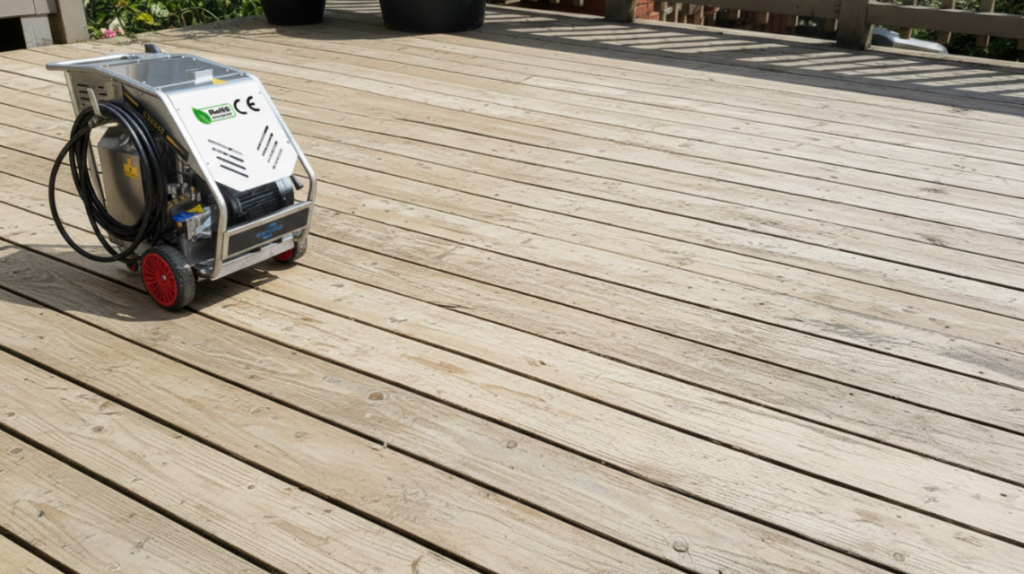
Safety is the least sloppy aspect of a DIY renovation. In the United States, houses built before 1978 are more likely to contain lead paint. Flushing such surfaces is extremely dangerous because high-pressure water can crush the paint into invisible toxins that can seep into the soil or be inhaled. Before you do it, go to the hardware store and buy a testing bag. Once the lead is found, stop immediately and ask a professional team to deal with it.
Final Preparation
Just because you flush the water doesn’t mean the work is done. Pressure washing will allow the material to absorb moisture, and you’ll have to give it at least 48 hours of sunny weather to dry thoroughly.
After it dries, I recommend a light sanding to smooth out any wood fibers that have been stirred up by the water pressure. The surface treated in this way is both flat and microporous, and finally a high-quality primer is applied, so that your new paint surface will have the strongest adhesion and will not repeat the same mistakes.
Author: Mark Thompson
Having managed thousands of deck, fence, and siding projects, I’ve seen firsthand how the right tools can either save a project or ruin a home. I am passionate about sharing the technical nuances of surface preparation—from PSI calibration to safety protocols—to help DIY enthusiasts achieve a professional-grade finish while protecting their most valuable investment.