 Wingspan Tech



How To Start Pressure Washer Motors In 3 Fast Steps
How can I start the high-pressure washer at once? Connect the water source, turn the fuel valve and engine switch to “ON”, close the choke valve (CLOSED), and then pull the start rope. But there is a “zero step” that is easily overlooked-before pulling the rope, you must first pinch the trigger of the spray gun to drain the air inside, so as to completely prevent the pull rope from rebounding and hurting your hands. Every weekend, we can always see many homeowners who are overwhelmed by improper operation, either flooding the engine or pulling out the starter. To avoid common pressure lock-up and fuel failures, you need a mechanized standard operating process. The following are the standard starting steps used by small engine maintenance masters.
W.C.P. Startup Rules: How To Properly Start A Pressure Washer
We have summarized a set of “Water-Compression-Power” (W.C.P) rules, which can fundamentally solve the problems of engine flooding and water pump damage. Whether you are using fuel or electric models, follow these 3 simple and quick steps to safely hit the machine.
The first step: water supply (take over and exhaust)
If the high-pressure water pump is dry in water shortage, the ceramic plunger inside will be completely scrapped within 60 seconds. First, connect the water pipe at home to the water inlet of the water pump, turn the faucet to the maximum, and then connect the high-pressure water pipe and spray gun.
Hold the trigger of the spray gun and wait until the water flow is stable. This step can exhaust all the air held in the system. Bubbles in the pump will generate huge back pressure. If you pull the starting rope against this pressure, the rope will suddenly bounce from your hand and may even break your fingers (experts call this “hydraulic locking”). When preparing to start the motor, be sure to hold the trigger with your left hand, or simply tie it to the open state with a tie.
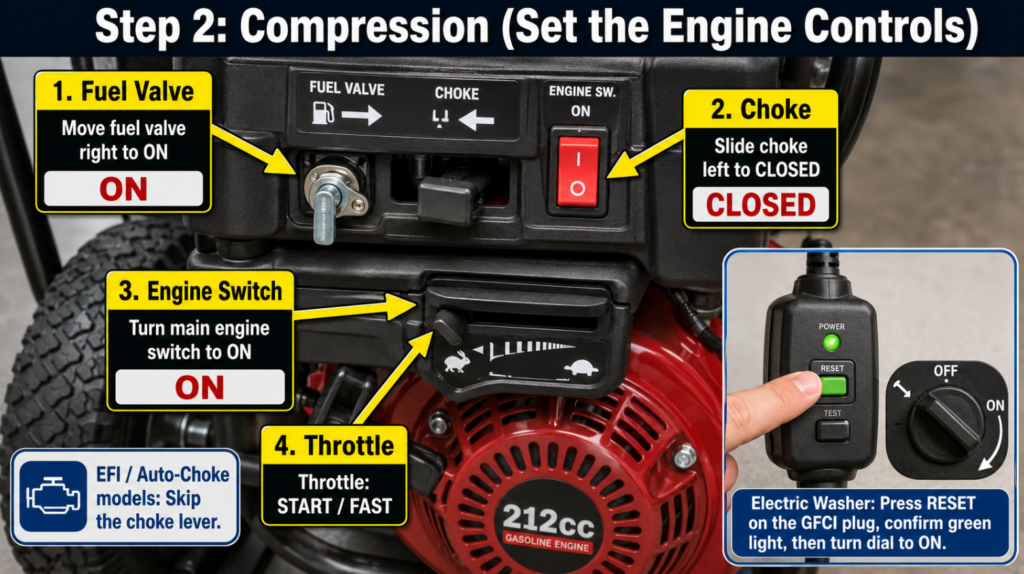
The second step: compression (set the engine control button)
Cold start requires a thicker mixture to ignite. Locate the engine’s control panel and set them to cold start mode. Push the fuel valve lever to the right to ON to allow gasoline to flow into the carburetor pan. Push the choke lever to the left to the CLOSED position. Finally, turn the main switch of the engine to “ON”.
If you buy a new high-pressure washer with electronic fuel injection (EFI) or automatic choke, you don’t need to worry about the choke. These modern engines will automatically adjust the air-fuel ratio. Electric cleaning machine is more convenient, there is no such fuel mechanical structure. If you use electric models, just plug the leakage protection (GFCI) plug into the wall, press the “RESET” button above, confirm that the green light is on, and then turn the machine knob to ON.
The third step: power (pull rope ignition)
Pull the drawstring smoothly over the compression point to prevent damage to the starter interior. First, gently pull out until you feel obvious resistance from the inside of the engine. At this time, you can quickly pull 1 with force to complete the ignition. Never let go and let the handle bounce back on the engine shell.
After the machine starts roaring, slowly push the choke lever to the right to OPEN for the next 5 to 10 seconds “. As the engine runs from a rough idle to a smooth, high-pitched hum, you can get to work.
| Startup Step | Gas Pressure Washer | Electric Pressure Washer |
|---|---|---|
| Power Preparation | Check fuel and engine oil levels | Connect the power cord to a properly grounded outlet |
| Water Supply | Connect the garden hose and turn the water on fully | Connect the garden hose and turn the water on fully |
| Air Purge | Hold the spray-gun trigger until water flows steadily | Hold the spray-gun trigger until water flows steadily |
| Main Switch | Set the engine switch to ON | Set the power switch to OFF before plugging in |
| Fuel Valve | Move the fuel valve to OPEN | Not required |
| Choke Position | Set the choke to CLOSED for a cold start | Not required |
| Starting Method | Pull the recoil cord gently to the compression point, then pull sharply | Plug in the unit and move the power switch to ON |
| Handle Control | Do not allow the recoil handle to snap back | Not applicable |
| Warm-Up Procedure | Move the choke gradually to OPEN over 5–10 seconds | Usually ready for immediate operation |
| Ready Indicator | Engine settles into a smooth, stable idle | Motor activates when the spray-gun trigger is pressed |
The Expert Defuses The Obstacle: What If The Engine Fails To Catch Fire?
Even if your steps are all right, spoiled gasoline or a stuck valve may stop the engine completely. Maintenance masters often encounter some of the instructions do not mention the fault.
Deterioration of gasoline and nozzle blockage
Gasoline containing ethanol will deteriorate after 30 days, leaving a layer of sticky jelly and blocking the main nozzle of the carburetor. If your washing machine eats 1 winter ash in the garage, it is not possible to add new oil directly to the old oil. You have to take a 10mm wrench, loosen the nut on the bottom of the carburetor, and empty the bottom shell. When the yellow stale oil flows clean and smells the pungent smell of new gasoline, tighten the nut and try to pull the rope again.
Solution to “air lock” of oil tank cap
If the vent hole of the fuel tank cap is blocked, a vacuum will form in the fuel tank, causing the engine to cut off fuel during pulling. If you find that the engine has just started and coughed up for two seconds, you can try to loosen the fuel tank cap by half a turn. If the engine can run normally after loosening the cap, you will have to replace it with a new vent cap.
Measured Data In 2024: Comparison Of Tensile Resistance
I took a standard 3200 PSI Honda (Honda)GX200 high-pressure washer to do a test to see how much effect the pump does not exhaust.
The test found that if the trigger of the spray gun is completely released to pull the rope, the peak pulling force will reach 45 pounds (about 20 kilograms), and the starting clutch will be obviously tightened. But as long as you hold the trigger and keep it open, the pull instantly drops to 12 pounds (about 5 kilograms). Therefore, exhausting the pipeline is a necessity for mechanical operation, and it is definitely not only a safety suggestion. Remember: you must hold the trigger before starting each time, and don’t let yourself “compete” with the machine “.
Frequently Asked Questions (FAQ)
The high-pressure cleaner ran out of oil. How to start after adding oil?
Fill up the oil, turn the fuel valve to “ON” and wait patiently for two minutes for the carburetor bottom shell to fill up the oil. Then set the choke to “CLOSED”, hold the trigger of the spray gun, and finally pull the starting rope.
Clearly added new oil, why the cleaning machine still can’t hit?
Eighty percent of the carburetor nozzle was blocked by the previous residue, or the spark plug carbon deposit was too serious. You can directly empty the carburetor bottom shell, spray some starting liquid into the air inlet, and remove the spark plug to see if it is dark and full of carbon deposits.
Do I have to turn on the tap before starting the machine?
Of course. If there is no running water to start the motor, the heat generated by high friction will instantly melt the sealing ring inside the pump. So before touching the engine, be sure to turn on the water and drain the air.
honda high pressure washer choke where?
The choke is a small gray or black lever, usually directly above the fuel valve switch near the air filter housing. When cold starting, push it to the left, or to the side with the Choke icon.
How long does a high-pressure washer need to heat up?
Fuel models generally need to heat the engine for 15 to 30 seconds. After the engine runs smoothly, slowly push the choke valve to the “OPEN” position. One thing to note: without pulling the trigger and spraying water, the machine must not be idling for more than 2 minutes, otherwise the water in the pump will be directly boiled.
Why does the drawstring always jerk back to the hand?
This is the pressure held in the pump, causing the starter to produce violent recoil. When pulling the starting rope, be sure to hold the trigger of the spray gun at the same time to release the internal pressure inside.
electric high pressure cleaning machine how to start?
Connect the water pipe, pull the spray gun to evacuate the air, and then insert the plug into the socket with the ground wire. Press the GFCI reset button on the power cord and turn the main knob ON “. The motor will stay quiet until you pull the trigger.