 Wingspan Tech



How To Start A Pressure Washer: 5 Fast & Safe Steps
Do you want to start a high-pressure washer smoothly? In fact, the action is not too complicated: connect the garden water pipe, turn the faucet to the maximum, hold the trigger of the spray gun to exhaust the air inside, then turn the engine switch to “ON” (if it is a fuel machine, remember to open the choke door), and finally pull the start rope or press the electric start button. However, despite these simple actions, as long as you miss one step, the pump in the machine may be completely scrapped in less than a minute.
Many novices will skip the fatal link of “exhaust”. For this mistake, the machine will strike every minute. If you don’t want to pay high maintenance costs for a wave of blind operations, you have to honestly abide by a set of rules that conform to the internal hydraulic system of the machine. In the practical operation, we have found out a set of process that can be called “dead knock”, which can not only ensure smooth start-up, but also protect the operator and the sealing ring of the internal water pump well.
The Core Thinking Of The Insider: The Starting Rule Of P.A.R.S.
To safely handle the high-pressure washer, you have to change your mind: don’t stare at the engine, the water pump is the big head. The engine just makes a hard effort, and it is the water pump that really carries all the friction and pressure. In order to prevent hand mutilation and error, our equipment testing laboratory has been strictly implementing this set of P.A.R.S. rules:
- P-Exhaust (Purge): Before touching the engine, hold the trigger to release all the excess air in the system.
- A- Position adjustment (Align): Turn the fuel valve, choke valve and engine switch to the positions where the cold engine starts.
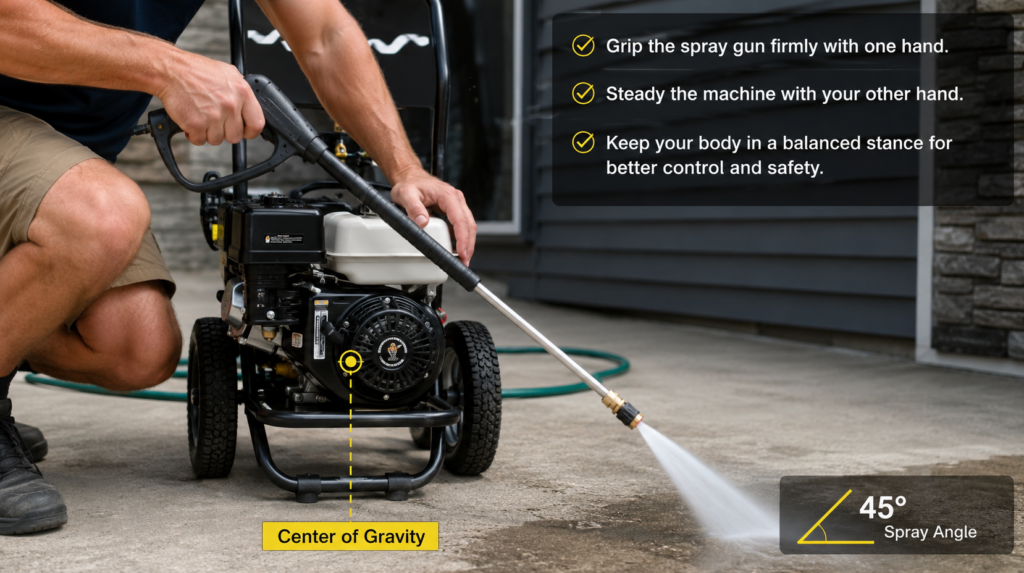
- R-Pull Rip (Rip): One hand tightly pulls the trigger of the spray gun to release the held water pressure, and the other 1 pulls the start rope with the other hand.
- S-Test Spray (Spray): First try the nozzle on the hard ground that is resistant to construction, such as the cement driveway, and don’t go up to those delicate things.
Five Steps! General Safe Start-Up Guide For Any High-Pressure Washer
The starting sequence of the fuel model and the electric model is slightly different, but the bottom safety logic is actually common. Listen to me and follow the following 5 steps step by step.
Step 1: Connect the water source and exhaust
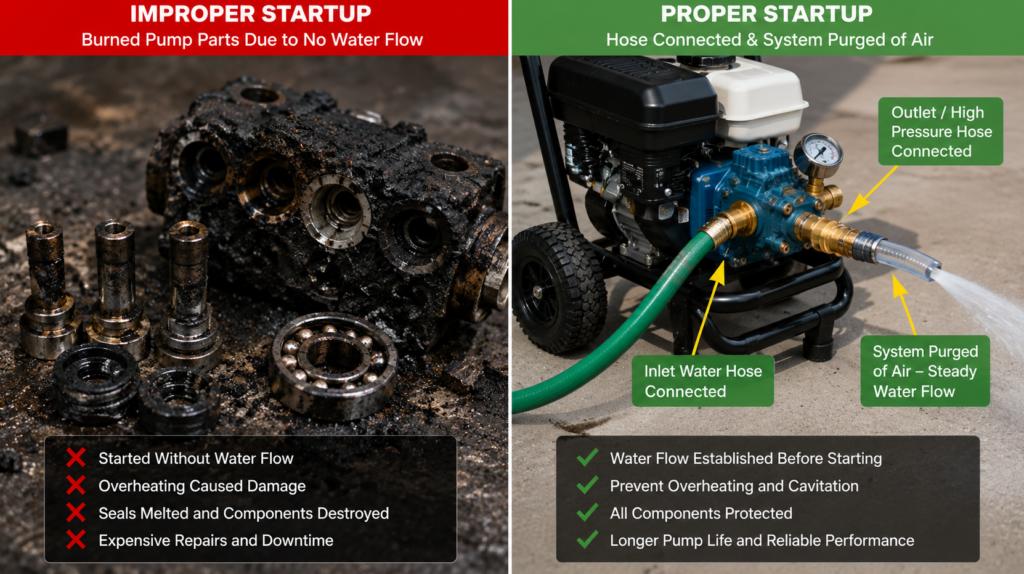
Never fire a fire when there is no steady flow of water coming out of the spray gun! Water here is not only used to wash things, it is the internal pump plunger “life-saving coolant” and lubricant. If you let the pump “dry burn”, it will immediately cause cavitation phenomenon-the bubbles held in it will burst violently under high pressure, which will not only scrape the ceramic plunger, but also directly fuse the heat release valve.
Specific operation: connect the strong garden water pipe to the water inlet of the machine and screw the outdoor faucet to the maximum. Then put on the gun, muzzle down to the ground, and hold the trigger. 1 at first you will hear the hissing sound of “sniffing” with the water, hold on for about 30 seconds, until the water becomes a solid, flowing water column.
Step 2: Connect the pipe and select the right nozzle
Remember, before starting the engine, be sure to connect the high-pressure hose to the machine outlet and the spray gun head. What if you wait for the machine to be pressed before picking it up? Sorry, the quick-connect connector was deadlocked at that time, and it was impossible for manpower to press it in.
Take a quick look at the O-shaped rubber ring on the joint. If this circle cracks, the water pressure will definitely go crazy. Next, snap the nozzle you want to use into the spray gun head. Pull the brass ring back, plug it into the nozzle, and push the brass ring forward. Be sure to pull twice hard after loading to make sure it is stuck. If it is not clamped tightly and the system is 1 pressurized, the nozzle will fly out like a bullet, which is extremely dangerous.
| Nozzle Color | Spray Angle | Best For | Recommended Surfaces | Hazard Level | Safety Notes |
|---|---|---|---|---|---|
| Red | 0° | Maximum cutting power for stubborn stains | Concrete, steel, heavy-duty industrial equipment (spot cleaning only) | Extreme | Never use on wood, vehicles, painted surfaces, or people. Can cause severe surface damage and serious injury. |
| Yellow | 15° | Heavy-duty cleaning | Concrete driveways, brick, stone, metal surfaces | High | Maintain a safe distance to avoid etching or stripping surface coatings. |
| Green | 25° | General-purpose cleaning | Decks, fences, patios, sidewalks, outdoor furniture | Medium | Ideal balance between cleaning power and surface protection for most household tasks. |
| White | 40° | Gentle rinsing and delicate cleaning | Vehicles, windows, siding, painted surfaces, outdoor furniture | Low | Safe for most delicate surfaces when proper distance is maintained. |
| Black | 65° (Low Pressure) | Soap and detergent application | All surfaces during pre-soak or detergent treatment | Very Low | Designed for low-pressure chemical application only. Not intended for high-pressure cleaning. |
Step 3: adjust the fuel valve, choke valve and switch (for fuel engine)
If you are buying an electric model, skip this step directly-plug in the socket with leakage protection and press “ON” to finish. But the cold start of the fuel engine, you need to move a few valves.
Find the engine control area first. Screw the fuel valve to the “OPEN” or “ON” position to allow the gasoline to advance to the carburetor. Then set the choke valve to the “CLOSED” or “CHOKE” (closed/choke) 1 position, which can restrict the air to enter and make the mixed fuel in the cold state more intense. Finally, turn the main switch to “ON”.
The fourth step: anti rebound “pull rope stunt”
This is the ultimate secret for insiders to prevent the thug from rebounding from the pull rope: 1 one hand keeps holding the trigger of the spray gun and the other 1 pulls the start rope.
Why? Because when you go to shake the engine, the pump immediately wants to build up pressure. If the spray gun is turned off at this time, this pressure will be held in the unloading valve and will violently push the engine piston in reverse. The dark force of this recoil is extremely easy to rip the drawstring from your hand roughly, and you will suffer if you don’t get your fingers or wrists right. Pinch the trigger to release this pressure, and the engine can turn very easily, usually once or twice the fire will start.
Step 5: Run and observe the pressure stability
First, try spraying the water gun at a safe place. Once the fuel engine is on fire, immediately turn the choke back to the half position (“OPEN” or “RUN”). Let the engine warm up for about 10 seconds, then push the choke completely.
Put the spray gun at a 45-degree angle to the concrete floor and pinch the trigger. The water pressure should soar to the top in an instant and feel steady. At this time, put up your ears to listen to the engine speed: when you pull the trigger, it is normal for the speed to drop slightly; release the trigger and the speed will increase again. However, if the water pressure is large and small and intermittent, it is mostly because your water pipe is broken or the filter screen of the water inlet is blocked by dirt.
Destroy The 3 New Mistakes Of High Pressure Washer
The machine is on, but it doesn’t spray water
If the fuel engine is turning all the time and you don’t pull the trigger, don’t be in this state for more than 2 minutes. At this time, the pump is actually taking that little bit of water for internal dead circulation. Friction will quickly heat this water to the boiling point, which will not only melt the internal sealing ring, but also force the heat release valve to spit water on the ground. If you want to stop and do something else while washing, please turn it off directly.
Make do with the old gasoline left over from last year
If the machine eats 1 winter ash in the warehouse, be sure to drain the old oil left in the carburetor before starting. Gasoline spoils so fast that it leaves behind a sticky layer of gummy gum that blocks the tiny spouts in your carburetor to death. When the time comes, the engine will either burp crazily or fail to stay alive. Be sure to use fresh fuel, and it is best to add some marine-grade fuel stabilizers.
Don’t look at the oil dipstick before pulling the rope
Every time before opening dry, the oil and the oil dipstick of the water pump should be pulled out to have a look. If the engine oil is not enough, it will trigger the low-oil shutdown sensor and will not give you the chance to ignite at all. If the water pump is short of oil, it will be over. Metal and metal will be directly ground hard, and this machine will be basically completely useless.
FAQs
Do I have to turn on the faucet before starting the machine?
Of course. Not only do you have to maximize the water, but you have to completely drain the air from the spray gun to ignite it. As long as the pump “dry burn” even for a few seconds, it will cause irreparable overheating injury.
The machine has been on 1 all winter, how can it not catch fire anyway?
The main culprit is basically the deterioration of the old oil to the carburetor blocked. Drain all the old gasoline, clean the carburetor bottom shell, replace it with a new spark plug, and try again and it will basically be full of blood.
What exactly is the choke door used?
It can limit the amount of air entering the carburetor, thereby creating a 1 mixture of “more oil and less gas. This will make the cold engine very easy to start. However, when the machine is warmed up, you must remember to turn it on.
Can you start the machine without a water pipe?
Absolutely not. No water is equivalent to pumping the pump only lubricating fluid and coolant. Those ceramic pistons inside will crack and be scrapped in an instant.
Why does the starting rope seem to be stuck and can’t be pulled at all?
Because the pressure held in the pump locked the unloading valve. Pinch the trigger of the spray gun and let the air out of it, and the rope immediately becomes smooth.
The machine is already hot. Do you need to open the choke door to restart?
No need. If the engine block is still hot within a few minutes of your shutdown, just leave the choke at the “RUN” position to start the fire.
How long can the machine run without pulling the trigger?
The upper limit must not exceed 1 to 2 minutes. The water circulating in the pump heats up extremely violently. If you are not spraying water, it is safest to turn off the engine directly.
What gasoline should be added to the high pressure cleaner?
Unleaded gasoline with octane number 87 and above is fine, but it must be noted that the ethanol content must not exceed 10% (that is, E10). Mixed gasoline with high concentrations of ethanol will corrode the plastic tubing in the machine to the ground.