 Wingspan Tech



How to Adjust Power Washer Pressure in 3 Easy Steps
Adjusting your power washer pressure takes three simple actions: swapping to a wider-angle nozzle, stepping back from the surface, or twisting the variable wand dial. Performing any of these actions instantly drops the pounds per square inch (PSI), protecting delicate surfaces like car paint or soft wood decks. Many DIYers mistakenly try turning the brass unloader valve on the pump to lower the pressure. Doing that usually blows the pump seals. Here is the exact system professional technicians use to manage pressure safely and effectively.
The “D.N.A.” Pressure Control System
Professional cleaners rely on a specific sequence to alter water force without damaging their equipment. We call this the D.N.A. method: Distance, Nozzles, and Accelerators. You can apply this framework to figure out how to adjust power washer pressure on any machine, whether it runs on gas or electricity.
Step 1: Distance (The Inverse Square Rule Of Washing)
Stepping back from your target is the fastest way to drop the water impact force. Water loses kinetic energy exponentially the second it leaves the wand. Backing away just six inches can cut the actual pressure hitting your siding by half. You do not need to turn off the machine or swap parts to use this method. Start spraying from three feet away and slowly walk forward until the dirt starts lifting.
Step 2: Nozzles (Color-Coded Pressure Drops)
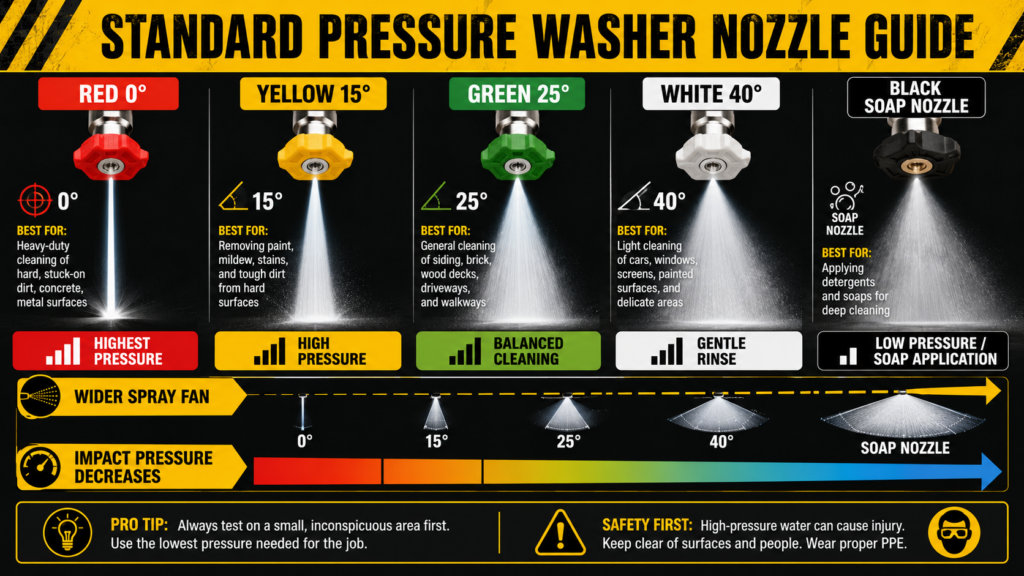
Swapping your quick-connect nozzle changes the geometry of the water stream, instantly altering the pressure. A 0-degree red tip concentrates all the machine’s power into a pinpoint, which easily cuts through solid wood. Switching to a 40-degree white tip spreads that exact same water volume over a wide fan pattern. Spreading the water out drastically lowers the PSI at the point of impact. Keep a set of universal color-coded tips in your pocket. Snap in the green (25-degree) or white (40-degree) tip when transitioning from cleaning hard concrete to washing a vehicle.
Step 3: Accelerator & Wand Dials (Cutting Power At The Source)
Lowering the output directly from the machine provides complete control over your PSI and Gallons Per Minute (GPM). Gas pressure washers feature a throttle lever on the engine. Sliding the throttle down reduces the engine RPM, which spins the pump slower and lowers the pressure. Electric models typically rely on a Vario Power spray wand. Twisting the barrel of the wand restricts the internal water flow, allowing you to dial the pressure up or down seamlessly while holding the trigger.
Real Test Data: How Distance Kills PSI Impact
Distance dictates cleaning power more than the rating on your machine’s box. We tested a standard 3000 PSI gas power washer using a 15-degree yellow nozzle to measure the exact impact force at various distances. The data shows exactly why backing away is the safest way to adjust a pressure washer for fragile surfaces.
| Distance from Surface | Estimated Impact Pressure | Safe Surface Example |
| 2 Inches | 3000 PSI | Concrete Driveways |
| 12 Inches | ~1400 PSI | Hardwood Fencing |
| 24 Inches | ~600 PSI | Vinyl Siding / Car Paint |
Why Beginners Destroy Pumps: The “Unloader Valve” Trap
Twisting the unloader valve to regulate pressure will ruin your pump. The unloader valve is a heavy brass spring mechanism designed to redirect water into a bypass loop when you release the trigger. Uninformed users often mistake this valve for a volume or pressure knob. Adjusting it messes up the tension spring. The pump will fail to bypass the water properly, causing a massive internal pressure spike that blows the rubber seals. Leave the unloader valve alone and rely entirely on your nozzles, distance, and throttle to control the wash.
Frequently Asked Questions
Can You Turn Down The Pressure On An Electric Pressure Washer?
Changing the nozzle or twisting the variable wand dial is the only way to turn down the pressure on an electric machine. Most electric motors run at a fixed speed, meaning you cannot lower the engine RPM like you can on a gas unit.
What Is The Best Nozzle For Washing A Car?
The 40-degree white nozzle is the safest choice for washing cars. The wide spray pattern disperses the pressure enough to prevent stripping the clear coat or damaging plastic trim pieces.
How Do You Adjust The Unloader Valve On A Pressure Washer?
Setting the unloader valve requires a pressure gauge and is solely done to match the pump’s maximum output, not to change cleaning pressure. Only professional technicians should adjust this valve during maintenance.
Why Does My Power Washer Pulse When I Adjust The Wand?
A pulsing pump indicates restricted water flow or a clogged nozzle. Dropping the pressure too low on a variable wand can sometimes confuse the unloader valve, causing it to rapidly switch between spray and bypass modes.
Will Lowering The Engine Throttle Damage My Gas Pressure Washer?
Running a gas engine at a slightly lower throttle is perfectly safe and reduces the water pressure. Dropping the throttle too low will stall the engine under the load of the water pump. Keep the engine speed high enough to maintain a smooth, consistent spray.