 Wingspan Tech



How to Connect Water Hose to Pressure Washer Leak-Free
If you want to connect the water pipe and the high-pressure car washer tightly, you have to master several hard core details: check the rubber gasket inside, align the straight thread perfectly to prevent slippage, and then tighten it by hand. Many novice Xiaobai turned over the car on this most basic step-wrapping the raw material belt at the water inlet with his eyes closed, or taking a big wrench to “make a miracle”. As a result, not only the water flooded the mountain, but also the water pump was burned.
Remember one thing: whether the garden water pipe can be sealed depends not on the metal thread at all, but on the physical seal produced by the extrusion of the rubber gasket inside. Today, I’ll take a look at your wrong operations that cause the machine to spray water everywhere, teach you a professional 4-step sealing method, and talk about how to use quick-connect joints to completely say goodbye to thread wear.
Raw Material Belt Trap: Why Do You Wrap More and More Leak?
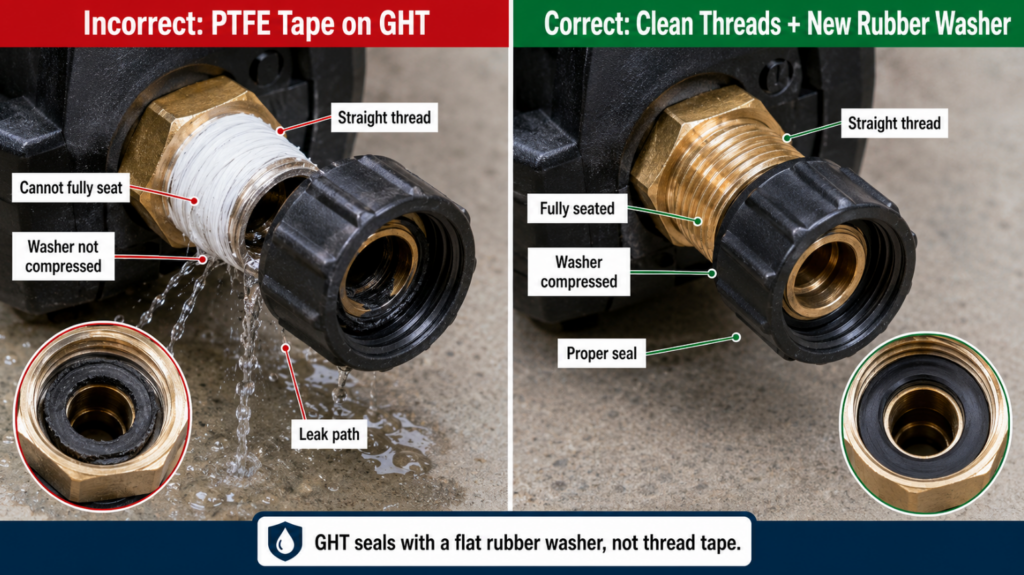
The water inlet of the car washing machine is wrapped with raw material tape (Teflon tape), which is definitely the “number one culprit” of water leakage “. Many people apply the experience of repairing water pipes at home to garden equipment. The water pipes at home use NPT (tapered) threads. The more they are tightened, the more they are tightened. Raw material is really needed to fill those tiny gaps.
But the car washing machine uses GHT (garden water pipe thread). It’s a straight thread! Its only function is to draw the water pipe closer to the machine so as to squeeze the flat rubber gasket inside. If you wrap the raw material tape around the straight thread, the water pipe joint cannot be screwed to the end, and the rubber ring cannot be pressed tightly. The water directly bypasses the uncompressed gasket and sprays along the joint gap. How to treat it? Quickly rip off the raw material belt, throw away the squashed old gasket, and replace it with a thick and new rubber gasket.
S.E.A.L. 4-step method: creating bulletproof-level sealed connections
Professional after-sales technicians rely on this “S.E.A.L. Rule” to nip leaks in the bud. Every time you drag the car washer out of the garage, you must go through these four mechanical inspection steps:
- Surface Check
Take a clean cloth and wipe the brass water inlet filter and the pipe threads thoroughly. Even a single grain of sand stuck to the rubber gasket will create a tiny gap, which the high-pressure water flow can instantly wash open. - Evaluate the Washer
Use a flathead screwdriver to pry out the rubber washer in the water pipe and take a look. If it feels as hard as plastic, or has cracked or completely flattened, replace it quickly. The rubber has long since lost its elasticity after a winter of freezing in a cold wind-whooshing shed. - Align with a Reverse-Turn
How to prevent catastrophic “slippage”? Put the water pipe joint against the water inlet of the machine, do not rush to the right, first slowly turn counterclockwise. When you can clearly feel a distinct “click” as you turn it, it means the threads have perfectly engaged in the groove; at that point, tighten it further by turning clockwise. - Pure manual locking (Lock by Hand)
Only use your bare hands to tighten! Never crack with big pliers or a big wrench. The torque of those tools is too large, which will not only deform the brass inlet pipe, but also destroy the circular structure of the joint. Once the brass piece is deformed, the machine will have to leak for a lifetime.
The ultimate upgrade in 2026: double O-ring quick connect system
By 2026, regular car washes and smart car owners have long abandoned the traditional threaded connection. The brass water inlet on an ordinary household car washer will soon slip and be scrapped if you can’t twist it all day long.
Want to protect the machine? Directly put on a set of “double O-ring quick connect system” made of anodized aluminum “. Screw the male adapter to the car washer and never remove it. Plug the female adapter into your water pipe. The structure of the double O-ring is extremely stable, and even if it encounters the sudden surge of hydrostatic pressure in the modern municipal pipe network, it will never leak a drop of water. Those cheap brass on the market will corrode and get stuck after a long time of quick connection, but this stuff is made of anodized aluminum. It is not afraid of calcium scale in hard water. It can be plugged and unplugged at any time without leakage.
| Test Category | Direct Threaded Connection | Traditional Single O-Ring Brass Quick-Connect | 2026 Dual O-Ring Aluminum Quick-Connect |
|---|---|---|---|
| Leak Resistance | Moderate sealing performance; depends on thread tightness and installation accuracy; may develop leaks after repeated assembly and disassembly | Improved sealing compared with threaded connection, but single O-ring design is more vulnerable to wear, deformation, and pressure fluctuations | High sealing reliability; dual O-ring structure provides redundant protection against pressure surges and prevents water leakage |
| Thread Wear | High wear risk due to frequent tightening and loosening; repeated cycles can damage brass inlet threads | Medium wear risk; quick-connect design reduces thread stress but brass components may corrode and seize over time | Low wear risk; adapter remains permanently installed, reducing repeated thread stress and mechanical damage |
| Operation Time | Slow installation; requires manual threading and tightening for each use | Faster connection process but may require maintenance due to corrosion and O-ring replacement | Fast plug-and-play operation; quick connection and disconnection without tools or leakage |
| Corrosion Resistance | Depends on base material; exposed threads may suffer from mineral buildup and corrosion | Brass provides basic corrosion resistance but can accumulate calcium scale in hard water environments | Anodized aluminum construction offers strong resistance to corrosion, mineral deposits, and long-term outdoor exposure |
| Pressure Stability | Sensitive to improper tightening and thread condition during pressure fluctuations | Stable under normal conditions but single sealing point provides limited protection | Stable performance under sudden hydraulic pressure changes due to dual sealing structure |
Must do homework before starting up: water flow survey test
If the water intake is not enough to feed the high-pressure water pump, it is useless for you to connect the water pipe perfectly. Water pipe knots or tap water pressure is too low, will cause the pump to produce “cavitation”. In the low-pressure vacuum state, the water will boil instantly, and the ceramic plunger in the pump will be shattered in a few seconds.
Before connecting the machine, you must do a GPM (gallons per minute) “bucket test”. Take a standard 5-gallon (about 19 liters) bucket and throw one end of the hose in, with the faucet on to the maximum. Pinch the stopwatch to calculate how long it will take to fill the bucket. If it takes 60 seconds, the water flow in your home is 5 GPM. The safety bottom line for most fuel-fired car washers is 2.5 GPM. If the water flow in your home does not even reach this minimum, no matter how beautifully you make the thread seal, you will eventually burn the pump.
People Also Ask (FAQ)
Why is the connection between the water pipe and the car washing machine always leaking?
Nine times out of ten, the leak is because the rubber gasket inside is lost, cracked or completely squashed. Either you screwed the slippery thread or made the low-level mistake of wrapping the straight thread with the raw material tape, resulting in the gasket not being tightly sealed at all.
How tight does the water pipe on the car washer have to be?
Just tighten it up! Never use pump pliers, pliers, or wrenches. Excessive torque from the tool can crush the rubber washer horribly and severely deform the brass joint, causing a water leak that can never be repaired.
Can I use one of those stretchy retractable hoses to connect to a car washer?
Absolutely not! That kind of pocket telescopic hose with a car washer is a disaster. The latex inner tube inside it will seriously hinder the water flow, causing GPM (flow per minute) to plummet. Once it falls below the minimum water inlet requirement of the car washer, the water pump will be completely scrapped because of “starvation. Be honest and buy 1 5/8-inch thick heavy-duty rubber or polyurethane water pipes.
What is the size of the water inlet of the car washing machine?
Almost all domestic and commercial car washers on the market use standard 3/4 inch garden water pipe threads (GHT). This North American standard size means you can plug in a standard garden hose without buying any adapters.
Do I need water before starting the car washer?
Of course! Before starting the engine or plugging in the power-on, be sure to turn the faucet to the maximum and pull the trigger of the spray gun to exhaust all the air held in the system. If the car washer is allowed to dry, the sealing ring of the water pump will be burned within ten seconds.
Will using quick-connect fittings reduce water pressure?
As long as you buy a high-quality “full flow” quick connector, it will definitely not affect the water pressure and water flow. However, those cheap and narrow-caliber inferior connectors do get stuck, so you must choose the large-caliber double O-ring quick connector specially designed for large-flow water inlet of the car washer.