 Wingspan Tech



How Pressure Washer Works: Hidden Motor & Pump Secrets
To understand the high-pressure cleaner, you have to take apart the plastic shell and look inside: the high-torque motor drives the volumetric water pump to provide a stable water output (GPM flow); The unloading valve and the narrow nozzle are the real culprits that “suppress” this water flow into terrorist pressure.
Many people threw the machine directly as scrap metal in less than two years. In fact, most of them did not understand the principle of bypass circulation inside the machine. Today, we will take the hard core to disassemble the mechanical structure of the axial pump and the three-cylinder plunger pump, talk about why the internal sealing ring of the machine will be destroyed within three minutes of idling, and give you a set of accurate troubleshooting ideas without guessing when encountering “sudden pressure drop”.
Where does water pressure come from? The easy-to-understand “P.A.N. Kinetic Model”
Remember the 1 saying: the pump itself does not produce pressure, it is only responsible for water supply. In order to help the repairman quickly locate where the pressure was generated and which step was missed, I summarized this “P.A.N. Framework”:
- P(Pump Displacement-Pump Displacement): The plunger in the pump draws water from the water pipe and pushes it out quantitatively (for example, 2.5 gallons per minute). Attention, the water flow at this time is under no pressure.
- A(Agitation-unloading distribution): The water flow immediately hits the unloading valve (pressure regulating valve) group. If you pull the gun trigger, the valve will open the main channel, allowing all the water to rush out along the high-pressure pipe.
- N(Nozzle Restriction-Nozzle Blocking Flow): The real pressure is abruptly “suppressed” here at the nozzle! Think about it, how much reaction force would be generated by squeezing 2.5 gallons of water per minute through a tiny pinhole of only 0.04 inches? This extreme physical restriction multiplies the kinetic energy, and the originally gentle water flow instantly becomes a cutting water knife 3000 PSI.
Disassemble the mechanical structure of the water pump: swash plate pump VS three cylinder plunger pump
How long the machine can be used and whether it can be repaired depends on how the water pump is designed. The biggest disadvantage for many buyers is that the pumps they buy are simply not worthy of their work intensity.
Swash plate pump (Axial Cam Pumps): disposable household fast-moving consumer goods
The swash plate pump works by turning an inclined swash plate (Swashplate) on the drive shaft to move the piston back and forth. The advantage of this thing is that it is small in size and can be directly connected to the motor. But the fatal injury is that pushing the piston obliquely will produce great lateral friction, which will cause extremely fast wear on the piston sealing ring. Therefore, the manufacturer simply sealed it when leaving the factory-once the leak burst and seal, I’m sorry, it can’t be repaired, only the whole pump head can be replaced.
Three-cylinder plunger pump (Triplex Plunger Pumps): the real main force of commercial work
Commercial cleaning uses a three-cylinder plunger pump because it uses a direct-drive crankshaft structure similar to an automobile engine. The crankshaft pushes three ceramic plungers to insert into the water pipe bus “straight in and straight out”, without the lateral friction of the swash plate pump, and the life span can be thousands of hours at random. The most fragrant thing is that its brass pump head is extremely simple to disassemble. Whether it is to change the ceramic plunger, one-way valve or V-shaped sealing ring, the cost of accessories for a few meals can be done, and there is no need to change the assembly.
| Comparison Dimension | Axial Cam Pump | Triplex Plunger Pump |
|---|---|---|
| Actuation Method | Angled swash plate drives multiple pistons in an axial motion | Direct-drive crankshaft and connecting rods operate three plungers |
| Lateral Friction | Moderate to high due to side loading from the swash plate | Very low because the plungers move straight in and out |
| Rebuildability | Limited; often replaced as a complete pump assembly | Highly rebuildable; plungers, valves, seals, and packing can be replaced individually |
| Max Lifespan (Hours) | Approximately 300–800 hours | Approximately 2,000–5,000+ hours |
| Typical PSI Range | 2,000–3,500 PSI | 3,000–5,000+ PSI |
Unloading valve: the “heart” of machine troubleshooting”
Any high-pressure cleaning machine, unloading valve is definitely the most likely to go wrong with the door. As long as there is no pressure on the machine or it cannot be started, the veteran will check it in the first place.
Bypass cycle during “pressure hold”
When you release the trigger of the spray gun, the water outlet channel is instantly closed, but the motor is still racing with the pump at 3400 rpm. At this time, 1 the unloading valve detects the pressure surge, it will immediately direct the high-pressure water to a very small bypass circulation water path inside the pump head to prevent the pump body from being directly exploded by pressure. If you release the trigger, the engine will stall. Don’t doubt, your unloading valve must be stuck in the closed state.
Insider warning: fatal “3-minute thermal shock”
To let the machine idle for a long time is definitely a destructive operation. The water keeps spinning in that small bypass loop, and the high-speed plunger rubs wildly, heating the stagnant water to boiling point (100°C / 212 °F) in less than three minutes. Hot boiling water will directly heat the rubber V-shaped sealing ring, and even cause the ceramic plunger to break due to thermal expansion and contraction. Listen to my 1 advice: as long as you don’t pinch the water gun for more than a minute, turn off the machine immediately. Although many machines now have thermal relief valves to drain this boiling water, this stuff is extremely prone to failure on older machines.
Real Case: How Does Cavitation Destroy a Car Washer?
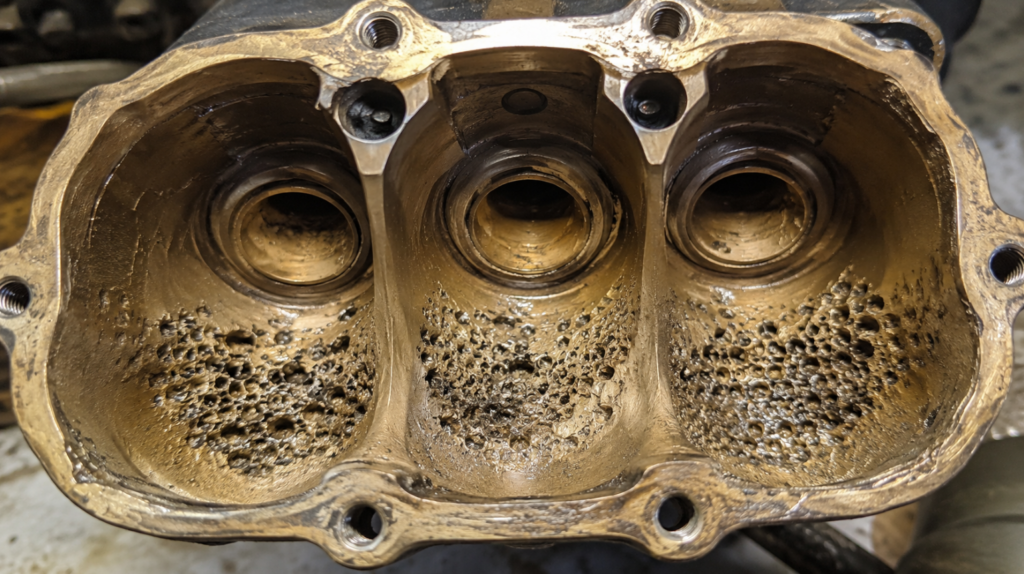
Share a true story from last year. In 2025 I went to do a maintenance review for a company that does commercial fleet cleaning, when they burst 12 three-cylinder pumps in a row. The maintenance worker has been scolding the quality of the brass pump head now, but I 1 check that the real killer is actually “cavitation (Cavitation)”.
At that time, the water pipe used by the workers was a 100-foot-long, half-inch-thick household pipe directly connected to a municipal faucet with very weak water pressure. You know, a high-performance triplex pump eats 4.0 gallons of water per minute, but that slender tube can only feed it 2.5 gallons at most. If the water is not supplied, the vacuum microbubbles will be generated inside the pump head. When the plunger hits these vacuum bubbles, the bubbles implode instantly. This microscopic level of blasting force is comparable to a small bomb, which abruptly gnaws off a layer of skin from the inner wall of the brass pump head.
How did we solve it later? Not a penny was spent on repairing the pump, the water inlet pipe was directly replaced by a 3/4 inch thick pipe, and a buffer water tank was added to ensure positive pressure water supply, and the failure rate returned to zero overnight.
New Trends in the Industry in 2026: Popularization of Electronic Unloading Valves (EUV)
The commercial car washer industry is rapidly eliminating the old-fashioned mechanical spring unloading valve. By 2026, slightly more high-end machines are basically using a combination of electronic unloading valves (EUV) and frequency converters (VFD). It no longer circulates the boiling water foolishly, but as soon as the trigger is released, EUV immediately sends a signal to the motor, allowing the speed to drop to almost stop. This is equivalent to eliminating the dead knot of the bypass heating cycle from the root, and the life of the pump sealing ring has directly soared by 300. This is definitely the most cool technology upgrade in the field of fluid power hardware in this decade.
People Also Ask (FAQ)
Q: What is it that the machine is always “panting” when it comes out of the water for a while?
A: This is called “surge” and is usually caused by insufficient water supply from the pump or air intake. Go and check whether the water pipe joint is loose or the O-ring inside is broken. In addition, be sure to take a look at the water filter, if the filter is blocked by dirty things, the pump can not absorb water will appear this crazy gasping phenomenon.
Q: Can the high-pressure cleaning machine dry burn (no water idling)?
Answer: Absolutely not! A dry spin can destroy the inside of your machine in a few seconds. Water is not only used for spraying in the machine, it is also the only lubricant and coolant for the internal plunger and rubber parts. No water? The metal is directly dry friction, and the high temperature generated instantly can take the machine away directly.
Q: How does the car washing machine suck up the car washing liquid to foam?
A: It depends on the “Venturi effect”. There is usually a chemical ejector behind the machine water pump. When you replace the black nozzle that specializes in low pressure, the water flow speed drops suddenly and a partial vacuum will be generated inside the ejector. This vacuum creates a strong suction force that forcibly sucks up the car wash along the siphon and mixes it with the water.
Q: Why is there suddenly no pressure after washing?
Answer: The high probability of sudden pressure drop is the 3 reason: the O-ring in the unloading valve burst, the nozzle hole wear becomes larger, or the small one-way valve in the pump head is stuck with dirt. If the motor sounds normal, but it is not strong, it can basically be locked because the unloading valve is relieved in advance.
Q: car washing machine winter also need to do antifreeze maintenance?
Answer: It is necessary. As long as there is still water in the pump head, the aluminum or brass pump casing can be cracked in an instant 1 to the expansion of the frozen volume in winter. When storing before winter, be sure to circulate the special pump antifreeze (pump saver) in the system 1 times to push out the residual water and maintain the internal sealing ring by the way.