 Wingspan Tech



Can You Power Wash Cedar Siding
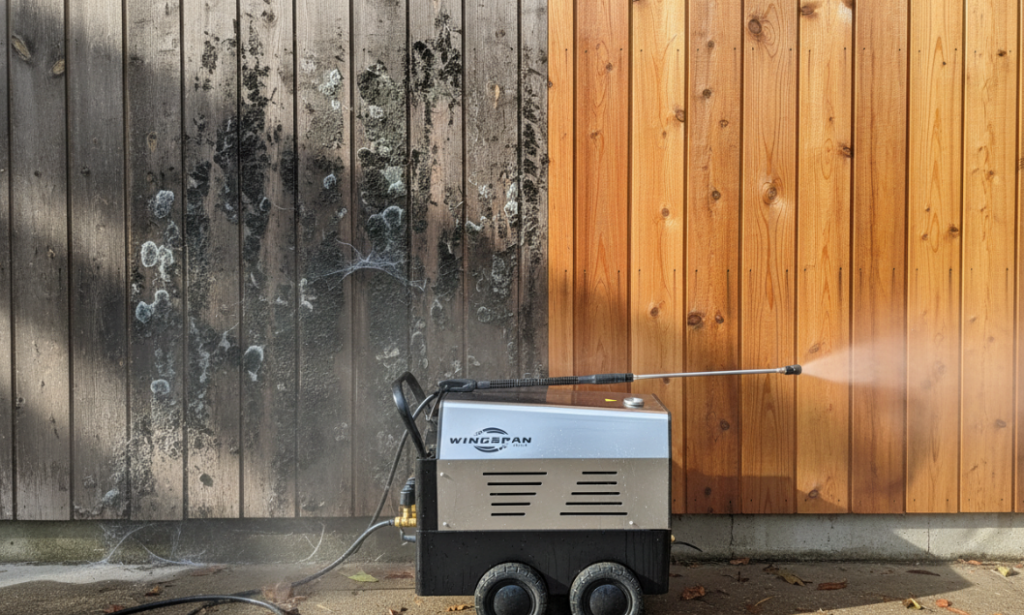
It’s true that you can pressure clean a cedar exterior, but the real heart is how you do it without destroying this most valuable facade on your house. But traditional high-pressure thrusts must be abandoned in favor of “soft washing” techniques to protect the integrity of the wood.
For owners planning to do it themselves, this means turning the pressure of your pressure washer to the low-impact range of 500 to 800 PSI, using a 40-degree wide fan nozzle, and never getting the gun head closer than 12-18 inches from the board. Your goal is not to use water pressure to remove “crush” dirt, but to use water as a delivery system to bring specialized cleaners or surfactants into place to break up mold, moss, and algae at a molecular level. Once you exceed these parameter limits, it is very easy to cause the wood fibers to become irreversible “etched”, “chiseled” or “furring”—— that is, the wood surface becomes rough and loses its original flat structure. Always follow the direction of the wood grain when operating, maintaining a long, smooth strafing motion to avoid leaving joint indentations. After cleaning, it must be left to dry for at least 48 hours before applying sealant or coloring paint, otherwise it is very likely to induce tannin staining or wood rot caused by moisture sealing.
Why Choose “Soft Wash” Over “Violent Rinse”
I’ve seen too many cedar homes destroyed by this misguided thinking “the more stressed, the cleaner”. Soft washing is the industry gold standard because it treats cedar wood as a delicate organic material rather than a dead end like cement floors. Traditional pressure washing relies on mechanical force to hard “tear” away contaminants, while soft washing relies on chemical reactions. With this low-impact delivery, we ensure that the cleaning agent penetrates the porous surface of the cedar wood, killing mold spores from the roots rather than just cutting off the green moss on the surface.
Master Technical Specifications
To safely complete a DIY cleaning, you must adhere to these three technical indicators:
500-800 PSI range: Common household cleaning maneuvers can easily reach over 3000 PSI, which you must lower. 500-800 PSI is roughly equivalent to a strong garden hose with a shaped energy nozzle, which is strong enough to flush but not enough to destroy the structural strength of the wood.
40-degree fan nozzle: Never touch the red or yellow nozzle. The 40-degree nozzle can disperse the water flow to a wider surface, further reducing the impact force per unit area.
12-18 inch buffer tape: Distance is your life saver. Getting too close creates a water flow “needle prick effect” that cuts through the soft cedar wood fibers like a scalpel.
The Role Of Surfactants And Detergents
The “magic” of safe cleaning actually happens at the chemical level. Professional surfactants or wood-safe cleaners can remain on the surface without drying out, during which time “reaction time” the solution breaks down the bond between the wood and organic pollutants. This process allows dirt to be easily carried away by the low-pressure water flow.
O-Series High Pressure Washer 220V
The durable ceramic pump and powerful four-stage motor provide high-performance cleaning power, with adjustable pressure, support for customized voltage and power.
380V 1500Bar Water Blaster
1450 RPM ultra-high pressure water jet pump, high cost performance, suitable for 50Hz voltage. It’s a great tool for removing rust and deburring in factories.
Diesel Power High Pressure Cleaner
The pump unit is the core component of a cleaning machine or water treatment system. Composed of a high-pressure plunger pump and an electric motor
Foam Cannon for car washing
Foam Cannon S V3.0 (Thicker Snow Foam Technology) with 1/4 Inch Quick Connector for Pressure Washer, 34 oz Bottle (V3.0 (1/4″ Quick Connector) + SOAP Sample)
Identify And Circumvent “Pilling” And “Etching”
What happens if you don’t listen to advice about overpressurizing? You’ll come across “furring”. When cedar wood is subjected to excessive stress, the lignin connecting the wood fibers is destroyed, causing the surface to become hairy. Not only does this ruin the aesthetics, it also makes the wood as susceptible to water absorption and rot as a sponge. Additionally, “etching” or “chisel marks” can leave permanent scars on the wood grain that are difficult to repair with later sanding and can cause your house’s exterior to depreciate significantly.
Key Points Of Action
- Follow the grain: Always wash in the direction of the cedar planks. Going against the grain may pick up the wood fibers directly.
- Continuous Movement: Maintain long, steady sweeps. A gun tip that stays in one place for even a second can leave a noticeable “lap mark” or dent.
- From top to bottom: Wash down from the top, making sure sewage flows downward and does not contaminate the area that has been washed.
Post-Wash Process

Cedarwood is very prone to tannic acid discoloration ——if the wood is persistently damp or the paint is sealed prematurely, natural oils can leach out of the surface, leaving black streaks.
48-hour principle: Before applying any protective coating, you must wait for at least 48 hours of fine weather. This is to ensure that the moisture content inside the wood is reduced to a safe level.
Final Step: Once the wood is dry, it is crucial to apply a high-quality wood sealant or stain paint. This blocks out moisture and UV rays, preventing the wood from becoming brittle or turning that lifeless silvery-gray color, thus protecting the results of your hard-earned cleaning.
Author: Jason Miller
My career has been defined by a commitment to preserving the structural integrity and aesthetic beauty of delicate materials like cedar. I’ve seen firsthand how the wrong technique can devalue a home, which is why I’m passionate about teaching homeowners the science of ‘soft washing.’ When I’m not on a job site restoring weathered facades, I’m sharing technical insights to help DIYers achieve professional-grade results without the professional price tag.