 Wingspan Tech



Will A Power Washer Work With Low Water Pressure
Yes, a power washer can technically work with low water pressure, but there is a critical distinction you must understand to avoid destroying your equipment: it is about water flow (GPM), not just static pressure (PSI).
As long as the water source can maintain a very basic pressure (even if it is only about 20 PSI), the machine will work normally—provided that the gallons per minute (GPM) of your water supply meets or exceeds the rated flow rate of the cleaning machine.
For example, if your faucet can only produce 2 gallons of water per minute (2 GPM), but your machine needs to suck in 2.5 gallons per minute, the pump will “starve”. This leads to very destructive physical phenomenon: cavitation. Simply put, it is because the pressure in the pump drops so low that it causes bubbles to form in the water, which then burst violently. This process will eat the internal components like termites, destroying the seal and ceramic plungers.
How To Judge Your Pressure Washer Is “Water Shortage”
To avoid this permanent damage, you must learn to recognize the symptoms of insufficient water flow. The most obvious signal is sound.
- The “Screaming” pump: If the pump is short of water, it tends to make a loud, grinding-like sound, or a high-frequency scream. This shows that the internal parts are grinding dry, losing the lubrication and cooling provided by the water flow.
- Surge: If you find that the engine or motor runs fast and slow repeatedly (“hiccups” or hunting in jargon), or the water pressure is high and low, this is usually because the water in the water inlet pipe cannot keep up. The rhythm of the pump cannot fill the pump cavity.
Once you encounter these two situations, don’t hesitate to shut down immediately. Otherwise, either the motor is burned or the pump head is overheated and scrapped.
Practical Solutions To Low Water Pressure
If you confirm that the water source is really weak, there is no need to give up immediately. You can try the following options to operate the machine safely. The core ideas of these methods are two: to increase the flow and to reduce flow resistance.
1. Optimize your water inlet pipe
The pipe that connects the faucet to the machine is often the bottleneck.
- Shorten the distance: water running in the pipe is a friction loss. If you can use 25 feet of pipe, don’t use 100 feet, which has a great impact on the water flow to the pump head.
- Increase pipe diameter: Standard 5/8-inch garden hose may “jam” and restrict flow. Changing to a 3/4 inch pipe allows more water to pass through, which can effectively compensate for the low water inlet pressure.
2. Use a buffer water tank
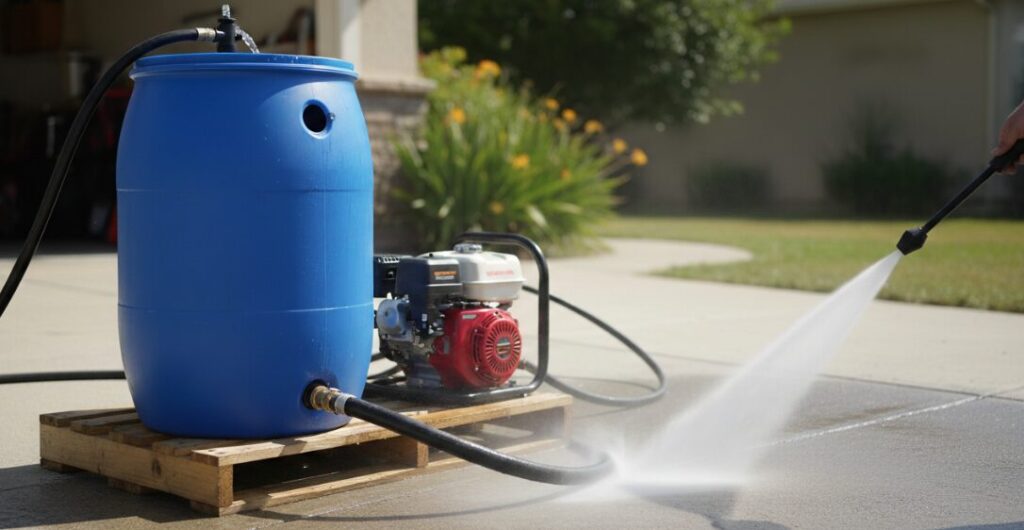
For those who use well water (well pressure is extremely low) or where the municipal water supply is particularly unstable, a buffer tank is the expert solution. This is usually a water supply connected to a large storage bucket (say 50 gallons). The logic is simple: the bucket can slowly replenish water from a low-pressure water source, but when the high-pressure washer works, it draws still water directly from the bucket. This ensures that the pump will always have a “stock” of water to pump, completely eliminating cavitation.
O-Series High Pressure Washer 220V
The durable ceramic pump and powerful four-stage motor provide high-performance cleaning power, with adjustable pressure, support for customized voltage and power.
380V 1500Bar Water Blaster
1450 RPM ultra-high pressure water jet pump, high cost performance, suitable for 50Hz voltage. It’s a great tool for removing rust and deburring in factories.
Diesel Power High Pressure Cleaner
The pump unit is the core component of a cleaning machine or water treatment system. Composed of a high-pressure plunger pump and an electric motor
Foam Cannon for car washing
Foam Cannon S V3.0 (Thicker Snow Foam Technology) with 1/4 Inch Quick Connector for Pressure Washer, 34 oz Bottle (V3.0 (1/4″ Quick Connector) + SOAP Sample)
3. Check and clean the water inlet strainer
Before you blame the water pressure, check the machine itself. Most high-pressure cleaners have a small filter or screen at the inlet. If the filter is blocked by sand, scale or debris, its symptoms are exactly the same as low water pressure. Dismantling it and washing it clean is often the fastest and most economical way to restore water flow.
4. Add a booster pump
If you don’t have the space or means to get a gravity water supply tank, you can consider connecting a pipeline booster pump in series between the water source and the washing machine. This device can mechanically boost the water pressure and flow rate into the machine to ensure that it can meet the minimum requirements (usually higher than 20 PSI and the flow rate is satisfactory).
5. Make sure your nozzle is not wrong
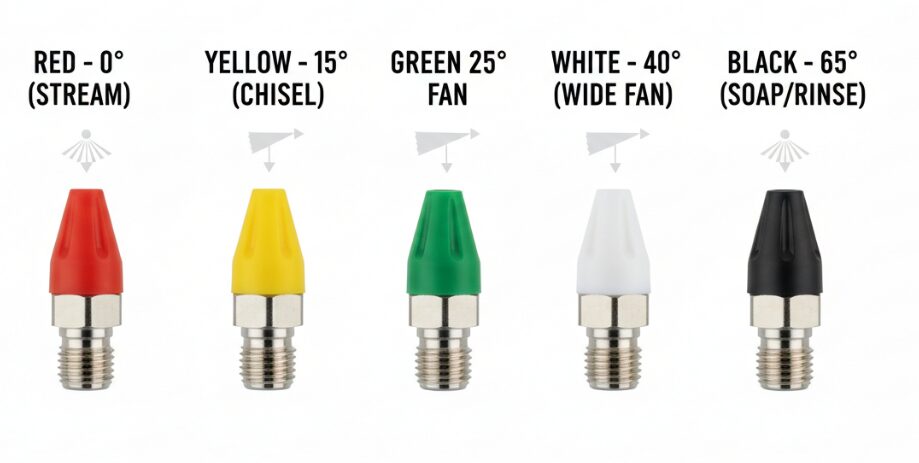
Sometimes the machine runs smoothly but the water doesn’t come out well, it’s purely a nozzle problem. The black nozzle (for foaming) itself is designed to have a large aperture and low pressure, and the purpose is to use the Venturi effect to inhale detergent. If you forget to replace it when washing, no matter how high the water pressure in your home is, the machine will not be able to build up pressure. When working, remember to change back to the high-pressure nozzle (red, yellow, green or white).
Author:Mark Stevens
Hi, I’m a certified exterior cleaning equipment technician with over 12 years of experience. I specialize in pump maintenance and hydraulic systems. I hope to help homeowners and professionals troubleshoot pressure washer issues, ensuring you get the best performance without damaging your gear.
Last updated: April 20, 2026