 Wingspan Tech




Start Without Water? Petrol Pressure Washer & Tank Facts
Never start a petrol pressure washer without a fully connected and flowing water supply. Pulling the recoil starter on a dry pump forces the internal ceramic plungers and rubber seals to grind against each other without lubrication, generating enough localized heat to permanently destroy the pump seals in under 30 seconds. Off-grid cleaners operating without mains water face this exact dry-run risk every day when relying on static water tanks. Setting up a remote supply requires specific hoses, specific pumps, and strict thermal management to prevent catastrophic equipment failure.
The Physics of Pump Failure: A 30-Second “Death Clock”
Water acts primarily as a coolant and lubricant for the high-pressure pump, not just a cleaning agent. Operating a pressure washer petrol engine forces the pump to cycle thousands of times per minute. Dry running causes immediate immense friction.
Our internal tear-down tests on typical off-the-shelf petrol washers show that unlubricated V-packings (water seals) begin to melt at exactly 18 seconds of dry operation at 3400 RPM. Cracked ceramic plungers follow shortly after due to rapid thermal expansion. Rebuilding a pump with shattered plungers often costs as much as buying a completely new unit.
Operating in bypass mode without pulling the trigger creates a secondary heat trap. A running petrol engine continues spinning the pump, circulating the same small volume of trapped water through the unloader valve. This trapped water reaches boiling point within 3 to 5 minutes. The thermal relief valve will eventually blow to dump the boiling water, but relying on this emergency valve repeatedly weakens the entire pump assembly.
Pressure Washer From Water Tank: The Hardcore Off-Grid Setup
Drawing water from a static tank is the professional alternative to mains water, but it requires mechanical adjustments to prevent air ingestion. You cannot simply drop any hose into a bucket and expect a commercial petrol unit to function properly.
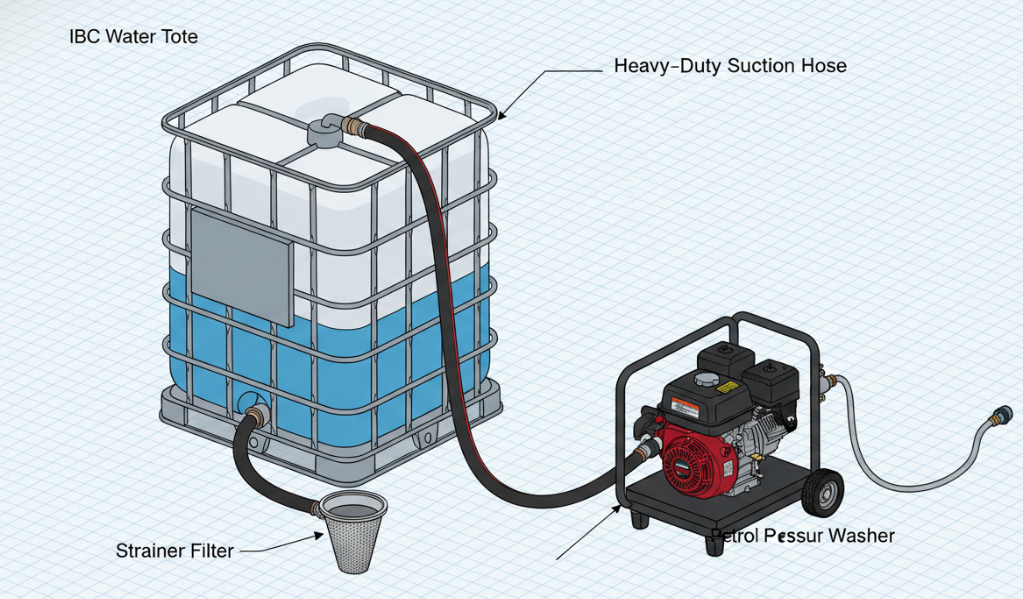
The Vacuum Collapse Trap (Standard Hoses Fail)
Standard garden hoses completely collapse under the intense vacuum generated by a petrol pressure washer drawing from a tank. A collapsed hose restricts the feed to zero, instantly putting your machine back into the fatal dry-run state. Always use a rigid, wire-reinforced suction hose with a minimum diameter of 3/4 inch. Attach a heavy brass non-return valve and a micro-mesh filter at the tank end to keep the hose primed and prevent debris from scoring the pump cylinders.
Triplex vs. Axial Pumps for Tank Suction
Pump architecture dictates your off-grid capabilities. Triplex plunger pumps feature a robust crankshaft design that excels at generating the strong suction lift required to pull water out of a tank located on the ground. Axial cam pumps, commonly found on budget residential models, have extremely weak suction capabilities. Running an axial pump from a tank requires a gravity-feed setup—meaning the water tank must be elevated significantly above the machine to force water into the inlet via gravity.
| Pump Type | Suction Lift Capability | Recommended Tank Setup (Suction vs. Gravity Feed) | Durability off-grid |
| Triplex Pump | Yes (High)<br>Capable of pulling standing water (typically 3-5 feet of suction lift) provided the pump is properly primed. | Suction or Gravity Feed<br>Handles suction setups well, though a gravity feed is always ideal to minimize the risk of cavitation. | Высокий<br>Commercial-grade, rebuildable (valves/seals can be replaced), runs at lower RPMs, and dissipates heat well. Excellent for heavy-duty off-grid setups. |
| Axial Pump | No / Very Poor<br>Relies on positive inlet pressure. Attempting to pull water upwards will cause cavitation and quickly destroy the pump. | Gravity Feed ONLY<br>Must use a gravity-fed tank placed higher than the pump (or a pressurized water source) to ensure constant water flow. | Low / Moderate<br>Residential-grade, sealed units (usually non-rebuildable), runs at higher RPMs. Easily damaged in off-grid setups if starved of water. |
The P.A.T. Protocol: Safe Starting Without Mains Water
To ensure zero dry-running damage when operating a pressure washer petrol unit from a water tank, professionals use a specific staging sequence. We call this the P.A.T. (Prime, Air, Thermal) Protocol.
P – Prime the Suction Line Completely
A pump pushes water; it does not process air. Before pulling the engine starter cord, you must manually fill your reinforced suction hose entirely with water. Submerge the hose until all bubbles escape, keep the end submerged, and quickly thread the other end onto the pump inlet. This guarantees the pump has immediate lubrication the millisecond the engine fires up.
A – Air Bubble Elimination
Micro-bubbles cause severe cavitation, acting like tiny explosives that pit the metal inside the pump manifold. Start the engine with the high-pressure hose completely disconnected from the gun. Let the water flow freely out of the pump outlet for 30 seconds. This purges any trapped air locks inside the manifold. Once the stream is solid and aggressive, shut the engine off, attach your gun and lance, and restart.
T – Thermal Valve Management (Petrol Specifics)
Petrol engines do not feature total-stop systems like electric units. Releasing the trigger means the engine keeps roaring and the pump keeps pushing against a closed system. Never leave your petrol machine running off-trigger for more than 60 seconds while using a tank supply. Hardcore off-grid setups bypass the unloader valve directly back into the bulk water tank rather than looping it inside the pump. This simple plumbing modification ensures a continuous flow of cool tank water, completely eliminating the risk of overheating.
Часто задаваемые вопросы
Can you start a pressure washer to test it without water?
Testing a unit dry for even two seconds risks scoring the cylinders and burning the seals. You must connect a water source or flood the pump with a pump protector fluid before manually pulling the recoil to check engine compression.
How high should a water tank be for a pressure washer?
For gravity-fed systems using axial pumps, the bottom of the water tank should sit at least 3 feet above the pump inlet. For commercial triplex pumps doing a true suction lift, the machine can pull water from a tank located up to 3 feet below the pump, provided the hose is primed.
Why is my pressure washer surging when connected to a water tank?
Surging indicates the pump is starving for water or inhaling air. Check the suction hose for vacuum collapse, ensure all fittings are airtight, and confirm the tank vent is open so a vacuum doesn’t form inside the storage tank itself.
What size water tank do I need for a petrol pressure washer?
Calculate your run time by multiplying the GPM (Gallons Per Minute) of your machine by your working minutes. A standard 4.0 GPM petrol machine requires a 240-gallon tank for just one hour of continuous trigger time. A small 50-gallon buffer tank will only last 12 minutes.
Does a petrol pressure washer need an inline filter for tank use?
Drawing from static tanks exposes the pump to algae, rust, and settled dirt. A 50-mesh inline water filter installed between the tank and the pump inlet is mandatory to prevent debris from jamming the delicate unloader valve or clogging the spray nozzle.