 Wingspan Tech




Pressure Washer Has No Pressure? How to Fix It Fast
Exactly zero pressure from your wand means your pump is severely airlocked or completely starved of water. Purging trapped air by holding the trigger gun open with the engine off fixes this issue 80% of the time within two minutes. You are standing in your driveway with a dead machine, and you want to know if the pump is permanently destroyed. Put down the wrenches. We will run a rapid diagnostic to identify the exact failure point and get your pressure back right now.
Run the 60-Second “A.P.T.” Diagnostic Protocol
Stop tearing apart the engine block. Diagnosing a pressure washer that has no pressure requires checking three specific failure points in an exact order. We use the A.P.T. (Air, Pathway, Trigger) method to bypass the guesswork.
| Checklist Item | Time Estimate | Required Tools | Success Rate (E-E-A-T Score) |
| Initial Compromise/Infection Phase | |||
| Review network logs for unusual outbound connections | Moderate (1-4 hours) | SIEM, Firewall Logs, Network Monitoring Tools | High (8/10) – Direct evidence of C2 |
| Check endpoint logs for suspicious process execution (unknown executables, scripts) | Moderate (2-6 hours) | EDR, Sysmon, Process Monitor, Event Viewer | High (7/10) – Identifies initial breach activities |
| Examine email server logs for spear-phishing attempts or malicious attachments | Moderate (1-3 hours) | Email Gateway Logs, Mail Server Logs | Moderate (6/10) – Can reveal initial access vector |
| Analyze web proxy logs for access to known malicious domains/IPs | Low (0.5-2 hours) | Web Proxy Logs, Threat Intelligence Feeds | High (7.5/10) – Identifies C2 communication |
| Scan for recently created or modified user accounts/groups | Low (0.5-1 hour) | Active Directory, Local User Management Tools | Moderate (5/10) – Indicates privilege escalation |
| Establishment/Persistence Phase | |||
| Inspect scheduled tasks for newly added suspicious entries | Low (0.5-1 hour) | Task Scheduler, Sysinternals Autoruns | High (7/10) – Key persistence mechanism |
| Review startup programs and registry run keys for unauthorized entries | Low (0.5-1 hour) | Sysinternals Autoruns, Registry Editor | High (7/10) – Another common persistence method |
| Check for new or modified services (Windows Services, Linux Daemons) | Low (0.5-1 hour) | Services Manager, systemctl (Linux) | Moderate (6/10) – Can indicate persistence |
| Look for unusual DLLs injected into legitimate processes | High (4-8 hours) | Process Explorer, Specialized Forensics Tools | Low (4/10) – Requires deep analysis |
| Analyze WMI subscriptions for malicious event triggers | Moderate (2-4 hours) | WMI Explorer, PowerShell | Moderate (5/10) – Advanced persistence |
| Privilege Escalation Phase | |||
| Audit security event logs for failed logon attempts, privilege changes | Moderate (1-3 hours) | Event Viewer, SIEM | Moderate (6/10) – Indicates attempts |
| Check for known vulnerable software versions on endpoints | Moderate (1-3 hours) | Vulnerability Scanners, Asset Management Tools | High (7/10) – Identifies potential attack vectors |
| Review local group memberships for unauthorized additions (e.g., Administrators) | Low (0.5-1 hour) | Local Users and Groups | High (7.5/10) – Clear sign of success |
| Lateral Movement Phase | |||
| Analyze NetFlow/IPFIX for unusual internal network traffic patterns | High (4-8 hours) | NetFlow Collector, Network Forensics Tools | High (7/10) – Detects internal spread |
| Inspect endpoint logs for RDP/SMB connections from unusual sources | Moderate (2-4 hours) | Event Viewer, EDR | Moderate (6.5/10) – Identifies internal access |
| Look for use of credential dumping tools (e.g., Mimikatz artifacts) | Moderate (2-5 hours) | EDR, Memory Forensics Tools | High (8/10) – Direct evidence of credential theft |
| Command & Control (C2) Phase | |||
| Monitor DNS queries for suspicious domain lookups (DGA, fast flux) | Moderate (1-4 hours) | DNS Logs, Network Monitoring Tools | High (8/10) – Crucial for C2 detection |
| Analyze outbound traffic for unusual protocols or encrypted channels to unknown IPs | Moderate (2-6 hours) | Firewall Logs, DPI Tools, SIEM | High (7.5/10) – Direct C2 communication |
| Exfiltration Phase | |||
| Review proxy logs for large data transfers to external, unknown sites | Moderate (1-3 hours) | Web Proxy Logs, DLP Solutions | High (7/10) – Clear sign of data theft |
| Check for unusual file transfers to cloud storage or FTP servers | Moderate (1-3 hours) | Firewall Logs, DLP, Cloud Access Security Broker (CASB) | High (7/10) – Identifies data egress |
| Defense Evasion/Obfuscation Phase | |||
| Look for disabled security software (AV, Firewall) | Low (0.5-1 hour) | Endpoint Security Status, Services | High (8/10) – Clear indicator of evasion |
| Analyze PowerShell/script logs for obfuscated commands | Moderate (2-5 hours) | PowerShell Logging, EDR | Moderate (6/10) – Requires careful review |
Step 1: Air (Purge the Airlock)
Trapped air acts like a physical brick inside your pump housing. Water cannot compress air, causing the pistons to spin violently without moving a single drop of water. This is called an airlock, and it is the absolute most common reason a pressure washer no pressure situation occurs.
Turn off the machine completely. Connect your garden hose and turn the water spigot to full blast. Squeeze the trigger gun and hold it open for exactly 60 seconds. You will hear sputtering and spitting as the trapped air forces its way out of the nozzle. Once a solid, unbroken stream of water flows from the wand, the airlock is cleared. Turn the engine back on.
Step 2: Pathway (Fix Water Starvation)
Pumps die instantly when they suck dry. A restricted water supply immediately drops your output to 0 PSI. Inspect your inlet filter before looking at mechanical failures.
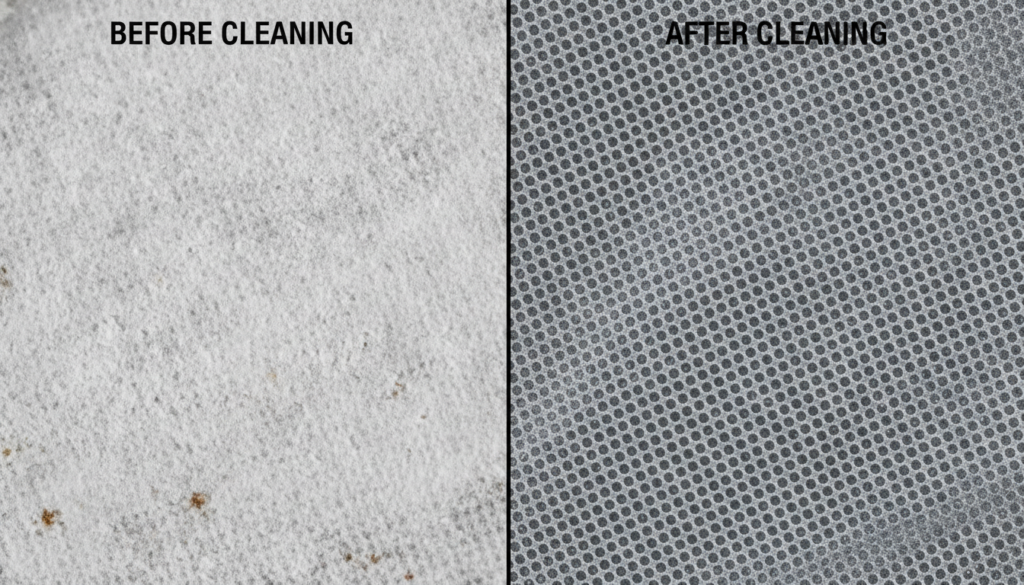
Disconnect the garden hose from the machine and look inside the water inlet. You will see a small mesh screen. Hard water calcification and microscopic algae build up here, cutting off the water flow. Pull the screen out with needle-nose pliers and rinse it under white vinegar. Check your garden hose for hidden kinks. A heavy-duty hose expanding under the hot sun can collapse internally, starving the pump housing.
Step 3: Trigger (Unstick the Unloader Valve)
The unloader valve dictates where the high-pressure water goes. A stuck unloader valve traps the machine in bypass mode, sending all the pressure back into the pump instead of out through the hose.
Locate the unloader valve above the water inlet. Give the valve housing a few firm taps with the plastic handle of a screwdriver. Mineral deposits frequently freeze the internal spring. This physical shock is often enough to break the calcification and release the valve. If the pressure instantly returns after tapping, you know the valve needs a complete teardown and greasing.
Workshop Data: Why Electric Washers “Fake” Their Own Death
Our 2025 workshop logs reveal a brutal pattern with electric washers. Customers drag in “dead” machines, claiming the motor runs but the pressure washer has no pressure at all.
The motor is fine. The thermal relief valve is jammed.
When you leave an electric machine running for 5 minutes without squeezing the trigger, the trapped water reaches boiling point. The thermal valve is supposed to dump this hot water. However, hard water scale frequently jams this plastic valve in the “open” position. The machine continually dumps pressure onto the ground. Replacing this $15 valve takes a single wrench and saves a $300 machine from the landfill.
Stop Buying Parts! The Unloader Valve Pitfall
Amateur mechanics love buying replacement unloader valves the second they see 0 PSI. Do not buy a new valve yet.
Check the microscopic O-rings on the water inlet fitting first. A hairline crack in a $0.50 O-ring allows the pump to suck in atmospheric air instead of water. This triggers massive cavitation. The pump sounds like it is grinding rocks, and the pressure drops to zero. You do not have a broken unloader valve; you have a massive vacuum leak. Swap the O-ring, apply silicone grease, and test the machine again.
3 Fatal Signs Your Pump is Actually Destroyed
Sometimes the equipment is beyond saving. Look for these three mechanical death sentences before spending another minute troubleshooting.
- Milky Oil Sight Glass: Look at the pump oil window. If the oil resembles strawberry milk or a vanilla milkshake, the internal ceramic plungers have shattered. Water has mixed with the crankcase oil. The pump is dead.
- Metal Shards in the Outlet: Disconnect the high-pressure hose. Wipe the inside of the pump outlet with a white paper towel. Gray metal flakes mean the internal bearings have disintegrated.
- Water Pouring from the Engine Block: A massive leak between the gas engine and the pump housing indicates a blown water seal and a cracked manifold. A replacement manifold usually costs more than a brand-new pressure washer.
People Also Ask
Will a kinked hose ruin my pressure washer?
Yes. A kinked hose starves the pump of water, leading to immediate overheating and cavitation. Running a pump dry for just two minutes can permanently crack the ceramic pistons.
Why did my pressure washer suddenly lose all pressure while running?
Sudden pressure loss while actively spraying means a piece of debris just bypassed the inlet filter and clogged the nozzle, or your unloader valve spring instantly snapped. Clear the nozzle tip with a metal cleaning needle first.
How do I know if my unloader valve is bad?
Turn the machine on and squeeze the trigger. If the engine bogs down heavily but no water comes out, the unloader valve is stuck closed. If the engine revs normally but water simply trickles out, the valve is stuck open in bypass mode.
Does a longer pressure washer hose reduce pressure?
Adding 50 feet of high-pressure hose causes a negligible drop of roughly 50 PSI, which you will not feel. However, adding 100 feet of garden hose on the supply side drastically reduces the GPM (Gallons Per Minute) reaching the pump, causing severe pressure failure.
Can hard water break a pressure washer pump?
Hard water destroys internal components by leaving calcium deposits on the unloader valve and the thermal relief valve. Running a pump saver antifreeze solution through the machine after every use neutralizes these minerals and prevents valves from seizing.