 Wingspan Tech




Low Pressure from Pressure Washer? Fix Problems Fast
The water pressure of the car washer suddenly decreases, and the water spouting out is soft and weak? Don’t rush to repair it! Nine times out of ten, this problem is caused by the blocked nozzle, the dirty water inlet filter screen, or the air leakage at the water pipe joint. There is no need to learn to repair cars or buy expensive tools. In fact, most of the problems of insufficient pressure are on the periphery of the water pump, which has nothing to do with the internal parts of the machine. Today, I will give you the “tool-free screening method” used by professional car beauty technicians, so that you can clean up these peripheral stumbling blocks by yourself in less than 5 minutes, so that your machine can immediately restore its strength when leaving the factory.
F.A.S.T. 4-step mine-clearing method: Beginners can handle it entirely by hand
Many car owners, as soon as they notice the engine is underperforming, end up wasting money by taking a perfectly good vehicle to a repair shop. Actually, it’s really not necessary. I’ve distilled this F.A.S.T. troubleshooting method to help complete beginners—without even touching a wrench—target and eliminate the four most common causes of low water pressure.
F-Inspect Fittings and O-Rings (Don’t Let Hidden Leaks Compromise the Water Pressure)
As soon as air gets into the pump, the water pressure immediately drops. You should know that water is incompressible, which is why it can generate immense pressure; air, on the other hand, is like a sponge—it absorbs all the power your pump supplies. If the rubber O-rings in those quick‑release fittings have aged, the water pump will take the opportunity to draw a significant amount of air into the system—even if you don’t see any dripping at the fittings! So, quickly inspect the high-pressure hose and the small black rubber O-rings on the spray gun. If you spot any cracks, flattening, or even missing rings, don’t hesitate—replace them with new ones right away to ensure the hose is completely sealed.
A- Purge the air from the piping (vent the system/Aeration Purging)
If air is trapped in the hose connected to the faucet, the water cannot reach the pump’s plunger, and the spray will naturally lack pressure. Many beginners often make a critical mistake: they rush to power on or ignite the machine before the water in the pipes has fully filled up. The correct procedure is to leave the machine turned off, open the tap fully, and then firmly hold down the trigger of the spray gun for about 60 seconds. At first, the nozzle will spray a mixture of air and water as if sneezing; once the water flow becomes smooth and that “popping” sound disappears, the air in the system has been fully purged.
S-Check the inlet strainer (Prevent the pump from running dry/Screen Inspection)
If the inlet filter becomes clogged, your high-pressure pump will struggle to draw in enough water—resulting in an insufficient GPM flow rate and preventing it from building adequate pressure. Manufacturers typically install a small, protruding metal screen where the machine connects to the tap water supply to filter out stones and debris. However, limescale, algae, and even tiny grains of sand in tap water can easily clog this mesh layer. Get to work: unscrew your water pipe, use your fingernail to pry out the small filter screen, and rinse it under the faucet until you can see the light clearly through the mesh.
T – Tip Clearing (Removing Tiny Blockages)
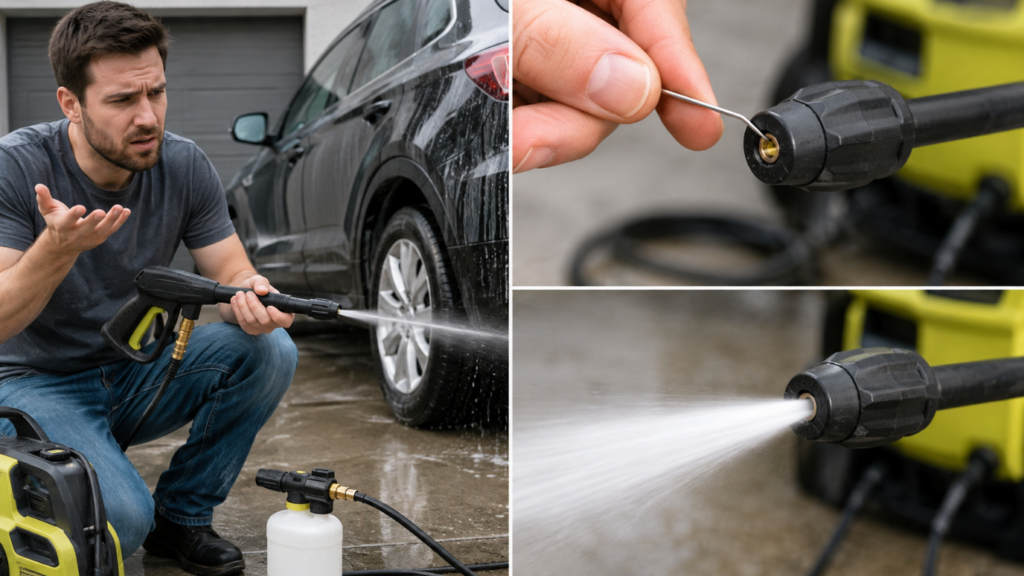
Even if just a single grain of sand becomes lodged in the nozzle, the entire water flow will be completely disrupted, causing the machine’s internal relief valve to release all the pressure. The water outlet hole on a standard car wash nozzle is only about one millimetre in diameter. Any tiny debris that slips through the filter will get firmly lodged in this hole as soon as it passes through. The solution is simple: remove the nozzle from the gun handle, find a stiff sewing needle or the machine’s own metal cleaning rod, aim it at the hole and push it through firmly to dislodge the dirt trapped inside.
A seasoned driver’s guide to avoiding pitfalls: never use one of those ‘retractable hoses’
If you’re using one of those flimsy ‘retractable garden hoses’ that extend as soon as water flows through them, I can guarantee that your car wash machine will have absolutely no pressure. These hoses contain a flimsy latex inner tube; whilst they expand under tap water pressure, your high-pressure pump generates a powerful suction force when drawing in water! This suction will instantly collapse the hose, cutting off the water supply and causing your machine to sputter and stutter, with water pressure fluctuating wildly. Take my advice: when supplying water to your car wash machine, stick to thick-walled, rigid rubber or polyurethane hoses with a diameter of at least 5/8 inch (approx. 16 mm).
Real-world data: How much does water pressure drop if you choose the wrong hose?
Words alone aren’t enough, so we took a domestic car wash machine rated at 3,000 PSI and tested it with three different water supply hoses to show you how substandard water supply can ruin cleaning performance. Once you’ve seen this data, you’ll realise that sometimes it really isn’t the machine’s fault – it’s simply down to choosing the wrong hose.
| Water Supply Setup | Measured Flow Rate (GPM) | Peak Operating Pressure (PSI) | Pump Noise Level |
|---|---|---|---|
| 5/8-Inch Heavy-Duty Hose (50 ft) | Not specified | 3 000 PSI | Normal and stable |
| 1/2-Inch Expandable Hose (50 ft) | Not specified | 1 200 PSI | Severe high-pitched cavitation noise |
| 5/8-Inch Heavy-Duty Hose (150 ft) | Not specified | 2 400 PSI | Moderately elevated pump noise |
Unveiling the Test Results:
Connect a standard 50-foot heavy-duty hose, and the machine effortlessly delivers its full 3,000 PSI of power. But as soon as the telescopic hose was installed, it collapsed under load; not only did the water pressure plummet to a paltry 1200 PSI, but the pump also emitted a grating, high-pitched noise of dry running and cavitation. Later, we connected three 50-foot‑long pipes end to end (for a total length of 150 feet). As a result, the excessive pipe length increased friction, causing the water pressure to drop to 2,400 psi. To sum it up: the shorter and stiffer the hose connected to the car washer, the more powerful the water jet will be.
Часто задаваемые вопросы (FAQ)
Q: The machine is running smoothly, but why is there no pressure?
A: Nine times out of ten, the water pump has run dry—either a kink or break in the hose, or the intake filter is clogged. At this point, although the motor is idling the pump, there isn’t enough water entering the system, so no matter how hard the plunger works, it still can’t produce a spray.
Q: Can a dirty nozzle also cause the car wash machine’s water pressure to drop?
A: Absolutely. Even a tiny speck of dirt lodged in the nozzle will build up reverse pressure inside the tube. This directly deceives the machine’s internal relief valve, causing it to mistakenly think you’ve released the trigger, and as a result, the output pressure is forcibly reduced to its minimum.
Q: Why does the water pressure from my electric car washer fluctuate, sometimes strong and sometimes weak, as if it’s “panting”?
Answer: This is called “surging”; it’s essentially caused by the pump alternately drawing in water and air. Typically, this is because the connections on your water‑supply hose aren’t tight enough, causing air to leak in, or because the flow rate (GPM) of your home’s faucet is too low to keep up with the car‑wash pump’s pumping speed.
Q: How do you completely bleed the air out of a car wash machine?
A: Attach the water hose to the machine, turn the tap fully on, but do not power on the car washer. Keep the spray gun trigger depressed without letting go, hold it for 1 to 2 minutes, until the water sprayed from the nozzle no longer makes that “popping” bubbling sound; this means it has been completely purged.
Q: Does the diameter of a water pipe affect the water pressure of a car wash machine?
Answer: Very much so. If your car wash’s flow‑rate requirement exceeds 2.5 GPM, using a relatively thin 1/2‑inch hose is like strangling it for water. You must switch to a 5/8-inch or 3/4-inch‑diameter water hose to adequately supply the pump’s inlet.
Q: What happens if the O-ring on the car wash gun is damaged?
Answer: Once the O-ring is damaged, the seal between the high-pressure hose and the spray gun fails completely. At this point, not only will high-pressure water flow down the handle and soak your hand, but the pump will also suck air back into the system, causing the water pressure at the nozzle to plummet.