 Wingspan Tech

Pressure Washer Tip Colors Chart: Never Ruin Paint Again
White is for car paint, Green is for wheels and siding, Yellow is for concrete, Red destroys clear coats, and Black is for low-pressure soap application. Memorizing this basic pressure washer tip colors chart is your first line of defense against thousands of dollars in property damage. Most paint peel and clear coat failure happens because users stop at learning the colors, ignoring nozzle wear and orifice size—two critical factors that turn a “safe” white tip into a paint-stripping weapon.
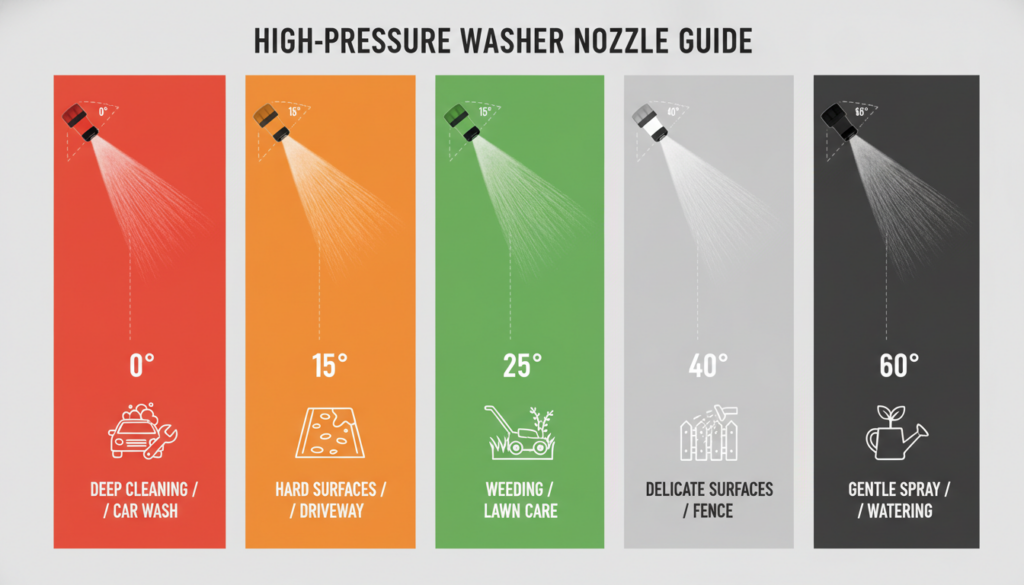
Every universal quick-connect pressure washer nozzle follows a standardized color-coding system based on the spray angle. The angle dictates the exact distribution of the water pressure. A narrower angle means higher concentrated force.
| Color | Degree | Safe Surfaces | Danger Level |
| Green | Low | Smooth, flat, stable, well-lit, clearly marked pathways, non-slip coatings, soft edges, guarded machinery. | 🟢 Low Risk: Minimal chance of injury. Proceed with confidence. |
| Yellow | Moderate | Uneven, slightly wet, moderately sloped, dimly lit areas, minor obstructions, machinery with exposed moving parts. | 🟡 Moderate Risk: Potential for minor injury. Exercise caution and awareness. |
| Red | High / Extreme | Slippery, highly sloped, unstable, poorly lit, cluttered, sharp edges, unguarded high-speed/temperature machinery. | 🔴 High Risk: Significant potential for serious injury or fatality. Avoid if possible, or proceed with extreme care and protective measures. |
The Definitive Pressure Washer Tip Colors Chart
Red: The Water Scalpel
Red nozzles shoot a concentrated, pencil-thin stream of water that cuts through soft materials instantly. You must never use a red tip on a vehicle, wood, or painted surface. Plumbers and contractors use 0-degree tips specifically for blasting heavy mud off industrial track equipment or stripping thick moss from deep concrete crevices.
Yellow: The Heavy Duty Stripper
Yellow tips act like a chisel, making them highly effective for concrete driveways and brick patios. The 15-degree fan strips away oxidation, stubborn grease stains, and loose paint from hard masonry. Keep this nozzle far away from auto auto detailing tasks, as it easily slices through automotive weather stripping and rubber tires.
Green: The General Purpose Sweeper
Green nozzles provide a moderate sweeping action suitable for unpainted outdoor furniture, boat hulls, and vinyl siding. Detailing enthusiasts occasionally use green tips for heavily soiled truck undercarriages or deep-cleaning heavily caked wheel wells, but you must maintain a strict minimum distance of 18 inches to prevent plastic trim damage.
White: The Detailing Standard
White is the undisputed safest choice for washing cars, windows, and fragile surfaces. The 40-degree wide fan disperses the water pressure evenly across a broad area, turning high PSI into a gentle, high-volume rinsing sheet. This is your primary tool for flushing away pre-wash snow foam and loose dirt from clear coat.
Black: The Soap Applicator
Black nozzles drop the pressure of your machine almost entirely, pulling detergent from the onboard chemical tank. The extremely wide 65-degree opening creates a low-pressure mist suitable for wetting down surfaces with soap.
Selecting the correct pressure washer tip colors is useless if you match them with the wrong orifice size. The orifice is the tiny hole inside the nozzle that dictates how much water can pass through at a given pressure.
Beyond Colors: The Orifice Size Secret
A 40-degree white tip with a tiny orifice forces your pump to push less water at higher pressure, potentially creating a 3,000 PSI blast that rips protective films right off your car.
To wash cars safely, professionals swap their factory nozzles for a size 3.0 or 4.0 orifice nozzle. Larger orifices drop the actual working pressure down to a paint-safe 1,000 to 1,200 PSI, while maximizing the GPM for a thicker, faster rinse. You test this by buying a dedicated detailing nozzle set rather than relying on the generic tips included in the hardware store box.
The D.A.R.T. Framework for Surface Protection
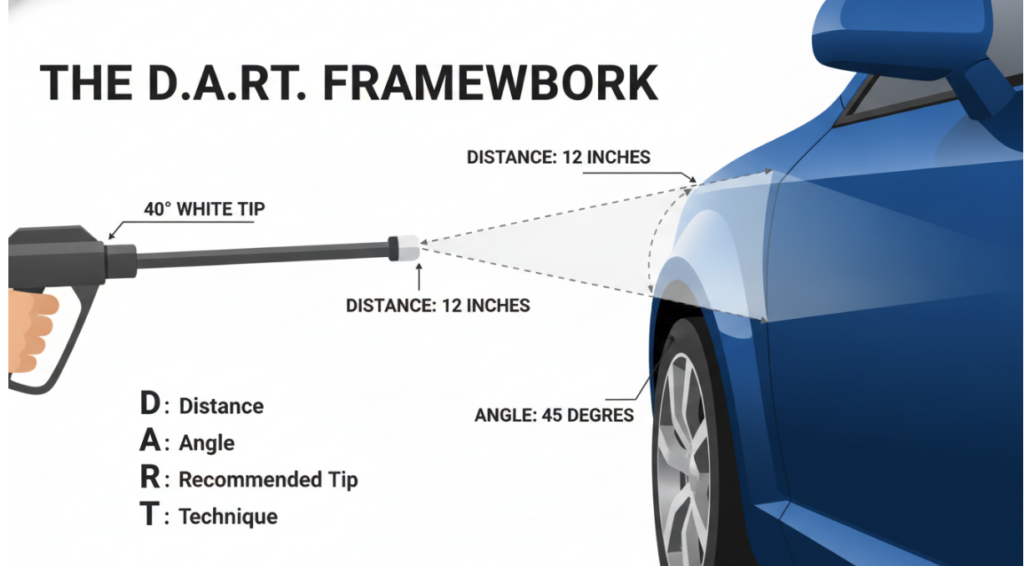
I developed the D.A.R.T. framework after documenting the exact conditions that caused clear coat failure on test hoods. Relying on a pressure washer tip chart is just one piece of the puzzle. You protect sensitive surfaces by controlling four variables simultaneously.
- Distance: Keep the nozzle tip exactly 12 to 18 inches away from the car paint. Pressure drops exponentially as water travels through the air. Moving the tip 6 inches away doubles the impact force compared to a 12-inch standoff.
- Angle: Never shoot water perpendicularly at a surface defect. Hit the paint at a 45-degree angle. This allows the water to sheet off safely rather than forcing its way underneath rock chips or peeling clear coat edges.
- Rate: Prioritize water flow over pressure. Car washing requires high GPM to carry away dirt safely, not high PSI.
- Tip Color: Lock in the White tip for 95% of your vehicle cleaning tasks.
Real-World Pitfall: The “Hidden Zero” Effect
Old, worn-out nozzles secretly transform into paint killers. After months of pushing high-velocity water, the soft brass or cheap stainless steel edges inside a 40-degree nozzle begin to erode unevenly.
Our shop tested a two-year-old white tip against a brand new one using a pressure gauge. The worn tip lost its uniform 40-degree fan pattern. Instead, it concentrated 60% of the water pressure directly in the center of the spray, creating what we call the “Hidden Zero” effect. You think you are using a safe white fan, but you are actually dragging a dangerous 0-degree laser line across your hood.
Replace your most used nozzles every 12 months if you wash your car weekly. Throw away any tip that displays a sputtering sound or a distorted, asymmetric water fan.
FAQs
What color pressure washer tip is best for washing a car?
The white tip is the best and safest choice for washing cars. It spreads the water pressure over a wide area, ensuring enough force to rinse away heavy soap and dirt without cutting into the clear coat or damaging rubber window seals.
Can I use a green tip to wash my car?
You can use a green tip on a car only for highly resilient areas like heavy-duty tires or heavily caked wheel wells. Keep the nozzle at least 18 inches away from painted panels, as the narrower 25-degree spray carries enough focused energy to dent soft plastics and lift chipped paint.
What happens if I use the red pressure washer tip on my driveway?
Using a red tip on a driveway etches deep, permanent lines into the concrete. The focused stream acts like a saw, removing the top layer of cement cream and leaving visible zig-zag patterns. Always use a yellow tip or a dedicated surface cleaner attachment for concrete.
Why does my white pressure washer tip feel too powerful?
Your white tip feels too powerful because the orifice size is too small for your machine’s GPM rating, causing a massive spike in working pressure. Buy an aftermarket white nozzle with a larger orifice to drop the pressure down to a car-safe 1,000 PSI.
What is the black tip on a pressure washer used for?
The black tip is designed exclusively for applying soap. It features a massive orifice that drops the pump’s pressure drastically, activating the pressure washer’s downstream chemical injector to siphon detergent from your soap tank onto the surface.
Do pressure washer tip colors mean the same thing across all brands?
Yes. For standard universal quick-connect nozzles, the color-coding is an industry standard. Red is always 0°, Yellow is 15°, Green is 25°, White is 40°, and Black is 65°, regardless of whether you buy a gas-powered Honda or an electric Ryobi machine.