 Wingspan Tech



Pressure Washer Guide 2026: Pressure, Adjustment, Tasks
As a high pressure washer manufacturer, I’d like to address some common questions about these pressure washer machines. Topics include: the appropriate pressure for different tasks; how to adjust the pressure on your washer; and maintenance and accessories (such as pressure washer nozzles).
I hope this guide will help resolve any issues you encounter when selecting or using a high pressure washer. Whether you’re a home user or a buyer, I believe the following information will be helpful to you.
Before reading on, you may want to briefly review the conversion formulas for PSI, Bar, and MPa.
Quick Reference Table for Pressure Unit Conversions:
- 1 Bar ≈ 14.5 PSI (For example: An electric pressure washer rated at 207 Bar is approximately equal to (3,000 PSI)
- 1 MPa = 10 Bar ≈ 145 PSI (e.g., an industrial-grade unit rated at 27.6 MPa is approximately equal to (4,000 PSI)
- 4,000 PSI ≈ 276 Bar ≈ 27.6 MPa
What pressure is required for common cleaning scenarios?
Typically, high pressure washers for personal or household use operate at pressures between 1,200 PSI (approx. 83 bar or 8.27 MPa) and 3,000 PSI (approx. 207 bar or 20.68 MPa); Commercial-grade pressure washers typically operate at pressures ranging from 3,000 PSI (approximately 207 bar or 20.68 MPa) to 4,000 PSI (approximately 276 bar or 27.58 MPa) or even higher.
Washing Your Own Car
For home car washing, a pressure range of 1,200 to 1,900 PSI (approximately 83 to 131 bar or 8.27 to 13.10 MPa) is recommended. Using a 40-degree wide-angle pressure washer nozzle effectively removes mud and dirt from the vehicle’s body while protecting the paint and rubber seals. It is recommended to maintain a distance of at least 30 centimeters between the nozzle and the vehicle’s body.
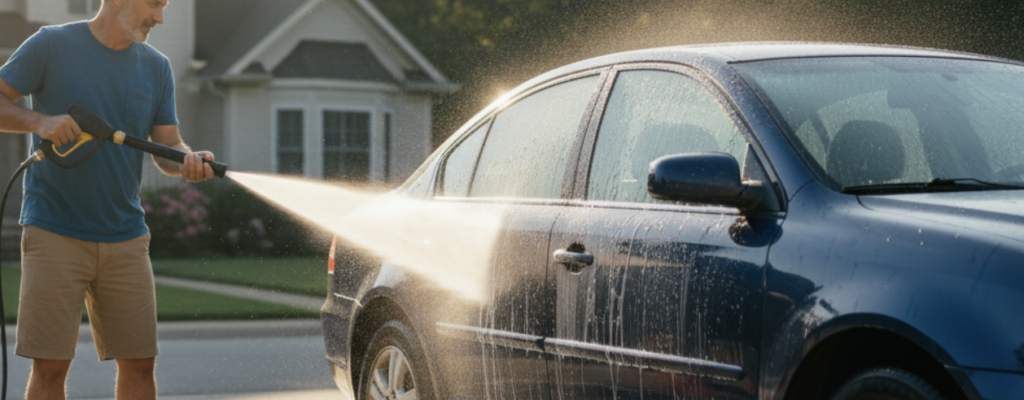
Car Washing at Commercial Car Washes / Commercial Self-Service Car Washes
Commercial car wash pressure washer typically operates at pressures between 1,500 and 2,000 PSI (approximately 103 to 138 bar or 10.34 to 13.79 MPa). In these settings, water flow rate is a critical factor; high flow rates allow for the rapid removal of foam and stubborn grime at moderate pressures, while ensuring machine stability during
prolonged continuous operation.
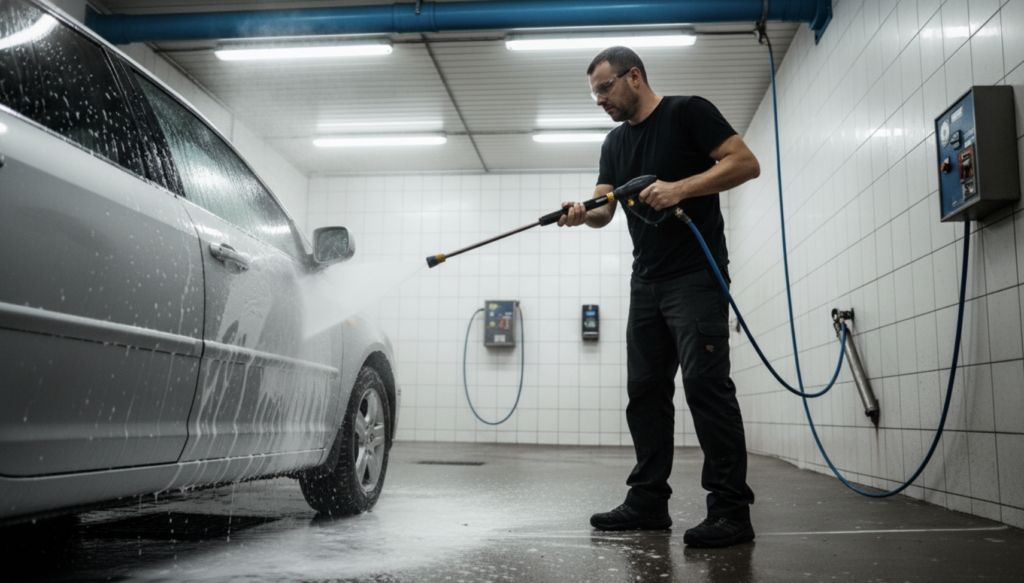
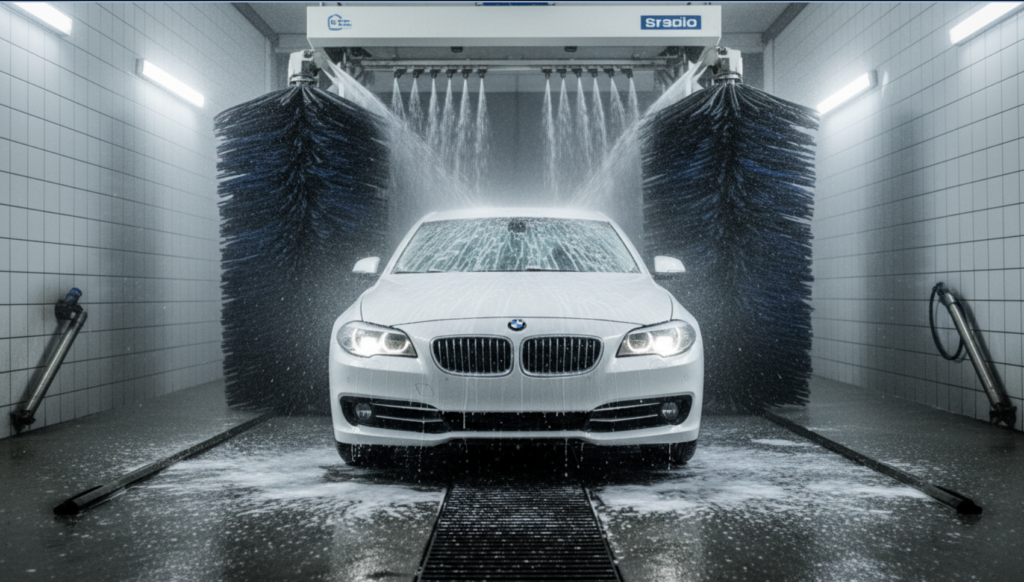
Gas Station Gantry Tunnel Car Wash Machines
The water pressure of tunnel car wash machines is generally maintained between 800 and 1200 PSI (approximately 55 to 83 bar or 5.52 to 8.27 MPa). These large-scale systems rely on dense pressure washer nozzle arrays, extremely high overall water flow rates, and specialized chemical detergents to complete the cleaning process. The lower pressure at any single point helps prevent damage to protruding parts such as rearview mirrors or roof antennas.
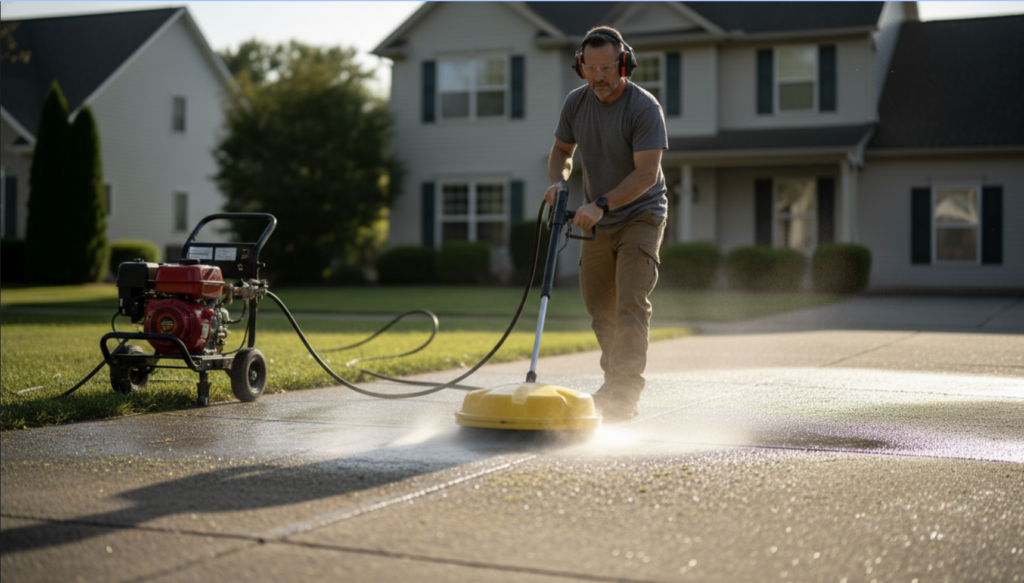
Cleaning Your Driveway or Garage, or Roads in Residential Communities (asphalt or concrete surfaces)
Removing moss and grime from concrete or asphalt surfaces requires a pressure of 2,500 to 3,000 PSI (approximately 172 to 207 bar or 17.24 to 20.68 MPa). Using a ground cleaning disc attachment can significantly improve cleaning efficiency and prevent the water stream from leaving zebra-striped wash marks on the surface.
Cleaning Walls
The pressure required for cleaning walls depends on the wall material. Brick or stone walls can withstand pressures of 2,500 PSI (approximately 172 bar or 17.24 MPa) or higher, while wood siding or vinyl siding requires only 1,200 to 1,500 PSI (approximately 83 to 103 bar or 8.27 to 10.34 MPa). It is recommended to start with low pressure and test in a hidden corner to prevent the high-pressure water stream from breaching the wall’s waterproofing layer or peeling off the coating.
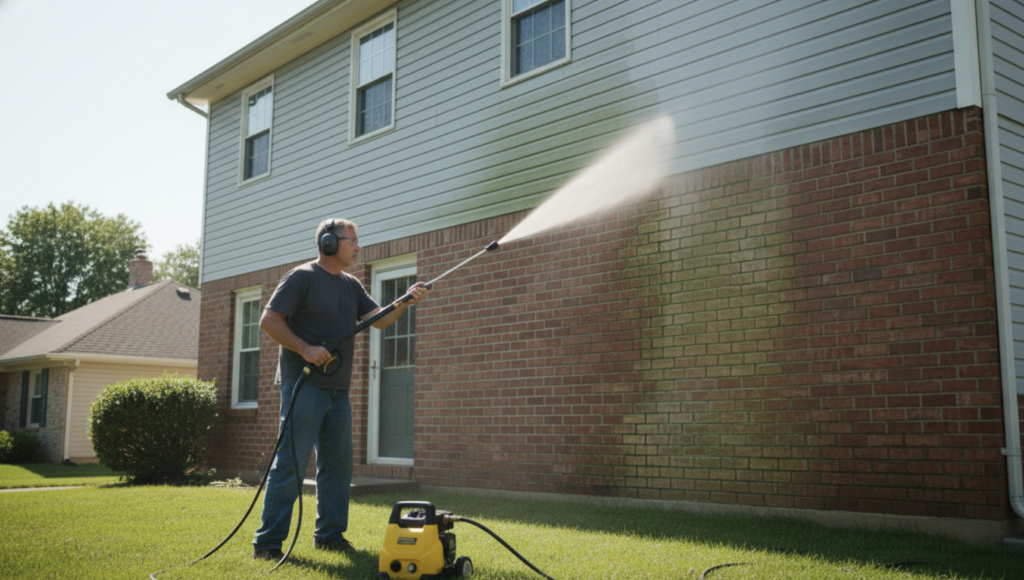
Removing Grease with a Pressure Washer
Thoroughly removing motor oil from garage or factory floors requires a pressure of around 3,000 PSI (approximately 207 bar or 20.68 MPa), and must be done using a hot water pressure washer in conjunction with a specialized industrial degreaser. The hot water breaks down the grease molecules, while the high-pressure water stream strips them from the surface.
Cleaning and Unclogging Gutters
Clearing leaves and silt from roof gutters requires a pressure of 1,500 to 2,000 PSI (approximately 103 to 138 bar or 10.34 to 13.79 MPa). Using a U-shaped extension wand attachment allows you to safely perform this work from the ground. Excessive pressure can damage the gutter’s mounting clips or cause dirty water to splash over a wide area.
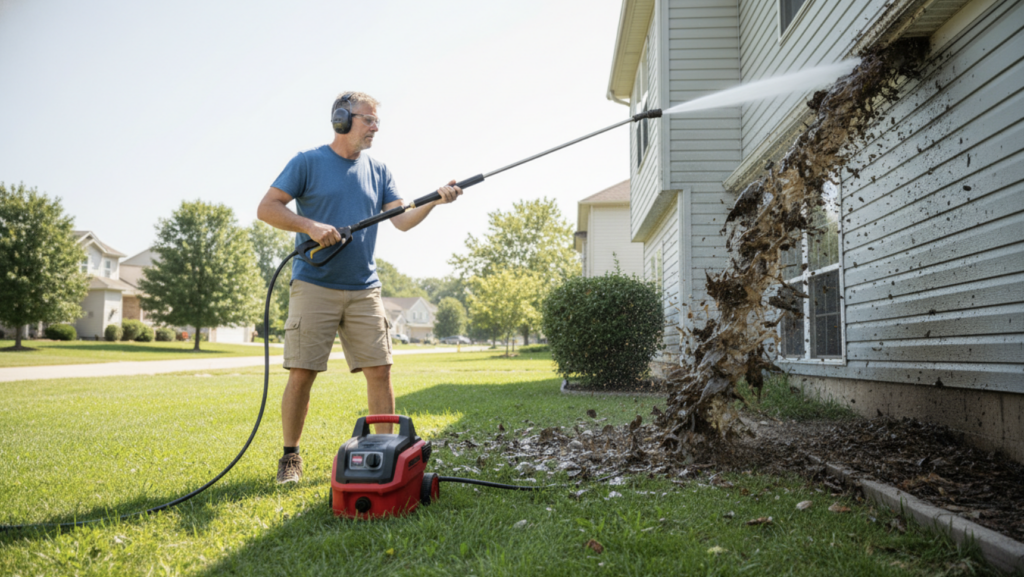
Cleaning and Unclogging Drain Pipes
Unclogging blocked underground pipes requires a specialized unclogging nozzle, with a recommended pressure of 1,500 to 3,000 PSI (approximately 103 to 207 bar or 10.34 to 20.68 MPa). The backward-directed water jet propels the hose automatically through the pipe while flushing the pipe walls. Extreme cases, such as blockages caused by tree roots, require more advanced industrial equipment.
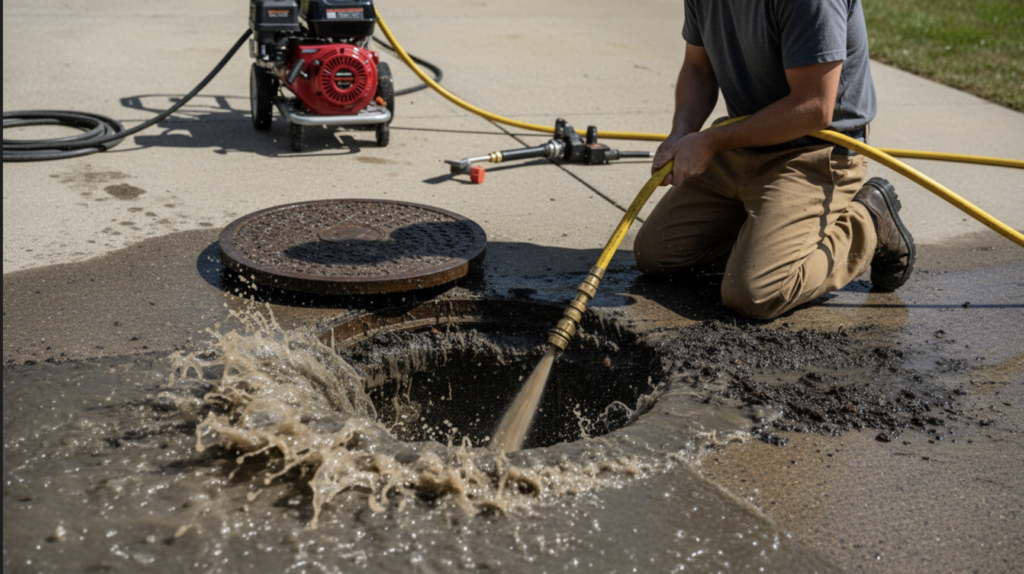
Cleaning Large-Scale Facilities, Such as Factories and Parking Lots
Large-scale commercial cleaning requires heavy-duty machines operating at 3,000 to 4,000 PSI (approximately 207 to 276 bar or 20.68 to 27.58 MPa). Most of this equipment is fuel-powered, offering extremely high operational efficiency and capable of handling forklift tire marks, stubborn industrial grime, and the demands of high-intensity continuous operation.
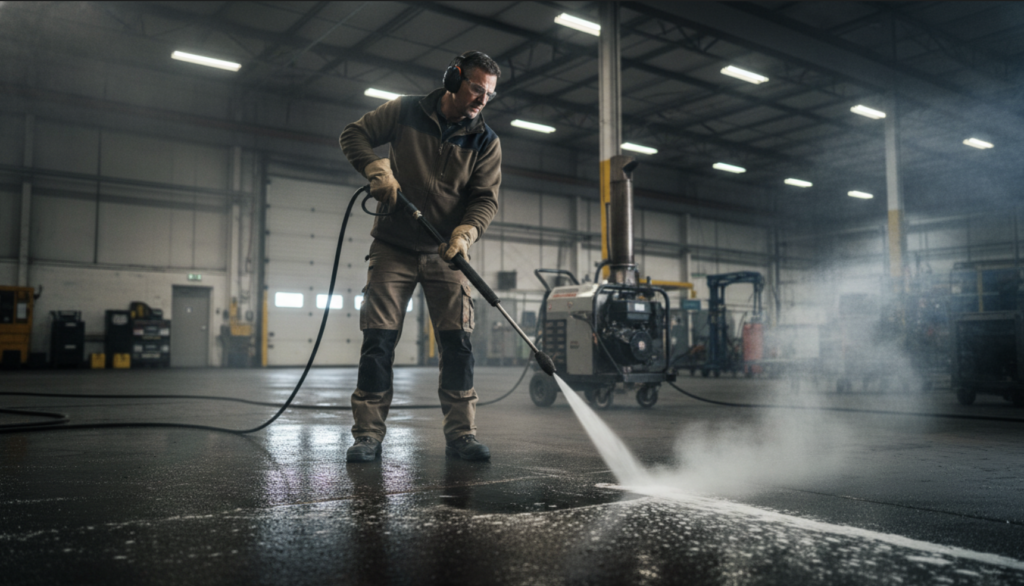
Cleaning a Deck with a Pressure Washer
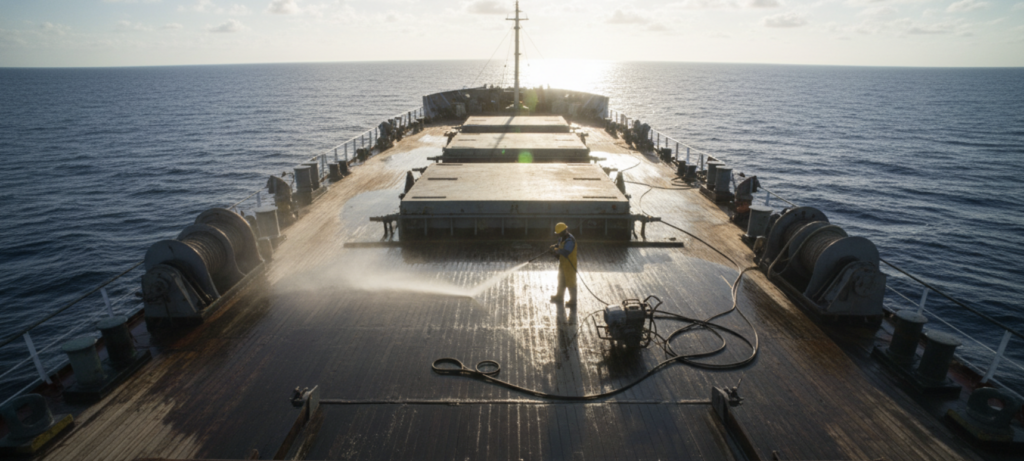
For cleaning fiberglass and wooden ship decks, a gentle pressure of 1,200 to 1,500 PSI (approximately 83 to 103 bar or 8.27 to 10.34 MPa) is recommended. This is sufficient to remove salt and bird droppings. During operation, care must be taken to avoid directing the high-pressure water jet directly at the sealant in the deck joints.
Removing Barnacles from the Hull
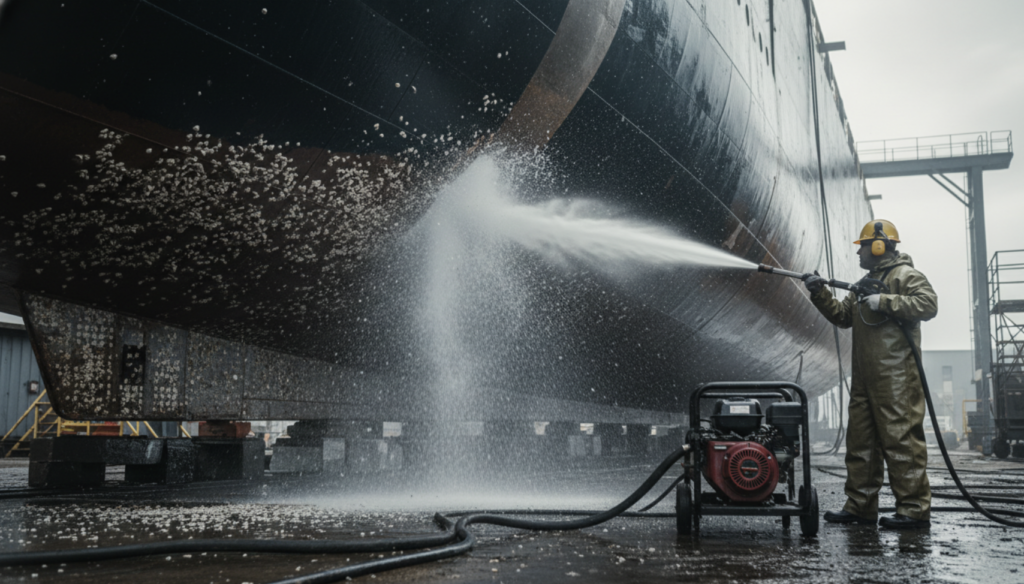
Removing highly adhesive marine organisms such as barnacles from the hull requires high pressure of 3,000 to 4,000 PSI (approximately 207 to 276 bar or 20.68 to 27.58 MPa). The high-intensity impact dislodges the growths at their roots. After cleaning, the hull must be recoated with antifouling paint.
Rust Removal with a Pressure Washer
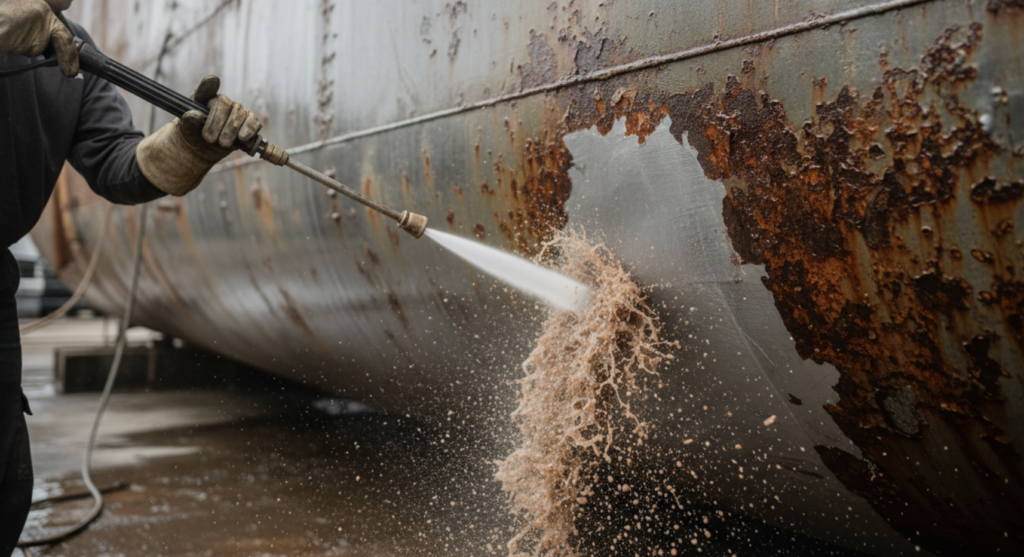
Removing rust from metal surfaces requires pressures of 3,000 to 4,000 PSI (approximately 207 to 276 bar or 20.68 to 27.58 MPa) or higher. Conventional water jets can only remove surface rust. By using a water blasting attachment to mix abrasive particles into the high-pressure water stream, results comparable to dry blasting can be achieved without dust pollution.
Removing Residual Paint, Graffiti, and Adhesives with a Pressure Washer
Stripping old paint or urban graffiti requires a pressure of 2,500 to 4,000 PSI (approximately 172 to 276 bar or 17.24 to 27.58 MPa). Hot water equipment performs better when dealing with these types of chemical deposits. Using a 0-degree nozzle or a rotating nozzle concentrates the impact force, breaking the bond between the paint and the substrate.
Removing Hardened Cement with a Pressure Washer
Breaking down fully hardened cement blocks on construction equipment requires ultra-high pressure of 4,000 to 7,000 PSI (approximately 276 to 483 bar or 27.58 to 48.26 MPa) or even higher. Conventional commercial machines struggle to accomplish this directly; typically, a cement softener must first be applied to break down the structure, followed by rinsing with a high-pressure water jet.
Pressure Chart for Common Pressure Washer Applications
| Cleaning Scenarios | Recommended Pressure (PSI) | Equivalent in Bar | Equivalent in MPa | Notes & Requirements |
| Gas Station Gantry / Tunnel Car Wash Machines | 800 – 1,200 | 55 – 83 | 5.52 – 8.27 | Relies on dense nozzle arrays, extremely high water flow, and specialized chemicals; prevents damage to rearview mirrors/antennas. |
| Washing Your Own Car | 1,200 – 1,900 | 83 – 131 | 8.27 – 13.10 | Use a 40-degree wide-angle nozzle; maintain at least 30 cm distance to protect paint. |
| Wood or Vinyl Siding | 1,200 – 1,500 | 83 – 103 | 8.27 – 10.34 | Start with low pressure and test in a hidden corner to prevent damaging waterproofing/coatings. |
| Cleaning Ship Decks (Fiberglass/Wood) | 1,200 – 1,500 | 83 – 103 | 8.27 – 10.34 | Gentle pressure is sufficient to remove salt and bird droppings; avoid directing at deck joint sealants. |
| Commercial / Self-Service Car Washes | 1,500 – 2,000 | 103 – 138 | 10.34 – 13.79 | Water flow is critical here; high flow removes foam/grime rapidly at moderate pressures. |
| Cleaning and Unclogging Gutters | 1,500 – 2,000 | 103 – 138 | 10.34 – 13.79 | Use a U-shaped extension wand; excessive pressure can damage mounting clips or splash dirty water. |
| Cleaning and Unclogging Drain Pipes | 1,500 – 3,000 | 103 – 207 | 10.34 – 20.68 | Requires a specialized unclogging nozzle; extreme blockages (like tree roots) require advanced industrial equipment. |
| Driveway / Garage / Concrete / Asphalt | 2,500 – 3,000 | 172 – 207 | 17.24 – 20.68 | Use a ground cleaning disc attachment to improve efficiency and prevent zebra-striped wash marks. |
| Brick or Stone Walls | 2,500+ | 172+ | 17.24+ | These materials can withstand higher pressures. |
| Stripping Old Paint, Graffiti, and Adhesives | 2,500 – 4,000 | 172 – 276 | 17.24 – 27.58 | Hot water equipment performs better; use a 0-degree or rotating nozzle to break the chemical bond. |
| Removing Grease (Garage/Factory Floors) | ~3,000 | ~207 | ~20.68 | Must use a hot water pressure washer in conjunction with a specialized industrial degreaser. |
| Large-Scale Facilities (Factories/Parking Lots) | 3,000 – 4,000 | 207 – 276 | 20.68 – 27.58 | Mostly fuel-powered, heavy-duty machines capable of handling forklift marks and continuous operation. |
| Removing Barnacles from the Hull | 3,000 – 4,000 | 207 – 276 | 20.68 – 27.58 | High-intensity impact to dislodge roots; hull must be recoated with antifouling paint afterward. |
| Rust Removal | 3,000 – 4,000+ | 207 – 276+ | 20.68 – 27.58+ | Use a water blasting attachment to mix abrasive particles for a dust-free sandblasting effect. |
| Removing Hardened Cement (Construction Eqpt.) | 4,000 – 7,000+ | 276 – 483+ | 27.58 – 48.26+ | Ultra-high pressure required; usually requires applying a cement softener first before rinsing. |
Is the Pressure on a Pressure Washer Fixed? Can It Be Reduced?
The output pressure of a pressure washer can be adjusted as needed. Most machines are rated at their maximum working pressure when shipped from the factory, but reducing the pressure during actual use allows for cleaning tasks on more delicate surfaces. Replacing the nozzle with one that has a larger orifice is the most direct way to reduce pressure. A larger orifice allows water to flow through more easily, thereby reducing pressure buildup within the pump. You can achieve precise pressure control by selecting nozzles with different angles or specific specifications. Adjusting the machine’s relief valve can also alter system pressure. The relief valve controls water circulation within the pump; loosening the valve spring slightly can reduce the final water pressure output. Frequent, drastic adjustments to the relief valve can accelerate wear on internal components, so it is generally recommended to set it within the optimal operating range and keep it fixed.
For fuel-powered washers, pressure can be reduced by lowering the engine RPM. Throttling back the engine slows the pump’s rotation, thereby reducing both water flow and output pressure. This method is simple to operate and also reduces fuel consumption and operating noise. Some high-end models are equipped with multi-position pressure adjustment knobs, allowing you to set the desired output pressure directly on the control panel.
Below is the full text with the H tags preserved and pressure units (bar and MPa) converted:
How to Adjust the Pressure on a Pressure Washer
For example: Let’s say you want to buy a pressure washer to clean your dirt bike. Every time you ride on the trails, the engine radiator fins and hard-to-reach corners of the frame get clogged with thick mud. When cleaning these narrow crevices, you have to hold the nozzle very close to the surface. If the water pressure is too high, it will definitely damage the wiring and pressure washer O rings, so you really need a feature that lets you lower the pressure at any time.
I went over the entire machine but couldn’t find a single pressure adjustment knob. How does this feature actually work? The answer is: You increase or decrease the pressure by changing the nozzle at the very front of the spray gun. If you install a pressure washer nozzle with a larger orifice, the water pressure will naturally decrease. If you switch to a nozzle with a very small orifice, the water flow is constricted, resulting in high pressure.
Replacing the Pressure Washer Nozzle
Replacing the pressure washer nozzle is the most direct way to adjust pressure. Nozzles with different orifice sizes and spray angles alter the concentration of the water stream. The more concentrated the stream, the greater the pressure on the contact surface. Most units use a standard 1/4-inch quick-connect fitting; users simply need to pull back the connector ring to remove the old nozzle and insert the new one.
How to Identify Pressure Levels by Nozzle Color
The industry uses a standardized color-coding system to distinguish between spray angles and pressure levels.
- Red (0-degree): The highest-pressure models are typically marked in red and have a zero-degree spray angle. They generate extremely powerful single-point penetration and are specifically designed to strip stubborn rust from metal surfaces or remove hardened mud from deep crevices.
- Yellow (15-degree): For heavy-duty cleaning, switch to a yellow nozzle. Its 15-degree fan-shaped spray provides a slightly wider impact area, making it suitable for removing stubborn grime such as oil stains from concrete driveways.
- Green (25-degree): The most versatile accessory for everyday household tasks is the green 25-degree nozzle. This model produces a very moderate impact, making it ideal for use on brick walls, wooden fences, or patio furniture.
- White (40-degree): When cleaning car surfaces or large glass windows, switch to the white nozzle with a 40-degree fan pattern. Because the pressure is greatly dispersed, using it effectively prevents damage to car paint or shattering of glass.
- Black: The black nozzle with the largest orifice is primarily used for low-pressure operations. It is specifically designed to work with chemical applicators, ensuring that cleaning agents are sprayed safely and evenly onto the target surface.
Using an Adjustable Spray Lance (Common in Electric Pressure Washers)
Most electric units come equipped with a multi-purpose, adjustable front assembly. Users can achieve stepless adjustment of the water spray pattern from 0 to 60 degrees simply by rotating the sleeve at the very front of the spray lance. Pushing or pulling the front mechanism of the spray lance immediately switches to low-pressure suction mode. This design eliminates the need for frequent physical attachment changes, making it ideal for scenarios requiring continuous switching between cleaning targets.
Adjusting the Engine Throttle (for Gas-Powered Pressure Washers)
Gas-powered pressure washers feature a throttle control lever on the unit’s body. Pushing the throttle to the low-speed position directly reduces the gas engine’s RPM. The pump’s operating speed decreases accordingly, thereby lowering the machine’s overall water pressure and flow rate. When cleaning delicate wooden decks or aged wall surfaces, reducing the throttle minimizes impact at the source, preventing high-pressure water from damaging the substrate.
Do Not Use the Unloader Valve to Adjust Pressure
One thing you must absolutely avoid: Some people attempt to adjust the pressure by turning the unloader valve on the machine’s pump. The unloader valve is designed to circulate water internally within the pump when you release the trigger on the spray gun, protecting the pump from bursting due to overpressure. It is a safety device, not a pressure adjustment switch. Blindly turning it will not only cause the pressure of the pressure washer to become extremely unstable but will also quickly overload and burn out the machine’s seals.
What pressure rating should your first pressure washer have? How many pressure models should you have?
Cold-water pressure washers in the 2,500 to 3,000 PSI (approx. 172 to 207 bar or 17.24 to 20.68 MPa) range are fully capable of meeting all the needs of a first-time buyer. This pressure range bridges the gap between basic car washing and deep cleaning of hard surfaces in the yard. Users can use it to blast away years of moss from their driveways without worrying about damaging the exterior of their homes due to excessive pressure.
The complete kit should include four basic angle nozzles and a dedicated chemical suction nozzle. These four basic accessories—red, yellow, green, and white—are sufficient to cover all common physical cleaning tasks. The suction nozzle relies on negative pressure within the low-pressure line to draw in external cleaning agents. To ensure the suction system functions properly and produces foam, the operator must replace the machine’s water outlet with the black low-pressure nozzle, which has the largest orifice.
Common Troubleshooting: Why Is My Pressure Washer Running at Low Pressure or No Pressure?
When the unit experiences a sudden drop in water pressure or no pressure at all, you can quickly identify and resolve the issue by inspecting the following specific components:
- Power and Gear Settings: Check the engine status and push the throttle lever all the way to the highest speed setting to ensure power output. Inspect the front of the spray gun to ensure that a high-pressure nozzle is currently installed.
- Water Supply Flow and Temperature: Test the water supply. Ensure the initial water pressure is at least 20 PSI (approx. 1.4 bar or 0.14 MPa) and the flow rate is no less than 4 gallons per minute (approx. 15.1 liters). The water temperature must not exceed 100°F (approx. 38°C); use cool tap water throughout the process.
- Clearing the Inlet System: Disconnect the front garden hose and thoroughly clean any dirt from the inlet and the internal filter screen. If you find any damage to the filter screen, replace it immediately with a new one.
- Seals and Spray Gun Leaks: Leaks at high-pressure hose connections are usually caused by damaged pressure washer O rings. Use a small flathead screwdriver to remove the old pressure washer O ring and replace it with a new one. If the spray gun body is leaking, replace the entire high-pressure spray gun with a new one.
- Clogged Pressure Washer Nozzle Orifices: Turn off the engine and pull the spray gun trigger to purge air from the system. Remove the nozzle and use a thin wire tool to carefully clear any small debris from the orifices.
- Pump Operation Test: Check the oil level in the pump housing and add specialized lubricating oil if it is low. To verify if the pump is damaged, disconnect the high-pressure outlet hose, connect only the inlet hose, and turn on the water tap. Start the engine while allowing water to flow naturally through the pump. If the water pressure and spray range at the outlet increase significantly, the pump is functioning properly, and the blockage is located in the spray gun or high-pressure hose downstream. If there is no change in water flow, the internal components of the pump are damaged.
How to Choose the Best Pressure Washer
The key to selecting a pressure washer is to identify your most frequent usage scenarios and then determine the required performance metrics and hardware configuration based on those needs.
What Pressure Should I Choose for My Pressure Washer?
As mentioned earlier, choose based on your specific needs. Here is a table showing the recommended pressure levels for various tasks:
Electric Vs Gas Powered Pressure Washer?
The choice of power source depends primarily on the availability of electricity in your work environment and any strict requirements for mobility. Electric models feature zero emissions, low operating noise, and minimal maintenance. Simply plug it into a power source and connect a water hose to start working immediately—making them ideal for use around residential properties or in poorly ventilated indoor spaces. Currently, the pressure limit for most mainstream electric models is around 2,500 PSI (approximately 172 bar or 17.24 MPa), which is more than sufficient for routine yard and vehicle cleaning.
Gas-powered pressure washers overcome the power limitations of standard electric motors, delivering immense pressure and water flow. For operations on construction sites without power outlets, large farms, expansive property perimeters, or on ships and decks, an internal combustion engine is the only reliable solution. You’ll need to regularly change the engine oil, refuel, and check the spark plugs. This routine maintenance of the internal combustion engine is rewarded with exceptional heavy-duty cleaning efficiency and the freedom of being completely untethered by power cords.
Consider the Material of the Pressure Washer (Machine and Hoses)
High Pressure Washer Pump Head Materials
Aluminum Alloy
- Advantages: Affordable and lightweight, suitable for occasional light use such as washing your car at home.
- Disadvantages: Sensitive to heat and not very durable. Continuous use should not exceed a certain duration, otherwise the machine may overheat, leading to internal wear and a shorter lifespan.
Solid Copper (Forged Brass)
- Advantages: Extremely sturdy and durable! Withstands continuous high temperatures and high-pressure impacts; virtually indestructible no matter how it’s used, with an exceptionally long lifespan—the standard choice for commercial and high-frequency use.
- Disadvantages: Slightly more expensive, and the machine is relatively heavy overall.
High Pressure Washer Hose Materials
Standard Plastic Hose (Polyvinyl Chloride/PVC)
- Advantages: Low cost and affordable.
- Disadvantages: The material is too stiff! It easily kinks and forms permanent creases when exposed to cold water, and it’s prone to aging and cracking after prolonged exposure to sunlight.
Rubber Hose / Steel-Reinforced Hose
- Pros: Extremely flexible and highly durable! Can be dragged across rough surfaces without damage; burst-resistant and kink-resistant; easy to store and use.
- Cons: More expensive than standard plastic hoses; steel-reinforced hoses are slightly heavier.
Pressure Washer Quick Connect Fittings Materials
Standard Plastic
- Advantages: Inexpensive and lightweight.
- Disadvantages: Cannot withstand high pressure. Over time, they tend to warp or even crack, leading to frequent leaks that can really dampen your work mood.
Solid Copper
- Advantages: Fits together perfectly and is extremely sturdy! It can perfectly withstand the impact of high-pressure water flow, ensuring maximum leak-free and uninterrupted performance.
- Disadvantages: It is slightly more expensive than plastic fittings.
High Pressure Washer Accessories and Tools
Replacement Nozzles
The orifice inside the nozzle gradually enlarges over time due to prolonged exposure to high-speed water flow and tiny particles. An enlarged orifice directly causes a drop in system water pressure. If you notice that your washer’s pressure does not meet the rated specifications, the first thing to check is the condition of the nozzle. For frequent users, it is recommended to replace the entire nozzle assembly every three to six months. When purchasing replacement parts, ensure that the orifice size of the new nozzles matches your equipment’s rated pressure and flow rate. An orifice that is too large will fail to generate sufficient pressure, while one that is too small may cause the pump to overpressurize and become damaged.
Here is a table to help you select the correct nozzles (by color).
| Nozzle Color | Spray Angle | Pressure Impact | Ideal Usage Scenarios & Functions |
| Red | 0° | Extreme Impact / Single-point penetration (capable of piercing cork) | Stripping stubborn rust from metal surfaces, removing hardened mud from deep crevices. |
| Yellow | 15° | Heavy-duty / Acts like a sharp scraper | Removing stubborn grime (e.g., oil stains from concrete driveways), stripping old paint. |
| Green | 25° | Moderate / Moderate impact | The top choice for everyday car washing, brick walls, wooden fences, and patio furniture. |
| White | 40° | Dispersed / Widest spray pattern | Rinsing large glass windows and washing car surfaces; effectively prevents damage to paint or glass. |
| Black | No specific angle (Largest orifice) | Lowest pressure | Triggering the machine’s siphon effect to draw in and safely, evenly apply chemical cleaning agents. |
Hose Lifespan and Replacement
The braided nylon hoses commonly found on household units are prone to irreversible damage when kinked. Commercial-grade steel-braided rubber hoses are similarly prone to fatigue due to rubber aging and prolonged exposure to high-pressure cycles. If you notice damage to the hose’s outer casing, exposure of the inner braided layer, or localized bulging of the hose body, you must immediately stop using it and discard it. High-pressure hoses cannot be repaired using conventional methods, and any repair attempts carry a high risk of rupture.
How to Use a High Pressure Washer Correctly?
Properly matching equipment specifications to the task at hand can significantly boost cleaning efficiency. Many users focus solely on pressure ratings while overlooking how other operational metrics limit actual cleaning performance.
How Much Water Flow Does Your Pressure Washer Need?
Different cleaning tasks require vastly different water flow rates. To provide an intuitive reference when selecting equipment, I’ve compiled a table of water flow requirements for common cleaning scenarios. The data here is primarily listed in the more familiar units of “liters per minute” and “ gallons per minute.”
| Mentioned Flow Scenario | Gallons Per Minute (GPM) | Liters Per Minute (LPM) | Context from Text |
| Minimum Inlet Flow Requirement | ≥ 4.0 GPM | ~15.1 LPM | The water supply from the faucet must be greater than or equal to the machine’s output flow rate (e.g., for a 4 GPM rated unit). |
| Extremely High Inlet Flow (Example) | Up to 12.0 GPM | ~45.4 LPM | Water is incompressible. A machine dispensing 4 GPM will only draw 4 GPM; excess flow will not force its way in or cause negative effects. |
| Highly Effective Cleaning Performance | 2.0 GPM | ~7.5 LPM | Used as a benchmark in Q&A #5: A 1,500 PSI / 2.0 GPM machine performs better at removing dirt because water flow “flushes” grime away. |
| Less Effective Cleaning Performance | 1.2 GPM | ~4.5 LPM | Used as a comparison in Q&A #5: A 2,000 PSI / 1.2 GPM machine removes dirt poorly because the flow rate is too low, despite higher pressure. |
What are the maximum water flow rate and pressure a pressure washer can handle?
Tip: It’s generally known that a pressure washer’s inlet hose requires a minimum water pressure of 20 PSI (approximately 1.4 bar or 0.14 MPa), and the water supply from the faucet must be greater than or equal to the machine’s output flow rate. For a unit rated at 4 gallons (approx. 15.1 liters) per minute, the faucet must be able to supply at least 4 gallons (approx. 15.1 liters) per minute.
What would happen if you connected a machine to a faucet with an exceptionally high flow rate, say up to 12 gallons (approx. 45.4 liters) per minute? Water is incompressible. The machine dispenses 4 gallons (approx. 15.1 liters) of water per minute, so it will only draw 4 gallons (approx. 15.1 liters) of water from the pipe. The excess water flow will not force its way into the machine; the unit will only draw water as needed, so a higher water flow rate will not cause any negative effects. Excessive inlet pressure is a different matter. Water pressure from a standard garden hose typically ranges between 45 and 80 PSI (approx. 3.1 to 5.5 bar or 0.31 to 0.55 MPa). If your inlet pressure reaches as high as 100 PSI (approx. 6.9 bar or 0.69 MPa), the machine will continue to operate for a short time, and the water pressure at the outlet might even increase slightly. This approach is extremely reckless and not worth the risk. Once the inlet water pressure exceeds the critical threshold of the machine’s internal components—for example, reaching 200 PSI (approximately 13.8 bar or 1.38 MPa)—the internal seals and water valves will be directly ruptured by the high pressure. As long as the inlet hose is not blocked or kinked, the pressure washer will draw water and build pressure at its own normal rate. Never attempt to force a high-pressure water stream into the inlet to improve cleaning performance. If you are unsure whether your household water pressure exceeds the recommended limits, the best solution is to consult the equipment manufacturer directly. They anticipated various forms of rough handling during the R&D phase, conducted detailed destructive testing, and are fully aware of the machine’s inlet pressure limits.
Why Pressure Matters When Using Pressure Washer Attachments
You bought a disc-shaped floor cleaner at a hardware store to clean a concrete floor. This attachment relies on powerful water pressure to create the backflow needed to spin its internal nozzles at high speed. If your machine’s actual pressure is only 1,500 PSI (about 103 bar or 10.3 MPa), but this cleaning disc requires a minimum of 2,500 PSI (about 172 bar or 17.2 MPa) to operate effectively, the internal rotor will spin sluggishly, ultimately leaving behind rings of uncleaned mud stains on the floor. If you forcefully connect a household car wash foam gun rated for a maximum of 2,000 PSI (approx. 138 bar or 13.8 MPa) to a fuel-powered pressure washer operating at 4,000 PSI (approx. 276 bar or 27.6 MPa), the instantaneous powerful water jet will instantly shatter the plastic valves and seals inside the gun.
Industrial/Commercial High Pressure Washers: Material Requirements for High-Intensity Continuous Operation: Use Forged Brass Pump Heads Instead of Aluminum Alloy Pump Heads
If you plan to use a high-pressure washer for commercial cleaning work, look specifically for equipment equipped with forged brass pump heads. Aluminum alloy pump heads are only suitable for occasional weekend use by ordinary households to wash their private cars; they cannot handle high-intensity continuous operation. When your car wash is bustling with business every day and the machine must run non-stop for hours on end, the aluminum alloy material will overheat and crack due to frequent exposure to high temperatures and the impact of water flow. If you’ve contracted a large underground parking garage floor cleaning project or need to spend an entire day on a construction site hosing down mud from heavy excavators, a standard aluminum alloy pump head simply won’t withstand this extreme wear and tear.
10 Answers to Common Questions About High-Pressure Washer Pressure
- How do you distinguish the pressure levels of different colored nozzles on a pressure washer? The color indicates the spray angle; the smaller the angle, the more concentrated the pressure. Red (0°) delivers extreme impact, capable of piercing cork; yellow (15°) acts like a sharp scraper, ideal for stripping old paint; green (25°) offers moderate pressure, making it the top choice for everyday car washing; white (40°) provides the widest spray pattern, suitable for rinsing glass and other delicate surfaces; black nozzles have the largest orifice and lowest pressure, specifically designed to trigger the machine’s siphon effect and draw in cleaning agents.
- How do you reduce the pressure of a pressure washer? The simplest method that won’t damage the machine is to switch to a wider-angle nozzle (e.g., replacing a 15-degree nozzle with a 40-degree one) or increase the spray distance. For gas-powered models, you can directly reduce the engine throttle to lower the speed; some mid-to-high-end models are equipped with an adjustable relief valve on the pump, allowing you to precisely lower the internal water pressure by turning a knob.
- Why does the pressure on a pressure washer drop or disappear? The primary cause is an issue with the water supply: a kinked inlet hose or a faucet that isn’t fully open can cause the pump to suck in air, resulting in a pressure drop. Another common cause is hard water scale clogging the nozzle’s micro-holes, which can be cleared with a cleaning needle. If the machine is leaking from the bottom or vibrating abnormally, it usually indicates that the internal seals have been damaged by high pressure or that the check valve is stuck; in this case, the water seal kit must be replaced.
- Is the pressure required for washing a car exactly the same as that for cleaning a driveway? Absolutely not. Car washing only requires 1,200 to 1,900 psi to safely remove grime and protect the paint; however, cleaning deeply embedded motor oil and stubborn moss from the pores of a driveway requires a powerful water stream of over 3,000 psi to thoroughly dislodge them.
- When evaluating cleaning performance, which is more critical: pressure or water flow rate? The product of the two (i.e., cleaning power) is the golden standard. Pressure is responsible for “lifting” the grime, while water flow is responsible for “flushing” it away. A machine with 1,500 psi and a flow rate of 2.0 gallons per minute often performs better at removing dirt than a machine with 2,000 psi but a flow rate of only 1.2 gallons per minute.
- Can extremely high water pressure damage wooden decks or concrete surfaces? Absolutely. If you use a 0-degree direct-jet nozzle at extremely close range, 3,500 psi of pressure can carve irreparable grooves directly into hard concrete. For softwoods like cedar, pressure exceeding 1,500 psi will cause extensive fiber breakage and fuzzing.
- Can insufficient water supply from the inlet hose cause substantial damage to the pressure washer? It can cause catastrophic damage. Insufficient water supply triggers cavitation, where vacuum-filled micro-bubbles form inside the pump and burst instantly under high pressure. These micro-explosions can completely shatter metal pistons and precision valves like sandpaper within minutes, rendering the pressure module completely unusable.
- Does extending the high pressure hose cause a drop in output pressure at the end? Definitely. Due to friction resistance between the water flow and the hose walls, pressure typically drops by 10% to 15% for every additional 50 feet of hose. If you need to work at extremely long distances, we recommend upgrading from a standard 1/4-inch hose to a 3/8-inch heavy-duty hose to significantly reduce pressure loss.
- Is it necessary for a typical household to purchase a gas powered pressure washer model? It depends on your core needs. The vast majority of electric pressure washers (1,500 to 2,500 psi) are sufficient for washing cars, cleaning window screens, and rinsing small decks. You only truly need a gas-powered model with over 3,000 psi when you need to strip large areas of old, caked-on paint, clean heavily greasy garage floors, or rinse two-story-high exterior walls.
- Does the internal high pressure state automatically release after releasing the trigger? No. Although the water flow stops when you release the trigger, the extremely high pressure is retained inside the machine by the relief valve. If not actively released, this prolonged pressure can accelerate the aging of sealing components and even burn out the motor. The correct shutdown procedure is always: turn off the machine, disconnect the water supply, and finally, be sure to pull the trigger once to completely release any residual internal pressure.
This article was last updated on May 20, 2026.