 Wingspan Tech



How To Pressure Wash A Driveway Without Concrete Damage
In order to safely flush the driveway with high pressure without damaging the concrete, it is essentially a problem of equipment parameter configuration and standardized operation. Directly limit the water pressure of the machine to 2,500 PSI, replace the standard spray gun with a rotating surface cleaning disc, and honestly rely on alkaline pretreatment to dissolve organic stains before applying water pressure. Over the years I ‘ve seen too many residential driveways left with permanent physical damage-jagged “tiger lines” and peeling surfaces all over the floor. Many owners have a good original intention, but a 4,000 PSI machine with a zero-degree nozzle is as destructive as operating a forklift in a warehouse with brute force. In fact, as long as the parameters are right, the lane can be restored to its original appearance without destroying its structural integrity.
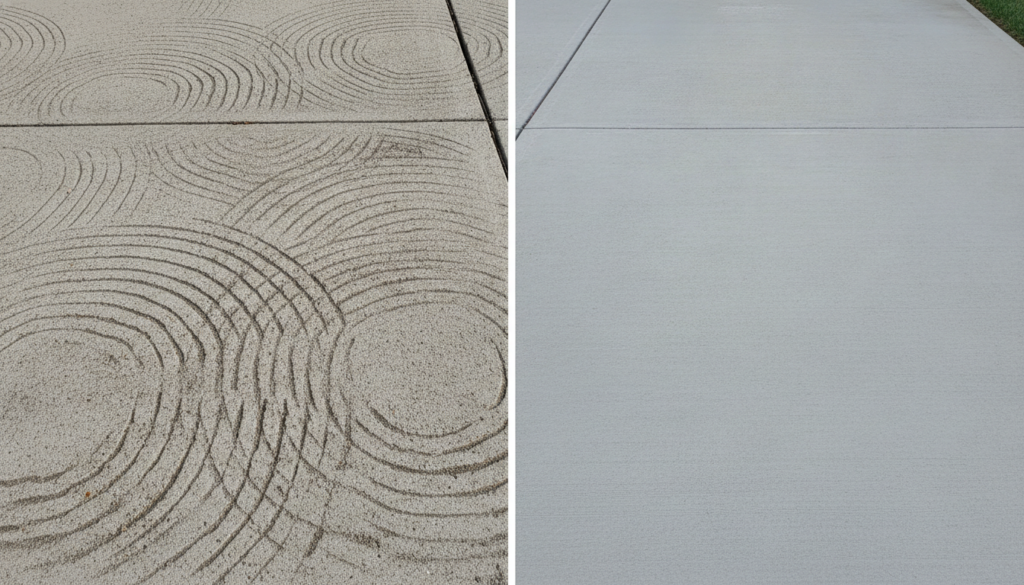
Why Does High Pressure Destroy Concrete: The “Cream Layer” Stripped Off”
High-pressure water will directly damage the protective layer at the top of the driveway, which is often called the “cream layer” of concrete in the industry. This layer is a smooth, cement-rich paste that floats to the surface during the laying and smoothing phase. In my experience, as soon as you bombard it with more than 3,000 PSI of water pressure, this microscopic sealing structure will completely shatter.
Once the cream layer is stripped, the underlying coarse aggregate (sand and stones) is exposed. Your driveway will immediately lose its original smooth texture and become a porous sponge. This causes algae, dirt and oil to penetrate deep into these newly exposed pores. It can be asserted that this will cause the lane to look only worse in the future, and the frequency of cleaning will increase in a straight line.
In the operation of the system, flow is always more important than pure pressure. Professionals value high GPM (gallons per minute) more than high PSI. A 4.0 GPM machine, depressurized to 2,500 PSI, can safely and efficiently wash away debris. Conversely, if a 2.0 GPM machine is pulled hard to 4,000 PSI, it will become a water knife and directly cut through bricks or concrete.
Comparison: High PSI/Low GPM vs. High GPM/Low PSI
| Feature / Metric | High PSI / Low GPM <br>(e.g., 4000 PSI / 2.0 GPM) | High GPM / Low PSI <br>(e.g., 2500 PSI / 4.0+ GPM) |
| Primary Mechanism | High stripping force; relies on sheer pressure to break surface bonds. | High rinsing volume; relies on water flow to sweep away loosened debris. |
| Cleaning Speed | Slower. While it breaks dirt loose, the low water volume cannot flush debris away quickly, leading to longer project times on large surfaces. | Faster. The high volume of water rapidly flushes away dirt and grime, significantly reducing overall cleaning time on flatwork. |
| Concrete Safety | Higher Risk. Excessive pressure can easily etch concrete, erode the cream layer, expose aggregate, and leave permanent wand marks (striping). | Lower Risk. Safer for concrete surfaces (including newer or decorative concrete) as the pressure is kept below the damage threshold while maintaining high efficiency. |
| Risk of Striping | High. Narrow spray patterns and high pressure often leave visible streak marks. | Low. Wider nozzles and higher flow rates provide more even coverage and smoother blending. |
| Best Suited For | – Spot cleaning (oil stains, chewing gum, rust)<br>- Hard, non-porous surfaces<br>- Paint or coating stripping | – Large flatwork (driveways, parking lots, sidewalks)<br>- General washing and rinsing<br>- Pre-treated surfaces (using chemical detergents) |
| Efficiency with Surface Cleaners | Low. Standard flat surface cleaners require higher GPM to spin and glide effectively. | High. Higher GPM allows surface cleaners to spin faster and hover smoothly, maximizing coverage. |
The Original C.P.R. Lane Protection Framework
In order to eliminate the error of manual operation and prevent concrete damage on the physical level, I have compiled this set of C.P.R. methods. The standard machine instructions will only teach you to “aim and shoot”. That set is too crude. The core logic of the C.P.R. framework is to let chemistry and surface area physics do the heavy work.
Step 1: C- Chemical Soft-Wash
The chemical must complete 80% of the cleaning before the pressurized water comes into contact with the concrete. Break down algae, mold and organic matter at the cellular level using a 1 to 1.5 percent solution of sodium hypochlorite (SH) in combination with specialty surfactants. Beat this layer of potion on a dry driveway and let it sit for 15 minutes. SH converts black organic stains into a liquid state, which can be washed off with minimal physical force.
Step 2: P-Paced Surface Cleaning
To protect the driveway, the rotating surface cleaning disk is a must-have hardware configuration. This cleaning disc is equipped with a rotating rod with two nozzles under a plastic dome. This mechanical structure can evenly distribute the water pressure to a diameter of 15 inches or 20 inches. It ensures that you always maintain a constant safe distance of about two inches from the concrete. If you use a standard straight-rod spray gun, the operating distance cannot be kept consistent at all. As long as the gun head is slightly closer to half an inch, it will cause immediate and irreversible notch damage.
The key to the success or failure of this step is the pace (Pacing). The cleaning disk is pushed at a slow, rhythmic walking speed of approximately 1 feet per second. Push too fast, the rotating nozzle will leave a circular spiral marks, which is commonly known as “zebra pattern”. Once this pattern appears, you have to wash it 1 times in the same area, which doubles the wear on the concrete.
Step 3: R-Rinse and Neutralize
The flushing process requires maximum water flow, not water pressure. Change into a wide 40-degree nozzle (whitehead) or a dedicated high-flow flushing nozzle. Keep the tip of the gun at least three feet from the surface and follow the natural slope of the driveway to direct those dirty suspended mud directly onto the street. If chemical residues or dirty water are allowed to dry on the concrete, the pores will reabsorb these pollutants, and the previous work will be wasted.
“1-Year Ban” On New Lanes”
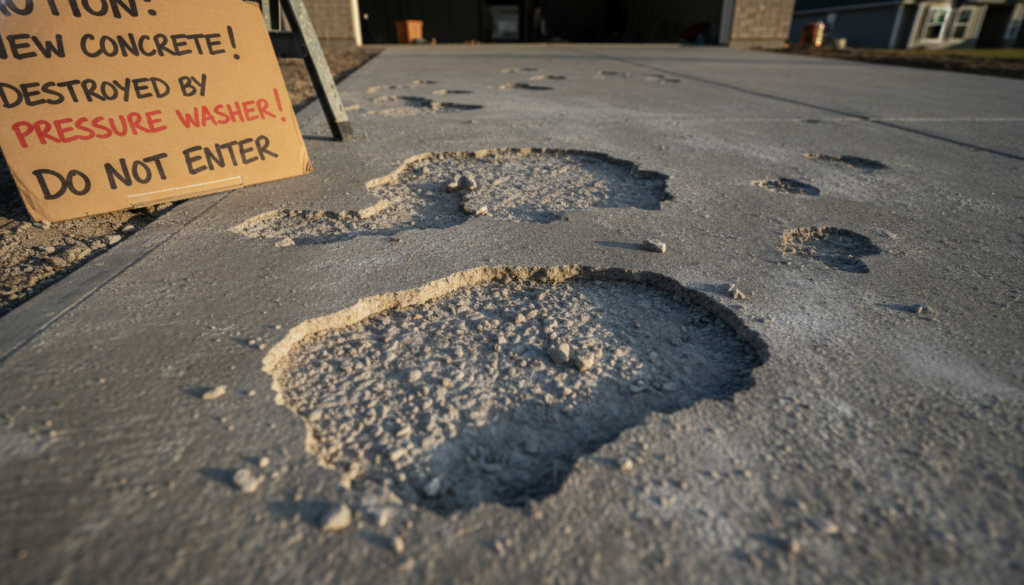
Never use a high-pressure water gun to clean concrete that has just been poured in the past 12 months. It takes up to a full year for freshly placed concrete to reach its maximum curing strength. That layer of “cream” on the surface of the new driveway is very fragile. If a set of high-speed water flow is placed on a plate that has only been poured for half a year, it will inevitably lead to serious spalling (block falling and chipping). To put it bluntly, in the first year, an honest and practical garden hose and a soft wool push broom are enough.
Parameter Configuration Of Professional Equipment With Zero Damage
The choice of nozzle directly determines your risk probability of damaging property. On flat ground, never use a red 0-degree nozzle or a yellow 15-degree nozzle. These sprinklers will concentrate the water flow into a very destructive needle tip size.
The green 25-degree nozzle is only used to treat the edge of the lane that the cleaning tray cannot reach. When performing edge finishing, the gun head must not be less than 12 inches from the concrete. For the main body surface area, connect your surface cleaning disk to a machine rated for at least 2.5 GPM and ensure that the rotating rod rotates fast enough to avoid streaking.
FAQ
How to remove oil stains without extreme water pressure?
Apply industrial grade degreaser or heavy duty alkaline cleaner directly to the dry oil spot. Use a stiff nylon brush to scrub the chemical into the pores. Let it react for 20 minutes, then rinse with a garden hose or low-pressure water. High PSI will only push the oil deeper into the concrete; it has to be pulled out by chemicals.
Cleaning old concrete driveway, how much PSI safest?
Stuck the pressure parameter between 2,000 and 2,500 PSI. Over more than 20 years, concrete will naturally degrade and become brittle. I have dealt with many old venues. Once the pressure exceeds 2,500 PSI, it is easy to collapse the expansion joint directly and cut off the aging edge.
Why do I have lines in the driveway after high-pressure flushing?
The lines appear because the distance is far and near when you use the standard spray gun, or the speed of pushing the surface cleaning disk is too fast. The spray gun will cause overlapping pressure marks (tiger stripes), and the fast-moving cleaning disk will leave circular grooves. The remedy is to retreat the area with a chemical wash and slowly push the cleaning disc at half the usual speed.
Is it safe to apply bleach to concrete before pressure washing?
Very safe. Liquid pool chlorine or household bleach (sodium hypochlorite) is already the industry standard agent for treating concrete. It is diluted with water to an effective concentration of 1% to 2%. It can perfectly kill organic attachments, and will not damage the structural integrity of the cement.
Do I need to seal the driveway after high-pressure cleaning?
Sealing treatment must be done after cleaning. High pressure cleaning opens up the microscopic pores of the driveway. Applying a permeable silane-siloxane sealant creates a hydrophobic barrier that prevents water from freezing in the pores and prevents future oil from contaminating the surface. After the concrete is completely dried for 48 hours, the sealant can be applied.