 Wingspan Tech




Limpia la casa con una hidrolimpiadora de forma segura: evita dañar el revestimiento exterior
To safely pressure‑clean your home without damaging the exterior siding, you need to control several key parameters: keep the machine’s pressure below 1,000 PSI, switch to a 40‑degree fan‑jet nozzle, and use a dedicated house‑washing detergent—don’t rely solely on the high‑pressure water stream to blast away dirt. To be honest, high-pressure direct injection is nothing short of a home‑killer. Homeowners who enjoy DIY projects on weekends often let water seep behind the siding within the first ten minutes of operation, soaking the wall cavities and triggering hidden mold that can easily cost you several thousand dollars to repair. You can certainly tackle exterior‑building cleaning in a single weekend, but it requires a shift in mindset: swap “aggressive pressure washing” for “chemical soft washing.” Scroll down, and I’ll break down the standard operating procedure used by our professional outsourcing team to dissolve green algae—without causing any damage to the paint.
High Pressure Will Ruin Your Exterior Walls.
It’s the volume of water that truly cleans a house, while it’s often the water pressure that causes damage. Consumer-grade pressure washers on the market easily deliver pressures ranging from 2,500 to 4,000 PSI, and this mechanical force can even cut through a 2×4 board in one go. Consider this: when destructive forces of this magnitude strike vinyl siding, painted wood panels, or HardiePlank fiber-cement boards, the result is the immediate removal of the surface’s UV‑resistant coating, along with breaches in the waterproof seal around the windows. In fact, the professional cleaning industry phased out the high-pressure wall-washing method as early as ten years ago. The current industry consensus is the “soft wash” technique—spraying a mixture of sodium hypochlorite and surfactants to eliminate organic contaminants at their source, followed by thorough rinsing with a high‑volume, low‑pressure water stream.
The Professional Framework For Cleaning House Exteriors
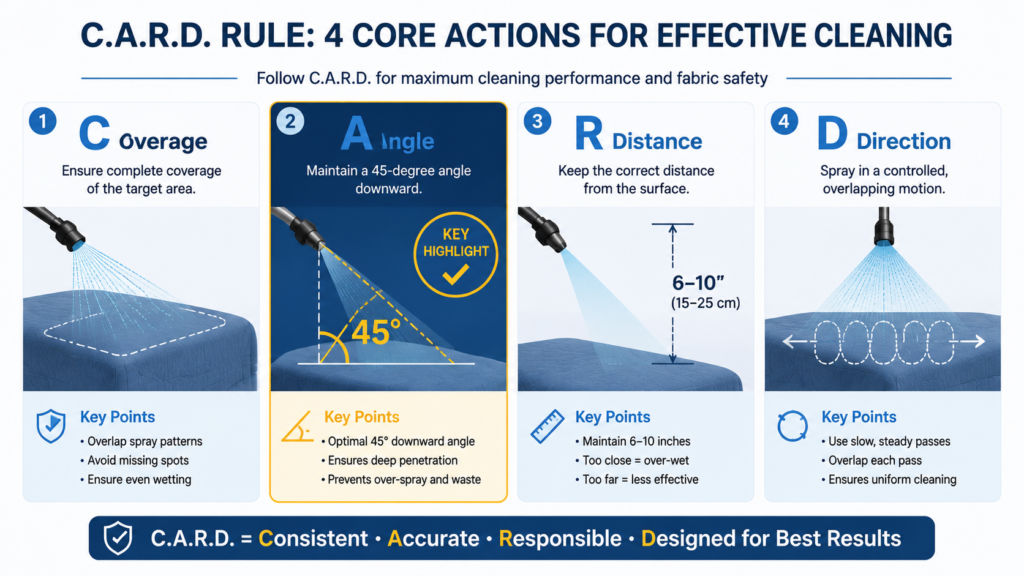
No matter what complex system you deal with, you need a standardized process. The C.A.R.D. rule is a fundamental framework that enables you to thoroughly remove years‑accumulated grime while ensuring your exterior wall warranty remains valid.
Chemistry : Let the potion do the work.
Always remember to install a downstream injector in the pipeline to dose chemical agents; never rely solely on hydraulic pressure. The injector draws the cleaning solution into the hose after the water pump, helping to protect your machine’s delicate internal components from corrosion. Based on my practical experience, the most reliable DIY cleaning formula is to mix 1 part outdoor bleach (10% sodium hypochlorite) with 3 parts water, then add a small squirt of your usual dish soap as a surfactant. Adding dish soap increases the liquid’s viscosity, allowing it to adhere to vertical surfaces and continuously break down algae for 5 to 10 minutes.
Angle: The “45-degree downward” rule for avoiding drain holes
Never spray the gun upward. Vinyl and aluminum siding are installed with horizontal overlaps, leaving small weep holes at the bottom edge to drain interior moisture. If you spray upward from the ground, the water will flow directly back into these drain holes and surge onto the back of the J‑channel. Find an extension wand or stand on a ladder, keep the spray angled 45 degrees downward, and you’ll replicate the natural scouring path of a heavy rainstorm.
Rinse: Apply the product from bottom to top, and rinse from top to bottom.
Many people have fallen flat on their face here. Remember this counterintuitive step: when applying chemical treatments, spray from the bottom of the house upward; but when rinsing, be sure to flush from the roof eaves downward. Applying foam from bottom to top helps prevent “clean streaks”—if a highly concentrated detergent solution runs down a dry, dust‑covered wall, a chemical reaction can occur, leaving permanent, impossible‑to‑remove clean marks. During the dwell time of the mortar, the wall surface must be kept moist. As soon as the algae turns brown or white, it immediately cuts back to pure water mode and starts to rush down from the eaves, allowing gravity to carry the chemical residue away.
Distance: The 18-Inch Golden Rule
Maintain a precise distance of 18 to 24 inches between the high-pressure nozzle and the panel surface. I have seen too many scenes. As long as the nozzle approaches less than 18 inches, the PSI force impacting the wall will increase exponentially, and a wavy “spray gun print” will be engraved directly on the plastic or wooden board “. Lock your elbows and use the entire body’s swaying motion to sweep across the wall; this is how you can maintain a consistent distance across the entire working surface.
Pre-Wash Trap: Oxide Layer Wipe Test
Before pulling the pull cord of the pressure washer, you must first check whether the wall panels are oxidized. Vinyl siding degrades under prolonged exposure to ultraviolet radiation, leaving a chalky residue on the surface. If you use conventional high-pressure washing on weathered siding, the entire house will end up with a disastrous zebra-striped pattern.
Before starting construction, take a minute to perform a swipe test. Put on a black nitrile glove or hold a dark‑colored cloth, and rub vigorously over the dry vinyl siding. If the glove is heavily coated with chalky powder, it indicates that the panel has already oxidized. At this point, you must not rinse directly with water; first apply a specialized deoxidizing chemical, scrub manually with a soft-bristle brush, and finally rinse with very low pressure to restore the surface’s luster.
Exterior Siding Pressure Washing Safety & Chemical Guidelines
| Siding Material | Maximum Safe PSI | Recommended Nozzle Tip | Core Risk | Chemical Dwell Time |
|---|---|---|---|---|
| Vinyl | 1,300–1,600 PSI | 25° Green Tip | Warping / seam separation | 5–8 minutes |
| HardiePlank (Fiber Cement) | 1,500–2,000 PSI | 15° Yellow Tip | Surface erosion / coating damage | 8–10 minutes |
| Brick | 2,000–3,000 PSI | 15° Yellow Tip | Mortar joint degradation | 10–12 minutes |
| Painted Wood | 500–1,200 PSI | 40° White Tip | Paint stripping / wood fiber damage | 3–6 minutes |
Safety Parameter Limits For Different Panel Materials
The water pressure resistance thresholds of different building materials vary significantly. During operation, you must carefully adjust your equipment parameters in accordance with the structural vulnerabilities of the specific panel.
Vinyl Siding: Don’t Overwhelm the Insulation Layer
The pressure is locked at a maximum of 1,000 PSI; install either the 40-degree or 65-degree soap nozzle. The vinyl panel is very soft, and just beneath it there is usually a layer of foam insulation. Once the pressure exceeds 1,500 PSI, the plastic panel will buckle inward, causing the seams to rupture and allowing water to leak directly into the insulation layer. Don’t force it—let your bleach and surfactants do all the work of breaking down the green algae.
HardiePlank and Fiber Cement Siding: Preventing Paint Peeling
Fiber cement boards look like wood, but they are actually made by compressing silicate cement and cellulose. Handle this material with care, keeping the pressure below 1,200 PSI. The greatest risk when cleaning HardiePlank is stripping off the surface acrylic paint. Maintain a steady, uniform speed as you move the spray gun; even pausing for just two seconds at a single spot can cause the high-pressure water jet to literally peel the paint off the cement substrate.
Brick & Mortar: Risk of Mortar Spalling
Don’t assume that just because bricks are hard, you can freely subject them to the maximum pressure. Set the machine to between 1,500 and 2,000 PSI. If it’s an old house built before 1980, the mortar in the brick joints has softened over the years due to weathering. If you use a 0‑degree red nozzle to spray, it’ll blow the mortar right out of the joints, and the cost of patching up those gaps afterward will leave you bleeding money. Before applying the cleaning agent, thoroughly wet the bricks with water; dry bricks act like sponges, instantly absorbing your chemical solution and leaving no residual active ingredient on the surface to kill mold.
PREGUNTAS FRECUENTES
Can I use a green nozzle to pressure wash the exterior walls of my house?
No way. The water spray from the 25-degree green nozzle is too concentrated for the house’s siding. This thing is practically a chisel—it’ll cut through the paneling, the wood grain, and even the window seals. For best results, use the white 40-degree‑angle nozzle, or attach the dedicated black soap nozzle for a gentle wash.
What will happen if bleach dries on the siding during cleaning?
If sodium hypochlorite dries on a wall, it will leave behind a layer of white powdery residue; it may even permanently stain the wallboard or cause window frames to warp. Before applying the treatment, be sure to wet the wall first, work in small sections, and try to do the job on a cloudy day or when direct sunlight is absent to prevent the solution from evaporating too quickly.
When pressure-washing the exterior walls, how can I protect the plants in my yard?
Before applying any chemical treatment to the wall, thoroughly water all nearby plants with plain water for about five minutes. Clear water will fill the stomata on plant leaves, preventing them from absorbing the subsequent bleach-laden wastewater. Once you’ve finished washing that section of the wall, immediately rinse the plants again with plenty of fresh water.
Why does my vinyl siding look blotchy after washing?
The appearance of streaks is usually due to not applying the cleaning agent in a “bottom-up” sequence, or because the wall panels already had a severe layer of UV‑induced oxidation before you began. When a high-pressure water jet strikes the oxidized panel, it unevenly scrapes away the powdery surface layer, exposing the underlying fresh paint in patches—resulting in a highly unsightly appearance.
Is high-pressure cleaning around windows and doors safe?
One must be extremely cautious. Stand at least three feet away and set the pressure to the lowest setting. Never aim the spray gun directly at the joints between the window frame and the siding; the water will be forced under the flashing, soaking and rotting your interior drywall.