 Wingspan Tech




Best wall mount pressure washer: Fixed Setup Guide
The so-called “wall-mounted” is actually a way of installation and storage. It has nothing to do with whether the machine has high water pressure, insufficient water output, or is specialized or unprofessional in its work. Whether this thing is suitable for you depends mainly on whether you only wash your car in a fixed area, as well as the on-site wall structure, water and electricity distribution, and the range that the water pipes can reach, which does not match your actual needs. So when choosing the one you’re looking for “the best wall-mounted pressure washer (best wall-mounted pressure washer)”, don’t bother looking at how much floor space you can save on the wall; that’s just scratching the surface.
Step 1: First understand the hardware foundation “fixed camera position”
Since it has been decided to go up the wall, the wall knot is not strong, whether the expansion screws can be held firmly, how high to hang it properly, and whether you can reach in smoothly when repairing the machine in the future… these are all hard indicators that must be determined in advance. When choosing a location, you also need to consider the water inlet pipe, power socket, sewer, and winter frost protection conditions. Never force the machine into dead ends that are easily splashed by water, will accumulate water, freeze in winter, or become airtight. Just by listening to the seller’s trick “supporting wall hanging”, you can’t guess exactly how big the wall load-bearing capacity and how thick the screws are needed. This matter must be based on real parameters.
In addition, if the machine is fixed to death, it can indeed save you the trouble of moving it around, but it should definitely not save you the time left for future maintenance. If you plan to install the water pump in a different direction, it will not affect the lubrication, exhaust, and drainage of the engine oil, and it is inconvenient to check the oil dipstick. In short, don’t just look at the wall and then go to the wall without thinking. The doorway inside the installation method is deep.
Step 2: The machine is doomed. How far can the tube be stretched?
The biggest feature of wall-mounted equipment is the machine “which is fixed in one place”. The full extent of your washing at this point depends on that high-pressure pipe. But the longer the pipe, the more the water pressure drops, and it is difficult to put it away; dragging it around on the ground is not only easy to wear out, but also very easy to trip people over. If you plan to use a wall-mounted pipe reel (whether it is hand-cranked or fully automatic), be sure to check one by one whether its load-bearing structure is suitable, whether the direction of pulling the pipe is smooth, whether it can be locked, how much force is required to roll it back, and whether it is inconvenient to maintain and prevent bumps and bruises.
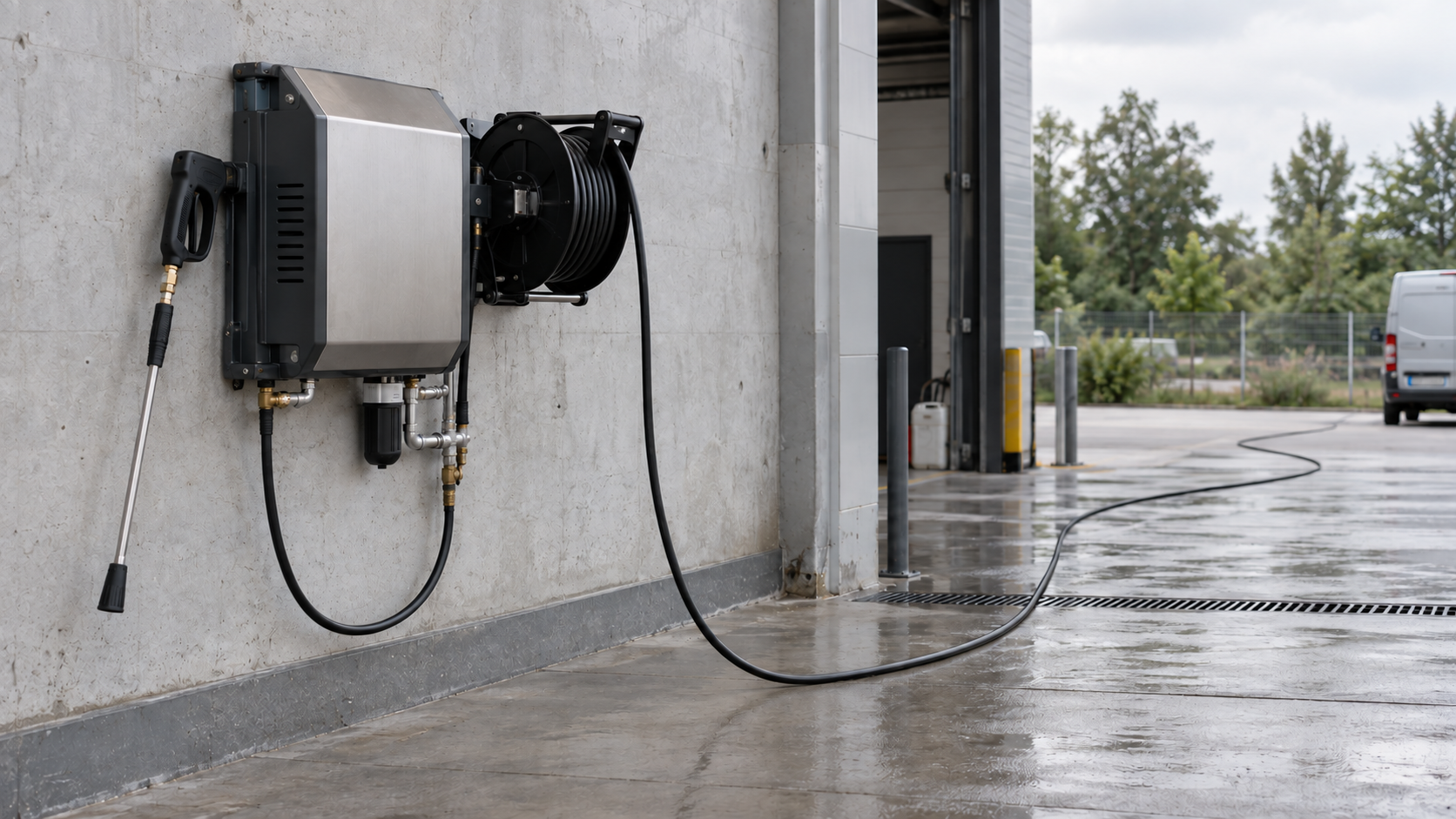
Don’t assume that some machines are easy to use just because they are small in size. Only by putting together your work area, the length of the hose, how to configure the pipe reel, and the actual area to be washed “by drawing and drawing” can you truly determine whether this wall hanging solution is reliable.
Step 3: Water, electricity, and water cannot be ambiguous in any one link
Car washers are “for large water drinkers”, and water must be fed to them all the time. Don’t assume that just taking a pressure gauge to measure static water pressure will make you feel stable; that doesn’t prove your water supply is insufficient. The thickness and length of the water inlet pipe, and the filters, valves, joints, and elbows strung in between, all directly affect the water absorption efficiency of the water pump. Once the water supply is insufficient, the machine will immediately experience a sharp drop in flow, inability to increase pressure, cavitation noises, trembling, and even the seals will be broken.
With more water flowing out, drainage naturally needs to keep up. Those ruthless players with high flow rates (high GPM) must be equipped with sewer or sewage recycling systems with sufficiently large throughput. Speaking of electricity, plugged-in machines must accurately verify the voltage, frequency, and number of phases on site. Is the socket on the right path? Can the line capacity withstand it? Are the grounding and protection devices installed? The most deadly point is that in humid environments, the power supply must be far away from the stagnant and flushing water flow.
Step 4: Finally, let’s deal with the pressure parameters and accessory details
How much more careful you need to be when looking at parameters. Water pressure (PSI) and flow rate (GPM) must be evaluated at the same operating point. Many manufacturers like to separate the “maximum pressure” and “maximum flow” that the machine can reach, but in actual work, these two peaks cannot be reached at the same time by default. If you only focus on the highest pressure to bluff, 80% of them will be taken into the ditch, misjudging the machine’s true performance.
In addition, your high-pressure pipes, spray guns, extension rods, connectors, and nozzles, which can withstand the working pressure and heat resistance, must completely cover the highest value of the machine output. Just look at how much pressure the entire system can withstand, depending on the one “the most crotch-pulling” in your pile of accessories. Even if you buy a pipe or connector labeled “general purpose”, you still need to check the interface diameter, pressure resistance, flow rate, temperature and material. Don’t think that just being able to force it on with a wrench is the end of the matter. Being able to tighten it is completely different from being safe and easy to use.
To summarize
To put it bluntly, the “wall hanging” format itself does not give you what is called the ultimate perfect answer. When choosing a plan, if you only see the highest PSI parameter that has blown the sky, but you don’t even know the flow rate in its actual working state, or how to fix the wall, how much space to leave for the repair machine, or whether the pipe is long enough, then don’t rush to pay ——because you can’t make a correct purchase judgment based solely on this incomplete information.