
 وينج سبان للتكنولوجيا




How to Connect a Hose to a Pressure Washer in 3 Steps
To connect the water pipe of the high-pressure cleaning machine, to put it bluntly, 3 is one action: drain the dirty water in the hose, align it with M22 or quick plug connector of the pump water inlet, and finally tighten it with bare hands to ensure that the O-ring inside is sealed in place. That’s all, but many novices are screwed hard because of their lives. As a result, the thread is crooked, leaving themselves covered in water and scrapping the pump. When I repaired small engines in my early years, I often saw guests directly reimbursing a machine worth 300 US dollars because of this short 30-second installation error. Whether the water pipe is connected well or not determines whether you can wash the car happily or collapse the water seal directly. It all depends on whether you understand how these joints bite. Let’s throw the instructions aside today and see directly how the maintenance veterans do not leak the water pipe.
Old driver’s “platoon-right-twist” (P.A.T.) 3 footwork
After repairing hundreds of sliding silk inlets, I summed up this “row, right, twist” (P.A.T. Protocol) rule. As long as you do so, all the pits that are easiest to step on when a novice takes over can be avoided.
Step 1: drain the water source (Purge)
Before you connect the hose to the machine, be sure to flush the pipe first! Water pipes placed in the yard often accumulate sediment, scale, and even crawl into insects. If these dirty things are directly rushed into the pump that has not yet been powered on, the water inlet filter screen as fine as cow hair will be blocked instantly, causing the motor to be unable to pump water and directly causing “cavitation” to destroy the machine. The method is very simple: turn on the outdoor faucet to the maximum, flush it for five seconds, watch the water become clear, and then turn off the water.
Step 2: Align the threads perfectly.
Don’t rush to apply force—first, align the hose connector with the machine’s water inlet perfectly straight. If you insert it at an angle and then force it, the brass or plastic threads will strip instantly, rendering it unusable.
If you’re using a traditional threaded fitting, keep your hand steady and align the pipe squarely with the pump’s center, pressing it firmly into place. If your machine uses a Quick Connect (QC) system, first pull the brass collar all the way back with firm pressure, then push the plug fully into the socket. Remember, you must clearly hear a “click” to confirm that the ball bearing is fully locked.
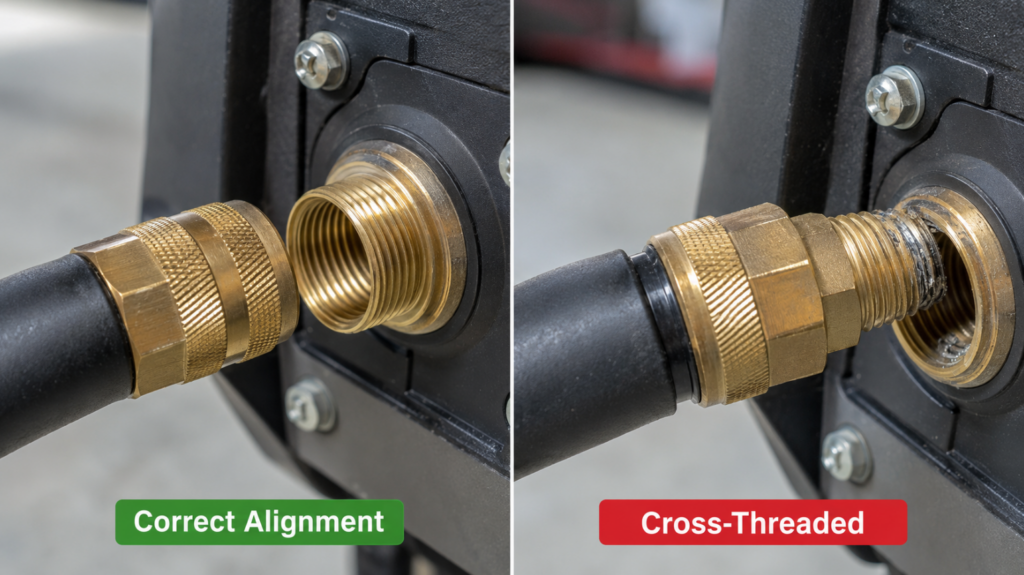
Step 3: Hand-tighten, then perform a pressure test with hot water (Twist and Pressure-Test).
Attention: Use only your bare hands to tighten the connector! Absolutely do not try to clamp it with pliers or an adjustable wrench. As soon as you use a tool, it will directly crush the rubber O-ring inside the joint. Once the O-ring deteriorates, as soon as the pump starts, high-pressure water will immediately spray all over your face. If you feel you can no longer turn it with your hand and there’s noticeable resistance, stop immediately.
Before pulling the engine recoil starter or pressing the start switch, first turn on the water faucet, then briefly squeeze the spray gun trigger. At this point, the water should flow smoothly out of the tap, relying on the household water pressure. This not only verifies whether your connection is secure but also conveniently vents any air trapped inside the pump.
Maintenance Man’s Warning: M22-14mm and M22-15mm Dead End
When a novice asks how to connect a pipe, he always thinks that all threaded water pipes are universal. Completely wrong! There are two standards in this industry that look exactly the same, but don’t come together at all: M22-14mm and M22-15mm.
If you rigidly connect a pipe with an inner diameter of 14mm to a machine with a diameter of 15mm, the sealing ring will be squeezed and deformed, which will definitely cause a large water leak. Generally, fuel-powered car washers (such as Simpson or Honda) are especially fond of using 14mm. Electric machines (such as Sun Joe or Greenworks) are almost all 15mm. Therefore, if you plan to replace the old pump with a new pipe, you ‘d better check the manufacturer’s specification sheet before you start work, and don’t go up blindly.
| Brand Category | Fitting Standard | Visual Identifier | Leak Risk if Mismatched |
|---|---|---|---|
| Most Gas Washers | M22-14mm | Light brass inner core | High — sealing ring may be squeezed and deformed, causing water leakage or blowout risk |
| Most Electric Washers | M22-15mm | Extended inner plug | High — fitting may not thread fully, causing poor sealing and connection failure |
Stop right now! Don’t wrap Teflon tape around the compression fitting anymore.
Plumbers do like to wrap PTFE (raw material tape) on the threads to prevent water, but you must not use it on the joints of high-pressure water pipes!
The hose of a pressure washer is not sealed by metal threads at all; instead, it relies on an internal rubber O-ring that is compressed against the metal base to provide a watertight seal. If you wrap the thread with too much Teflon tape, the nut won’t be able to screw on far enough, and the O‑ring won’t get properly compressed. A smart approach is to keep a small tube of dielectric grease in your toolbox. Every season, it is enough to put a little bit of sesame on the O-ring. This keeps the rubber moist, prevents it from aging and cracking, and it is 1 to screw it to the end the next time the pipe is connected, which is extremely silky.
أسئلة شائعة (FAQ)
Why does my pressure washer pipe keep leaking at the joint?
Nine times out of ten, the water leak is because the O-ring inside the pipe joint is missing, cracked, or crushed. Pull it out and check that rubber ring. If you look flat or damaged, just buy a standard 14mm or 15mm cleaning machine O-ring and replace it.
Can I directly use the ordinary water pipe used for watering flowers as a high-pressure pipe?
Don’t even think about it. Ordinary water pipes can only withstand pressures of 40 to 60 PSI. If you connect it to the high-pressure output port (that’s 1500 to 4000 PSI), the tube will burst on the spot in an instant. The watering pipe can only be connected to the water inlet (water source to the machine).
How do I change my threaded water pipe to a quick-plug type?
Go for a set of brass “M22 to 3/8 inch” quick-plug adapters. Screw the M22 socket to the water inlet of your pump, and then connect the 3/8 inch plug to the water pipe. Done! In the future, it will only take one second to “click” on or unplug the water pipe, and there will be no need to hum and hum any more.
Will there be a “click” sound after the water pipe of the high-pressure cleaner is connected?
Only available if you use a Quick Plug (QC) connector. If it is an ordinary M22 threaded pipe, just tighten it like screwing the cap of a mineral water bottle. If you plug the connector quickly, you must pull the collar back, insert it into the tube, and then loosen the collar until you actually hear the “click” of the mechanical lock.
What if the water pipe is stuck on the pump and cannot be screwed down?
This is because aluminum and brass parts have been used for a long time and have been electrochemically corroded and bitten together, especially if you throw it in the warehouse in winter and don’t take it apart. Find two wrenches and break them loose with careful force. Next time, remember to apply anti-seize compound to the threads.
Is it safe to connect two high-pressure water pipes together?
Safe, provided you use special “male-to-male” brass couplings that match the PSI pressure rating of your machine. However, it is best to control the total length within 100 feet (about 30 meters). If the pipe is pulled too long, the water pressure will drop and the pump will be overloaded.
