
 وينج سبان للتكنولوجيا




Best Pressure Washer 2026: Right PSI & Size Guide [Proven]
The best pressure washer for most homeowners in 2026 is a 2300-3000 PSI electric brushless motor unit with at least 1.7 GPM. This setup balances enough stripping power for grimy driveways with the delicate touch needed for car detailing, all without the maintenance headaches of gas engines.
Finding the right machine means looking past the flashy numbers on the box. Most people overpay for high PSI they’ll never use, while ignoring the GPM (flow rate) that actually does the work. If you want a machine that lasts more than two seasons and won’t strip the paint off your siding by accident, you need to understand how “Cleaning Units” impact your specific tasks.
2026 Pressure Washer Core Specifications Recommendation Table
| Application Category | مصدر الطاقة | PSI Range | GPM Range | Cleaning Units (CU)* | Typical Use Cases |
| الخدمة الخفيفة | Electric / Battery | 1,300 – 1,900 | 1.1 – 1.5 | 1,400 – 2,800 | Car washing, windows, outdoor furniture, grills, bicycles, small patios. |
| متوسطة المهام | High-End Electric / Entry Gas | 2,000 – 2,800 | 1.5 – 2.3 | 3,000 – 6,400 | Fences, decks, home siding (vinyl/wood), sidewalks, garage floors, gutters. |
| الخدمة الشاقة | Gas-Powered | 2,900 – 3,500 | 2.4 – 3.0 | 7,000 – 10,500 | Driveways, large concrete areas, brickwork, paint stripping, stubborn stains, second-story reach. |
| Commercial | Gas (Belt Drive) / Hot Water | 3,600 – 4,200+ | 3.5 – 5.0+ | 12,600 – 21,000+ | Industrial equipment, oil & grease removal, fleet washing, graffiti removal, parking lots. |
What Is A Good PSI For A Pressure Washer? (The Reality Check)
Pick a PSI that matches your most fragile surface, not your toughest one. For a residential user, 2000 to 3000 PSI is the gold standard.
- 1500 – 1900 PSI: Ideal for washing cars, outdoor furniture, and windows. You won’t risk denting the metal or breaking seals.
- 2000 – 2800 PSI: The “Homeowner Sweet Spot.” This handles deck cleaning and most siding.
- 3000+ PSI: Reserved for unsealed concrete, brick, and stripping old paint.
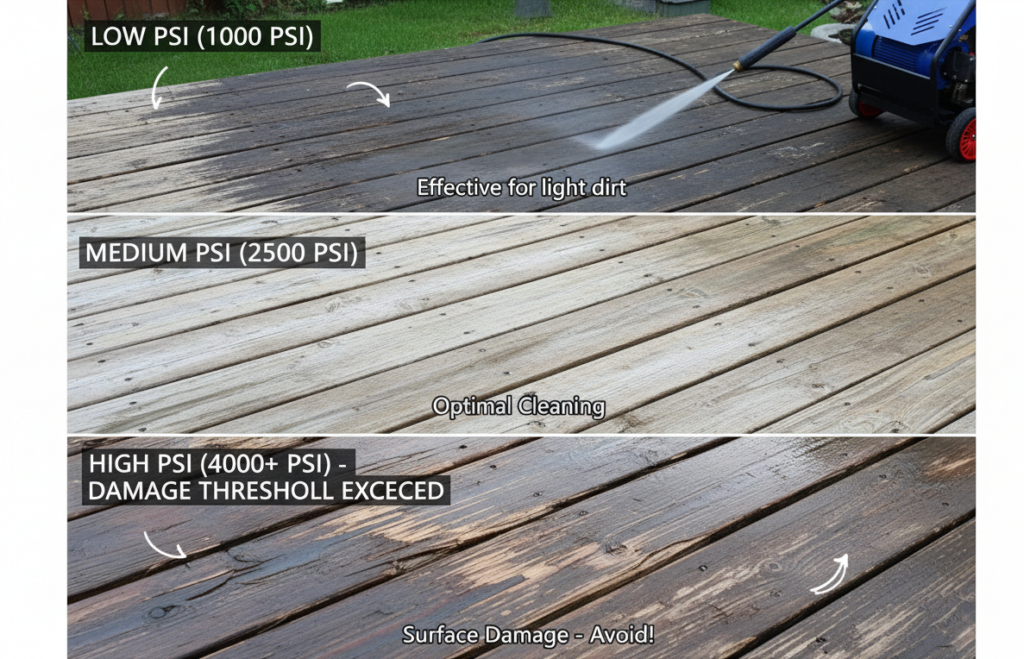
Experts focus on GPM (Gallons Per Minute) more than PSI. Think of PSI as the chisel that knocks dirt loose, and GPM as the “broom” that sweeps it away. A high-PSI machine with low flow will leave you cleaning a driveway one square inch at a time. To save your Saturday, look for a machine where the GPM is at least 1.5.
What Size Pressure Washer Do I Need?
Your “size” requirement depends on the square footage of your cleaning projects.
If you only clean a 2-car driveway once a year, a compact electric unit (Light-Duty) is sufficient. However, if you have 100+ feet of fence or a large patio, you need a Medium-Duty unit with a Triplex pump.
Most beginners make the mistake of buying based on storage size. Instead, buy based on motor type. Induction motors are heavier and larger but last 3x longer and run significantly quieter than the cheap, universal motors found in budget suitcase-style washers.
What To Look For In A Pressure Washer: The Expert’s “Hidden” Checklist
When you are unboxing your machine, check these three components immediately. They determine if your machine is a “one-season wonder” or a 10-year tool.
- Pump Construction: Avoid plastic pump heads. Look for brass or high-grade aluminum.
- Hose Material: If the hose feels like stiff plastic, it will kink and frustrate you. Look for “High-Flex” or steel-braided rubber hoses.
- Nozzle Connection: Ensure it uses a standard 1/4-inch quick-connect system. Proprietary plastic connectors mean you can’t upgrade to a turbo nozzle or a foam cannon later.
Pressure Washer 2026: Core Hardware Pitfall Avoidance List
| Component | Pitfall / Inferior Choice (Avoid) | Expert / Professional Choice (Select) | Technical Justification |
| Pump Type | Axial Cam / Wobble Plate | Triplex Plunger Pump | Axial pumps are “disposable” (100-200hr life). Triplex pumps use a crankshaft/connecting rod design, are fully rebuildable, and last 10x longer. |
| Pump Manifold | Plastic or Cast Aluminum | Forged Brass / Nickel-Plated Brass | Aluminum corrodes and cracks under high-pressure cycles. Brass is corrosion-resistant and handles thermal expansion without failing. |
| Pistons/Plungers | Stainless Steel Coated | Solid Ceramic Plungers | Steel plungers wear down seals quickly. Solid ceramic is nearly friction-less, heat-resistant, and won’t score or scratch. |
| Electric Motor | Universal (Brushed) Motor | Brushless Induction Motor | Universal motors are loud, run hot, and have carbon brushes that fail. Induction motors are silent, water-cooled (in 2026 models), and maintenance-free. |
| Gas Engine | Generic “No-Name” OHV | Commercial Grade (Honda GX, Vanguard) | Generic engines lack proper sleeve linings and have poor parts availability. Commercial engines offer easy cold-starts and 2000+ hour lifespans. |
| Pressure Hose | PVC / Thermoplastic (Plastic) | Steel-Braided / Non-Marking Rubber | Plastic hoses are stiff, kink easily, and “memory-loop.” Steel-braided rubber remains flexible and resists bursting from heat or abrasion. |
| Unloader Valve | Integrated / Internal (Fixed) | External / Adjustable Bolt-on | If an internal unloader fails, the whole pump is usually trashed. External unloaders can be replaced or tuned individually for under $50. |
| Connectors | Zinc-Plated or Proprietary Plastic | 304 Stainless Steel / Heavy Brass QC | Plastic/Zinc fittings corrode and “seize” onto the machine. 304 Stainless Steel ensures smooth Quick-Connect (QC) action for years. |
| Spray Gun Internals | Plastic Valves & Thin Wands | Stainless Steel / Brass Internals | Plastic triggers leak internally after one season. Professional guns use “Linear” designs with metal seats for high-temperature/pressure durability. |
| Bypass System | Static (No Thermal Protection) | Active Thermal Relief Valve | Running a pump without spraying water creates heat. A Thermal Relief Valve vents hot water to prevent the seals from melting. |
How To Avoid “The Rookie Mistake” (Day One Guide)
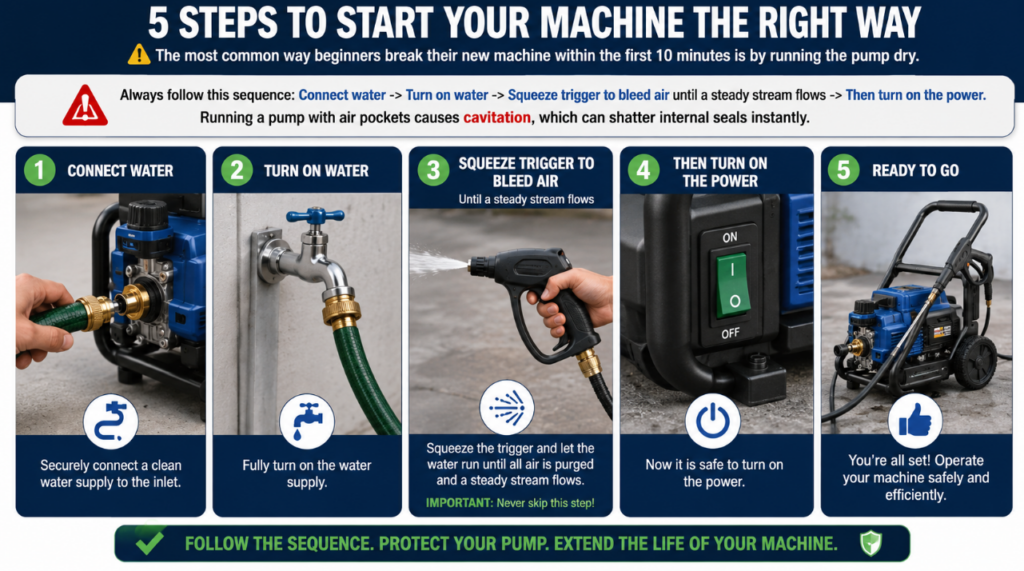
The most common way beginners break their new machine within the first 10 minutes is by running the pump dry.
Always follow this sequence: Connect water -> Turn on water -> Squeeze trigger to bleed air until a steady stream flows -> Then turn on the power. Running a pump with air pockets causes cavitation, which can shatter internal seals instantly.
People Also Ask (FAQ)
Q: Can I use water from a bucket or rain barrel?
A: Most entry-level electric washers require “positive pressure” (a garden hose). Unless the machine specifically has a “self-priming” feature or you use a specialized suction hose, drawing from a bucket will burn out the motor.
Q: Is 3000 PSI too much for a car?
A: Yes, if used with a narrow nozzle (0-degree). For cars, use a 40-degree (white) nozzle and keep the wand at least 12 inches away. 1500 PSI is generally plenty for automotive detailing.
Q: Why is my pressure washer pulsing?
A: This is usually a sign of water starvation. Check for kinks in your garden hose or a clogged inlet filter. If the pump can’t get enough water, it can’t create steady pressure.
Q: Do I really need a gas pressure washer in 2026?
A: Only if you are working in remote areas without electricity or doing commercial-grade concrete stripping. 2026’s high-end electric units now rival gas power without the oil changes and fuel stabilization issues.
Q: What is the best PSI for a pressure washer to clean concrete?
A: Aim for 2500 to 3100 PSI. Concrete is porous and holds stains deep; you need the extra punch and a Turbo Nozzle to lift years of oil and grime effectively.