
 Wingspan Tech


How Long After Power Washing Can You Paint
Typically, after a high-pressure washing, you should wait at least 24 to 48 hours before you begin painting the exterior of your house. However, this time window is never absolute; it depends to a large extent on the weather conditions and the material characteristics of your walls.
If you are dealing with a particularly “draft” porous material such as wood or masonry, or if the relative humidity of the air at the time exceeds 50%, then you ‘d better extend the drying time to 3 to 4 days. If you want to reach the professional delivery standard, guessing alone is not enough. The only way to be 100 sure is to take out a humidity meter and measure it. Before applying any primer or topcoat, we must ensure that the moisture content reading drops below 12% to 15%. If you rush to start construction without meeting this standard, the moisture will be locked under the coating, which will inevitably lead to blistering and bulging, and the paint will begin to fall off within a few months.
Effect Of Weather Conditions On Drying Time
Although the standard advice is to wait 24 to 48 hours, you can’t stare at the clock rigidly. It is the local weather that plays a key role in determining how quickly moisture evaporates from the facade.
The common rule is based on ideal conditions: warm temperatures, plenty of sunlight and low humidity. However, if the relative humidity in your area exceeds 50%, the air is actually saturated with moisture, which can significantly slow down the evaporation process. In this humid environment, even if you wait for 48 hours, the wall may still not dry. On the other hand, direct sunlight combined with a breeze can indeed accelerate drying.
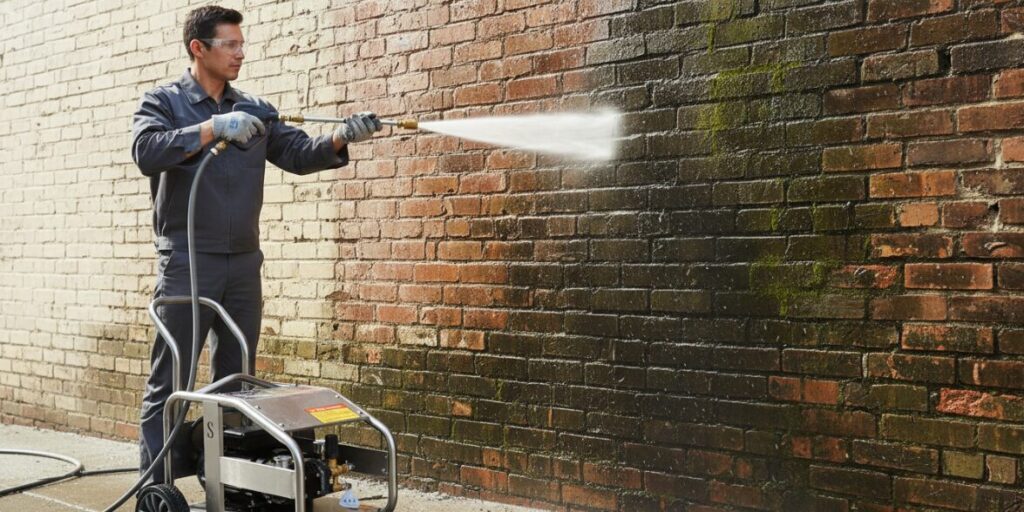
Therefore, before sticking to the “minimum waiting period”, be sure to check the weather forecast first. If you are not sure about the humidity, or if there is no sun in those days, it is always safer to wait one more day.
Surface Porosity: Why Wood And Masonry Take Longer
Not all building materials dry at the same rate. The texture and composition of your wall panel determines how much water it will “drink” during the high-pressure cleaning process.
Non-porous materials, such as vinyl or aluminum, drain quickly and usually fall into the category of shorter drying times. In contrast, porous materials such as wood, brick, stucco and masonry behave like sponges. During high-pressure cleaning, the water flows directly into the depths of the wood fibers or into the pores of the masonry.
At this time, misjudgment is most likely to occur-after a day, you feel dry on the surface, but the internal structure often contains a lot of moisture. This is why specifically recommend extending the drying time to 3 to 4 days for these materials.
Professional Standard: Use Hygrometer
Judging whether the surface can be painted by naked eyes or by touching it with hands is actually very unreliable. The only way to be 100% sure is to use a hygrometer. This tool can completely eliminate the “blind guess” component.
In order to ensure that the work done is professional, you should test in different positions on the wall, especially in shaded areas where the sun is not available all the year round. The data you are looking for is clear: the water content reading must be less than 12% to 15%. If the meter reading is still above 15%, the substrate is still too wet to effectively “eat” into the primer or topcoat. Waiting patiently until the readings fall into the safe zone is the only way to ensure that the new coating is chemically and physically ready.
O-Series High Pressure Washer 220V
The durable ceramic pump and powerful four-stage motor provide high-performance cleaning power, with adjustable pressure, support for customized voltage and power.
380V 1500Bar Water Blaster
1450 RPM ultra-high pressure water jet pump, high cost performance, suitable for 50Hz voltage. It’s a great tool for removing rust and deburring in factories.
Diesel Power High Pressure Cleaner
The pump unit is the core component of a cleaning machine or water treatment system. Composed of a high-pressure plunger pump and an electric motor
Foam Cannon for car washing
Foam Cannon S V3.0 (Thicker Snow Foam Technology) with 1/4 Inch Quick Connector for Pressure Washer, 34 oz Bottle (V3.0 (1/4″ Quick Connector) + SOAP Sample)
The Consequences Of Haste
Patience is crucial here, because the consequences of forced construction on wet surfaces are severe and often irreversible.
If you paint before the moisture content drops to the 15% threshold, you are actually sealing the water between the wall panel and the new paint film. When the temperature rises, the trapped water will try to evaporate and expand. Since the new paint is blocking its way, the accumulated pressure will directly push the paint film away from the wall.
This is the direct cause of the “blistering, bulging and premature peeling” I mentioned earlier. These problems usually do not take a few years, just a few months will appear, directly your original beautiful house renovation project, into an expensive rework site-then shoveling paint, polishing, re-brushing, which all indispensable.
Author: Mark Benson
I am a seasoned painting specialist focused on exterior durability. My approach prioritizes technical precision over guesswork. I advocate strictly for verifying surface dryness with moisture meters to stay below the critical 15% threshold.