 Wingspan Tech


How To Hook Up A Power Washer
129Learn How To Hook Up A Power Washer Safely. Follow Our Specific Order To Purge Air, Avoid Running Dry, And Protect Your Pump.
View details
Search the whole station
The plunger pump is the typical high-pressure positive displacement pump, which mainly generates a pressure difference at the hydraulic end through the reciprocating motion of the plunger to deliver fluid. Unlike the piston pump, which has a friction seal on the cylinder wall, the plunger of the plunger pump moves back and forth in a set of fixed seals. It is this design that makes it perform well when dealing with fluids with high pressure, high viscosity and abrasive particles, which is the fundamental reason why heavy-duty high-pressure cleaners are mostly used in this structure. During the working process, when the crankshaft drives the plunger to retreat, a vacuum is generated in the chamber, the suction valve opens, and the fluid is sucked in; and when the plunger advances, the suction valve closes, the discharge valve opens accordingly, and the fluid is extremely high Press out at a high speed. For the team responsible for operation and maintenance, the key to maintaining the best flow efficiency is to keep an eye on the wear of the packing and seals, while ensuring adequate lubrication at the power end.
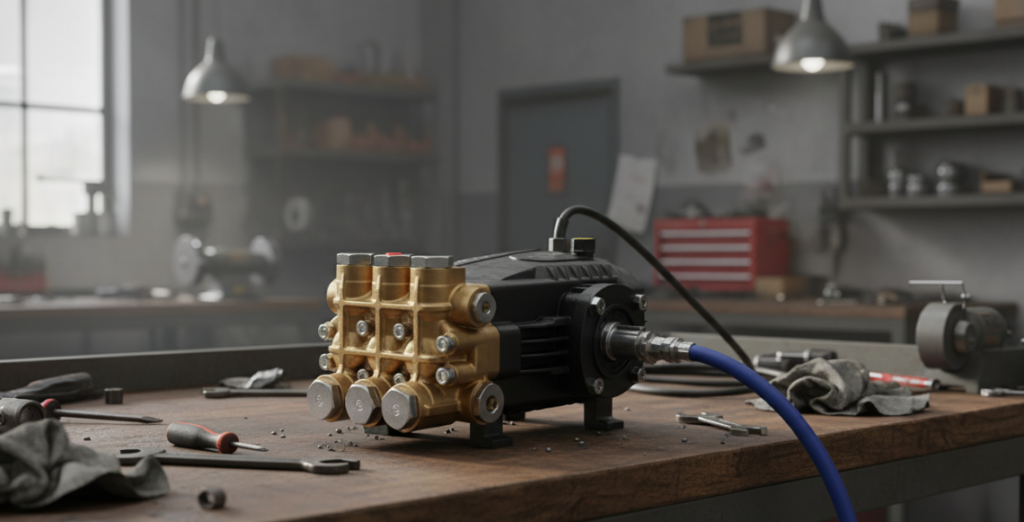
The high efficiency of the plunger pump, the core lies in how to accurately convert the rotary motion into reciprocating linear motion. At the power end, the crankshaft plays the role of the driving core. As it rotates, the plunger is forced in and out of the chamber of the hydraulic end.
Suction stroke: When the plunger contracts backward, the chamber space becomes larger and the internal pressure decreases. Using this pressure difference, the suction valve is smoothly pushed open, and the fluid enters the pump chamber.
Discharge stroke: The plunger changes direction and starts to push forward, and the internal pressure of the chamber rises instantly. At this time, the suction valve automatically closes, the discharge valve is opened, and the fluid is sprayed out at a high speed-this is the power source pursued by industrial cleaning.
Compared with the structure of the piston pump in which the seal moves with the piston in the cylinder wall, the piston pump uses a fixed seal is indeed a subtle design.
Wear resistance: The plunger itself does not directly rub the cylinder wall, so even if the water is mixed with some fine abrasive particles, it is not easy to cause scratches on the cylinder wall.
Seal life: Fixed packing constitutes a solid high pressure barrier. For field maintenance personnel, regular inspection of these seals is the most effective means of maintaining flow efficiency and preventing external leakage.
O-Series High Pressure Washer 220V
The durable ceramic pump and powerful four-stage motor provide high-performance cleaning power, with adjustable pressure, support for customized voltage and power.
380V 1500Bar Water Blaster
1450 RPM ultra-high pressure water jet pump, high cost performance, suitable for 50Hz voltage. It’s a great tool for removing rust and deburring in factories.
Diesel Power High Pressure Cleaner
The pump unit is the core component of a cleaning machine or water treatment system. Composed of a high-pressure plunger pump and an electric motor
Foam Cannon for car washing
Foam Cannon S V3.0 (Thicker Snow Foam Technology) with 1/4 Inch Quick Connector for Pressure Washer, 34 oz Bottle (V3.0 (1/4″ Quick Connector) + SOAP Sample)
In order to extend the service life of the high-pressure system, the operation and maintenance personnel must kill the two core pain points: pressure pulsation and cavitation.
Coping with pressure pulsation: the fluid is discharged rhythmically, and the plunger stroke frequency is consistent, this pulsation is easy to cause mechanical fatigue to the downstream pipeline. The installation of a pulsation damper is almost a necessary operation in engineering, which can effectively stabilize the pressure and protect the safety of the pipeline.
Governance cavitation phenomenon: when the pump “suction”, there will be cavitation. You will hear the iconic “knocking sound”. Air bubbles break on the surface of the plunger and valve, which will cause the metal surface to quickly appear pockmarked. My advice is to ensure that the water supply pipe diameter is sufficient, and do not let the pump run faster than the rated speed.
Power end lubrication: do not ignore the oil condition of the power end. The lubrication of the crankshaft, connecting rod and bearing is the last line of defense for the equipment not to lock up or overheat internally, which cannot be saved.

Hydraulic end integrity: regularly check the degree of wear of the plunger and packing.
Fluid dynamics matching: Ensure that your water supply pressure fully meets the water intake requirements of the pump, which is the fundamental prerequisite for eliminating cavitation.
Preventive maintenance: adequate lubrication at the power end is a prerequisite for achieving long-term, efficient and stable injection cycles.
Author: Alex Thorne
I have focused on solving complex mechanical failures in field operations, from cavitation issues to power end lubrication optimization. My goal is to share technical, no-nonsense insights that help maintenance teams and procurement professionals maximize the efficiency and longevity of their critical equipment.

Learn How To Hook Up A Power Washer Safely. Follow Our Specific Order To Purge Air, Avoid Running Dry, And Protect Your Pump.
View details
Yes, If Temps Are Above 38°F. Learn The Critical Safety Rules, Best Washing Hours, And How To Prevent Pump Damage Here.
View details
Is It Safe To Power Wash In The Rain? Discover The Pros And Essential Safety Tips From A Cleaning Professional.
View details
We are thrilled to announce that WINGSPAN TECH TAIZHOU CO., LTD. will be showcasing our latest cleaning and water treatment innovations at the 11th International Industry Week Indonesia. As a leader in high-pressure technology, we invite indu...
View details
HelloPlease log in