
 Wingspan Tech


How Do I Power Wash A Deck
To safely power wash a deck without damaging the wood, you must follow a “Low-Pressure, High-Volume” approach: the pressure of the high-pressure washer should be set between 500 and 1,200 PSI (if it is a cork such as cedar or pine, it must not exceed 1,500 PSI). Choose a 40-degree (white) or 25-degree (green) fan nozzle and keep the gun head 6 to 12 inches from the wood surface. The action should follow the wood grain and shoot continuously for a long distance, pushing outward from the side of the house.
In order to achieve the effect of a professional team and prevent the wood from burring, you have to pre-treat it with a professional oxygen-based bleach cleaner for 10 to 15 minutes, and watch the whole process to prevent the wood from drying. This combination of PSI, nozzle angle and parallel texture operation can keep the structural integrity of the wood fiber while taking away dirt and mold.
The “Low Pressure, High Flow” Rule
The most typical pit in deck maintenance is excessive force. If you want to wash clean without indentation, you have to put “low pressure, high flow” in the first place. Cleaning the deck is actually a combination of water flow and chemicals, not brute force.
Understanding The PSI Limit:
Facing cedar or pressure-treated pine, a pressure setting of 500 to 1,200 PSI is sufficient. Once it exceeds 1,500 PSI, the cellular structure of the wood will be permanently damaged, resulting in the kind of hairy “fluffing” phenomenon, and even serious cracks.
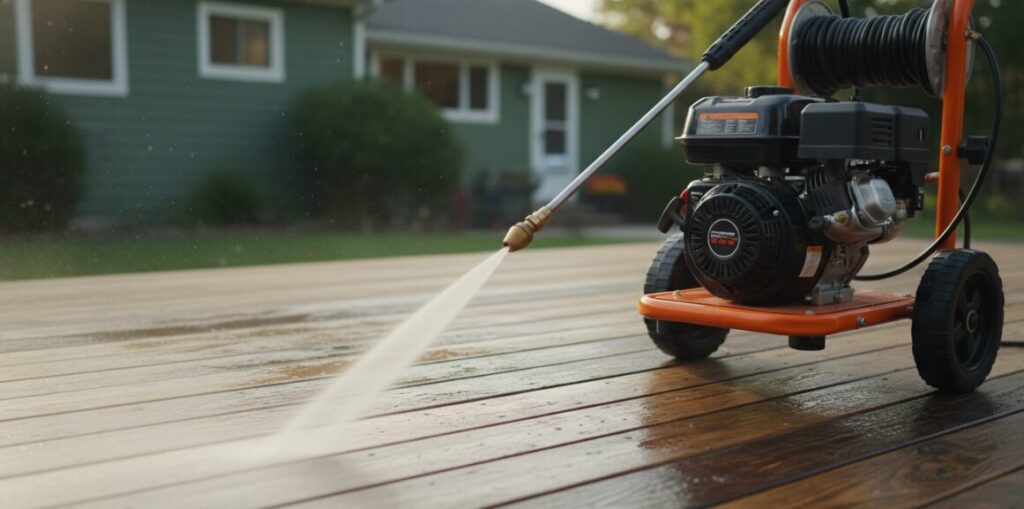
Choose The Right Nozzle:
Don’t touch the 0-degree (red) or 15-degree (yellow) nozzle, it’s too aggressive. Change to 40 degrees (white) for regular cleaning, or use 25 degrees (green) for stubborn stains. This fan nozzle can evenly spread the pressure over a wider surface.
Key Pre-Processing Steps
Washing the deck isn’t just about flushing with water, it’s more like a chemical reaction. Personally, I am very exclusive of ordinary chlorine bleach, and I prefer specialized oxygen bleach cleaners. Because it breaks down mold and organic stains, but it doesn’t destroy the lignin that holds the wood fibers together.
Dwell Time:
After spraying the cleaner, let it stay there for 10 to 15 minutes. You need to give those oxygen bubbles a little time to “top” the deep dirt to the surface.
Keep Wet:
This step is crucial: the wood surface must be wet throughout the process. If the cleaner dries on the wood, it will leave an ugly streak mark that you won’t be able to flush out if you want.
O-Series High Pressure Washer 220V
The durable ceramic pump and powerful four-stage motor provide high-performance cleaning power, with adjustable pressure, support for customized voltage and power.
380V 1500Bar Water Blaster
1450 RPM ultra-high pressure water jet pump, high cost performance, suitable for 50Hz voltage. It’s a great tool for removing rust and deburring in factories.
Diesel Power High Pressure Cleaner
The pump unit is the core component of a cleaning machine or water treatment system. Composed of a high-pressure plunger pump and an electric motor
Foam Cannon for car washing
Foam Cannon S V3.0 (Thicker Snow Foam Technology) with 1/4 Inch Quick Connector for Pressure Washer, 34 oz Bottle (V3.0 (1/4″ Quick Connector) + SOAP Sample)
Correct Spraying Technique And Trajectory
The way you swing the cleaning rod directly determines the final uneven color. In order to avoid “overlap marks” or potholes, you have to follow the rules of practice like an obsessive-compulsive disorder.
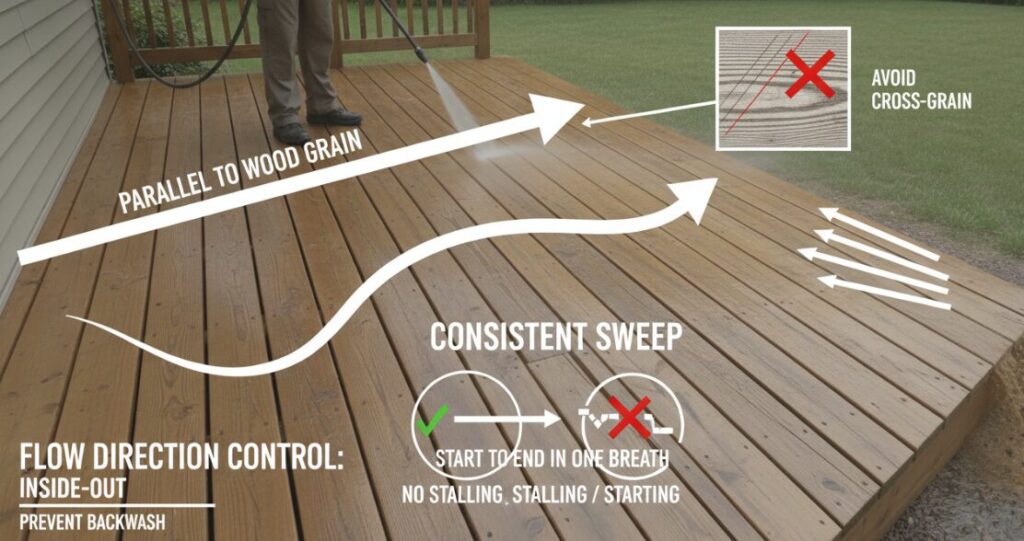
Parallel To The Wood Grain:
The trajectory of the gun head must always follow the direction of the wood grain. In this way, even if there is a slight wear and tear, it can naturally integrate into the wood grain, rather than cutting it off.
Consistent Strafing:
The movement should be large and smooth. Never ignite or stall in the middle of a board; on the contrary, you should sweep to the end of the board in one breath to ensure that the painted surface (or washed surface) has no joint marks.
Flow Direction Control:
Starting from the position close to the house, wash from inside to outside towards the edge of the deck. The reason is simple: prevent sewage and impurities from returning to the place you have washed clean.
Distance And Safety Calibration
The distance of the nozzle from the deck is the final variable that determines success or failure.
6-12 Inch Rule:
Stay in this range. Too close, you will find grooves carved into the wood (this is permanent damage); too far, the pressure is not enough, and the loose dirt cannot be washed away.
Keep Altitude Constant:
Hold this altitude steady throughout the strafing action. I found that many people are prone to make a mistake: when they wave at the end, their hands will involuntarily press down, leaving rows of ugly “U-shaped” cleaning marks on the board.
As long as you knock these PSI restrictions, choose the right nozzles, and honestly do oxygen pretreatment, you can make it look new without hurting the muscles and bones of the deck.
Author: David Miller
“Hi, I’m an exterior restoration specialist with over 10 years of experience in professional wood maintenance and pressure washing. My philosophy centers on the ‘Low-Pressure, High-Volume’ approach to ensure every deck I treat retains its structural integrity and natural beauty. I’ve dedicated my career to mastering the delicate balance of PSI settings and chemical pre-treatments, helping homeowners achieve professional-grade results without the risk of wood splintering or permanent damage. “