 Wingspan Tech




¿Puedo lavar mi coche con una hidrolimpiadora de forma segura? Método probado en 2026
Mucha gente me pregunta a menudo: «¿Lavar el coche con una pistola de agua a alta presión daña la pintura?». La respuesta es: es totalmente seguro, pero solo si se respetan estrictamente unos parámetros precisos: la presión del agua debe mantenerse por debajo de 1500 PSI, el caudal debe ser de al menos 1,5 GPM y solo se pueden utilizar boquillas de abanico de 40 grados o más.
Si utilizas directamente la pistola de agua de potencia ultraalta para limpiar la entrada del garaje sin tener en cuenta estas especificaciones concretas, la capa de cera de la pintura del coche se desprenderá al instante e incluso la capa de barniz sufrirá daños permanentes. Durante los años que he dedicado a probar equipos y calibrar parámetros, he probado no menos de cientos de soluciones de limpieza. Hoy he recopilado este conjunto de directrices estándar de descontaminación no destructiva de nivel profesional para que te sirva de referencia.
La “retórica del sector” que hay que filtrar
La mayoría de los tutoriales en línea repiten mecánicamente la misma retórica: “No pulverices desde muy cerca” y “El agua puede arrastrar los sedimentos”. A decir verdad, esta falta de indicadores cuantitativos en las recomendaciones hace que, cada día, muchos propietarios estropeen la pintura.
Según mi experiencia, si no se selecciona correctamente la abertura de la boquilla, lo que provoca un pico de presión instantáneo en el extremo de salida, la variable “distancia física” carece de sentido. No se puede sostener una boquilla de pulverización directa de 0 grados, situarse a tres pies de distancia y esperar que la pintura sea segura, ¿verdad? Los datos de las pruebas demuestran que la clave de la seguridad en la aplicación de la pintura reside en la dinámica de fluidos —concretamente, en la relación entre el caudal y la presión (la relación entre GPM y PSI)—, y no solo en la simple distancia física de pulverización.
Cambio de tendencia en 2026: el alto caudal (GPM) supera con creces a la alta presión (PSI)
La clave de la limpieza de la pintura del coche consiste en “eliminar” el barro y la arena, no en “triturarlos”. Por lo tanto, un caudal elevado es mucho más importante que una presión alta. Todo el sector del cuidado del automóvil ha comenzado a retirar progresivamente las hidrolimpiadoras de combustible de más de 3000 PSI y a pasar a unidades eléctricas con caudales reales más elevados.
Comparemos dos conjuntos de parámetros técnicos: una máquina con 1000 PSI pero un caudal de 2,0 GPM tiene una capacidad de lubricación y eliminación de arena que supera con creces a la de una máquina con 2500 PSI pero un caudal de solo 1,1 GPM. Un mayor caudal de agua permite formar una película de agua más espesa que actúa como barrera entre las partículas de sedimento y la capa de barniz, lo que reduce la fricción. Desde el punto de vista de la optimización del sistema, aumentar el caudal del equipo es la inversión más rentable para evitar arañazos en la pintura.
“Matriz de seguridad 1,5-1,5”: un conjunto de marcos de control contra la «estupidez»
Para ahorraros todos esos cálculos complicados, he resumido este conjunto en la “Matriz de seguridad 1,5-1,5”. En pocas palabras, consiste en fijar el límite superior de presión en 1500 PSI y el límite inferior de caudal en 1,5 GPM.
código de texto
1,5-1,5 Matriz de seguridad
   Caudal (GPM)
 ▲
 2,0 │ [Zona de seguridad y eficiencia] [Zona de lavado excesivo industrial/comercial]
     │ (Se recomienda utilizar una boquilla mejorada) (Fácil de provocar daños físicos)
 1,5 ├─── ─ ─ ─ ─ ─ ─ ─ ─ ─ ─ ─ ─ ┐
 │ │
 1,0 │ [Zona de caudal insuficiente] [Zona de riesgo muy alto]
 │ (Fácil de producir arañazos microscópicos) (Inyección directa de alta presión original)
     └────────────────────────────┴──────────────► Presión (PSI)
 1500
Cuando los parámetros del equipo se salen de este rango de seguridad, aumenta el riesgo de que la pintura resulte dañada. Para alcanzar este punto de equilibrio óptimo, suele ser necesario sustituir la boquilla de fábrica que viene con el túnel de lavado por una boquilla modificada con un diámetro interior mayor (normalmente de calibre 3,0 o 3,5). Este método consiste en ampliar la sección transversal de la salida y reducir de forma activa la presión del sistema, al tiempo que se maximiza el caudal de la máquina.
La matriz de seguridad 1,5-1,5 frente a las configuraciones de fábrica
| Modelo de hidrolimpiadora | Tipo de configuración | Tamaño del orificio de la boquilla | Presión de funcionamiento (PSI) | Caudal (GPM) | Puntuación de seguridad de la pintura (1-10) | Análisis de riesgos y rendimiento |
| Kärcher K5 Premium | Stock de fábrica | Vario Power (de serie) | 1.400 PSI | 1,20 GPM | 6.5 / 10 | Alto riesgo de que se produzcan microrayaduras; volumen de agua insuficiente para lubricar la pintura durante la eliminación de la suciedad. |
| Modificado (1,5-1,5) | 3,5 Orificio (40°) | 1.000 PSI | 1,55 GPM | 9.5 / 10 | Óptimo. Una presión considerablemente menor, combinada con un caudal elevado en galones por minuto (GPM), crea un colchón de agua denso y seguro. | |
| Ryobi RY142300 | Stock de fábrica | Boquillas estándar de 15°/25° | 1.600 PSI | 1,15 GPM | 5.0 / 10 | Pico de presión peligroso; los ángulos pronunciados de la fábrica concentran una energía cinética excesiva en la capa de acabado. |
| Modificado (1,5-1,5) | 4,0 Orificio (40°) | 1.100 PSI | 1,50 GPM | 9.5 / 10 | Óptimo. Reduce de forma segura la presión del sistema (PSI) al tiempo que maximiza el caudal volumétrico (GPM) del motor eléctrico. | |
| Sun Joe SPX3000 | Stock de fábrica | Boquilla de 25° de serie | 1.450 PSI | 1,24 GPM | 6.0 / 10 | La presión es apenas aceptable, pero el bajo caudal aumenta el riesgo de arrastrar partículas de suciedad abrasivas. |
| Modificado (1,5-1,5) | 3,0 Orificio (40°) | 950 PSI | 1,52 GPM | 9.0 / 10 | Máxima seguridad. Reducir la presión de funcionamiento por debajo de los 1.000 PSI garantiza una seguridad absoluta para las capas transparentes delicadas o envejecidas. |
Estandarización de las especificaciones de las boquillas y los ángulos de inyección
Para el lavado de superficies pintadas, la única opción adecuada es una boquilla blanca de 40 grados. Las boquillas de ángulo estrecho, de 15 o 25 grados, concentran la energía cinética en un área demasiado pequeña, lo que puede provocar fácilmente un desgaste localizado de la pintura. Durante el uso, la pistola pulverizadora debe mantenerse en un ángulo de 45 grados respecto al panel de la carrocería y moverse continuamente, aprovechando la fuerza de cizallamiento del chorro de agua para “barrer” el barro y la arena hacia abajo, en lugar de realizar un impacto vertical directo.
La regla de las tres zonas de distancia
En función del material y la resistencia de cada panel de la carrocería, la distancia de trabajo de la pistola pulverizadora debe ajustarse de forma dinámica.
- Zona 1 (cubo de la rueda y neumático): Mantener una distancia de entre 6 y 8 pulgadas. Estas zonas están fabricadas con materiales resistentes y presentan una fuerte adherencia de los contaminantes, lo que requiere un impacto mecánico considerable.
- Zona 2 (pintura y capa transparente): Mantén una distancia de entre 12 y 18 pulgadas. De este modo, el rocío en forma de abanico de 40 grados se dispersará por completo, lo que permite una cobertura óptima sin dañar la capa transparente.
- Zona 3 (cristales, juntas y emblemas): Mantén una distancia de al menos 24 pulgadas. Las juntas de las ventanas y los emblemas adhesivos de los coches son muy susceptibles a la infiltración de agua o a desprenderse bajo chorros de agua a alta presión.
Guía profesional para evitar errores habituales: cómo el lavado de coches puede dañar la capa transparente de tu vehículo
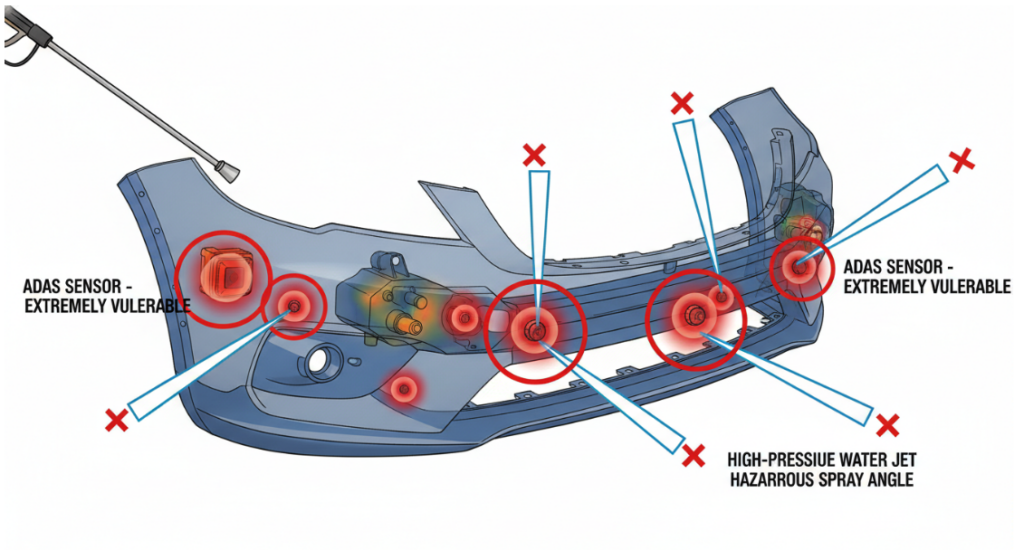
Dirigir con fuerza un chorro de agua a alta presión hacia los huecos de los paneles de un vehículo moderno puede provocar fácilmente fallos de funcionamiento en el sistema avanzado de asistencia al conductor (ADAS). En los modelos fabricados a partir de 2024, los parachoques y las rejillas incorporan numerosos sensores de radar y ultrasónicos de alta precisión. Los chorros de agua a alta presión pueden romper fácilmente las juntas originales del equipo, que cuentan con la clasificación IP67, lo que provocaría costosos daños en el sistema eléctrico.
La “trampa del deterioro” de los recubrimientos cerámicos (Crystal Coating)
Una presión excesiva (PSI) acelerará el deterioro y acortará la vida útil del recubrimiento cerámico de la superficie del vehículo (esmalte cristalino). Muchos propietarios de coches creen que un recubrimiento cristalino con una dureza de 9H es prácticamente impermeable, pero bajo el impacto físico sostenido de chorros de agua a alta presión, la capa hidrofóbica del recubrimiento puede sufrir fácilmente una delaminación inducida por cizallamiento mecánico. Para maximizar la vida útil de un costoso recubrimiento cerámico, mantener la presión por debajo de los 1.500 PSI es una línea roja que hay que respetar a toda costa.
Fallo del pulso de presión provocado por un frasco pulverizador de espuma
Muchas personas, al acoplar un pulverizador de espuma a una bomba de lavado de coches, pasan por alto la alineación correcta del orificio del recipiente interior, lo que puede provocar que la bomba sufra oscilaciones frecuentes. La mayoría de los cañones de espuma económicos del mercado vienen de serie con una boquilla pulverizadora que presenta un orificio de 1,1 mm. Si utilizas un lavacoches eléctrico de alto caudal, este orificio tan pequeño generará una contrapresión significativa. Debe sustituirse por un núcleo de boquilla con un orificio de 1,25 mm o más para adaptarse al caudal de la máquina y evitar ciclos frecuentes de arranque y parada del motor que podrían dañar la carcasa de la bomba.
Procedimiento operativo estándar de 2026: Tecnología de prelavado sin contacto “Foam First”
“Utilizar guantes de lavado de coches para limpiar directamente la pintura con barro seco y arena equivale a lijarla directamente con papel de lija”. La esencia del proceso «primero la espuma» consiste en utilizar la emulsificación química para suspender y eliminar el barro y la arena antes de que las manos toquen la pintura.
- Paso 1: Prelavado en seco del coche (espuma «Avalanche» sin contacto). Pulveriza espuma de alta calidad, de pH neutro y prelavada directamente sobre los vehículos secos y sucios. No rocíes agua primero, ya que los sedimentos secos tienen una mayor capacidad de adsorción, y aplicar la espuma directamente permitirá que el tensioactivo cubra mejor los sedimentos sin diluirse. Se dejó actuar la espuma durante 5 minutos.
- Paso 2: Enjuagar de abajo hacia arriba con un caudal elevado. Enjuaga de abajo hacia arriba, “de abajo hacia arriba”, y no de arriba hacia abajo. De este modo, la presión del chorro de agua y la gravedad forman un ángulo que elimina sistemáticamente los sedimentos emulsionados, “desprendiéndolos”. Por último, un enjuague rápido de arriba hacia abajo elimina cualquier resto de espuma.
- Paso 3: Dos cubos de líquido para lavado de coches (según sea necesario). Una vez que las partículas más gruesas se han eliminado mediante agua a alta presión, se procede a una limpieza minuciosa con guantes tradicionales de lavado de coches y un cubo de lavado provisto de una red filtrante para arena. En este punto, el guante debería deslizarse sin resistencia sobre la superficie pintada, limitándose a eliminar la película de suciedad residual del tráfico (Static Film).
Datos de pruebas reales: estudio controlado sobre el microdesgaste en un lavado de coches de 50 ciclos
Las pequeñas lesiones provocadas por una presión excesiva tienen un efecto acumulativo. A finales de 2025, mi equipo llevó a cabo una serie de experimentos controlados en el capó delantero de un Tesla Model 3 negro. Dividimos el capó en dos zonas, la izquierda y la derecha; la parte izquierda se limpió 50 veces utilizando la configuración convencional de 2500 PSI / 1,1 GPM, y la parte derecha se limpió estrictamente según nuestro estándar de 1100 PSI / 2,0 GPM en 50 ocasiones.
Los resultados experimentales son muy intuitivos: a la izquierda de los 2500 PSI, las propiedades hidrofóbicas de su recubrimiento cerámico disminuyeron en 45%, y se podían observar evidentes arañazos microscópicos (micro-marring) bajo luces de inspección industriales. En el lado derecho, con 1 100 PSI / 2,0 GPM, el ángulo de contacto de la gota de agua se mantuvo prácticamente inalterado (conservando una hidrofobicidad del 98%) y la superficie pintada permaneció intacta. Este conjunto de datos demuestra claramente que la búsqueda de una presión excesiva reduce la vida útil protectora de la pintura.
Datos del estudio sobre la microabrasión tras 50 lavados
| Ciclo de lavado / Intervalo | Configuración / Probado en el lateral | Espesor de la pintura (μmμm) | Ángulo de contacto hidrofóbico (°) | Valor de brillo (GU a 60°) | Estado visual de la superficie |
| Situación inicial (prueba previa) | Ambas caras (recubrimiento Fresh 9H) | 101.5 μmμm | 112° | 94,0 GU | Acabado impecable, similar al de un espejo; efecto hidrofóbico que hace que el agua se deslice en gotas. |
| Tras 10 lavados | Lado izquierdo (2.500 PSI / 1,1 GPM) | 101.4 μmμm | 95° | 91,2 GU | Se aprecian ligeras microrayaduras al examinarlo con la luz LED; ligera degradación del acabado granulado. |
| Lado derecho (1.100 PSI / 2,0 GPM) | 101.5 μmμm | 111° | 93,9 GU | En excelente estado. No presenta defectos visibles; conserva el brillo original y el agua se desliza por la superficie formando gotas bien definidas. | |
| Tras 30 lavados | Lado izquierdo (2.500 PSI / 1,1 GPM) | 101.1 μmμm | 78° | 86,5 GU | Se aprecian ligeras marcas circulares y un ligero desgaste de la pintura; el agua empieza a deslizarse en láminas en lugar de formar gotas. |
| Lado derecho (1.100 PSI / 2,0 GPM) | 101.5 μmμm | 110° | 93,8 GU | En excelente estado. No se observan daños apreciables ni degradación hidrofóbica. | |
| Tras 50 lavados | Lado izquierdo (2.500 PSI / 1,1 GPM) | 100.7 μmμm | 62° | 81,0 GU | Se observan una ligera red de araña y microarañazos en la capa transparente; la capa superior hidrofóbica presenta un desgaste considerable. |
| Lado derecho (1.100 PSI / 2,0 GPM) | 101.4 μmμm | 108° | 93,5 GU | Impecable. La superficie no presenta marcas circulares provocadas por el lavado; conserva el 96,4% del ángulo de contacto de perla original. |
Preguntas más frecuentes (FAQ)
¿Se puede utilizar una máquina de 3000 PSI para lavar coches?
Sí, pero solo si se sustituye la boquilla por otra de mayor diámetro (como la de 4,0 o 5,0) para reducir la presión de funcionamiento real por debajo de los 1500 PSI. Si se utiliza directamente la boquilla de serie de una máquina de 3000 PSI para lavar el coche, es muy probable que se dañe la superficie pintada.
¿Es seguro lavar el compartimento del motor a alta presión?
La limpieza del compartimento del motor requiere extrema precaución. La pistola pulverizadora debe mantenerse a una distancia mínima de 3 pies (unos 90 cm); utilice una boquilla con un ángulo de 40 grados y evite por completo el generador, la caja de fusibles y la entrada de aire.
¿Qué pasa si la pistola de agua se acerca demasiado al coche?
Si están demasiado juntas, se producirá un caudal elevado de agua que invadirá directamente el borde de la capa de barniz. Si hay pequeñas marcas de piedras y grava en la superficie pintada, el chorro de agua a alta presión desprenderá directamente la capa de barniz de la chapa de la carrocería a lo largo de la junta.
Con una hidrolimpiadora, ¿sigue siendo necesario frotar a mano?
Es necesario. La pistola de agua a alta presión puede eliminar más del 90% de las partículas grandes de sedimento y las partículas gruesas, pero en la superficie pintada suele quedar una capa de “película de tráfico” (Traffic Film) adherida por adsorción electrostática. Por último, la suciedad restante debe limpiarse con cuidado utilizando guantes de microfibra para lavado de coches.
La capa de barniz del coche ha empezado a desprenderse, ¿se puede lavar con una pistola de agua a alta presión?
En absoluto. La energía cinética mecánica del chorro de agua desmenuzará al instante la capa de barniz que queda suelta. Esas zonas dañadas solo deben frotarse suavemente a mano.
¿Qué tipo de boquilla para la cubeta de espuma es la más adecuada para una lavadora eléctrica?
Esto depende del caudal real de la máquina. Si el caudal de la máquina supera los 1,5 GPM, se recomienda utilizar un núcleo de pulverización con una abertura de 1,25 mm; si el caudal es menor, se puede utilizar un núcleo de pulverización de 1,1 mm, lo que garantiza el efecto espumante y evita que la máquina sufra oscilaciones frecuentes.
¿La pistola de agua a alta presión dañará las piezas de plástico del vehículo?
Sí, el chorro de agua a alta presión puede decolorar fácilmente las piezas de plástico negro e incluso eliminar la capa de protección contra los rayos UV de la superficie. Se recomienda mantener una distancia de al menos 24 pulgadas (unos 60 cm) al limpiar las piezas de plástico, las mallas centrales y las juntas de goma.