
 Wingspan Tech



Don’t Buy a Pressure Washer Until You Read This: 3 Mistakes That Ruin Your ROI
In the commercial cleaning industry, there is a highly enticing yet fraught phenomenon: many newcomers believe that by investing just $500 in a pressure washer, they can immediately launch a highly profitable career. However, seasoned maintenance experts, by analyzing thousands of hours of equipment failure data, have pointed out that this “low-threshold” illusion is often the precursor to a financial disaster. The most common and costly mistake for beginners is this: failing to properly maintain the pump or choosing the wrong nozzle, only to damage a customer’s expensive property on their very first job—such as tearing the fibers of a Trex composite deck or causing paint to peel off a car—resulting in liability that far exceeds the profit from that initial order. As an expert with over 15 years of equipment maintenance and hands-on experience, having disassembled countless sealing rings deformed by overheating and ceramic plungers shattered by cavitation, I can clearly tell every potential buyer: the success of commercial cleaning does not depend on how much money you spend on the machine, but on whether you understand the return on investment (ROI) logic behind the equipment.
The Science Of Cleaning: PSI Vs. GPM
When evaluating the performance of a high-pressure washer, PSI (pressure per square inch) and GPM (flow per minute) are the two most frequently mentioned but also the most commonly misread metrics. For ordinary consumers, labels of up to 4000 PSI are often very attractive, but in the eyes of professional contractors, GPM is the lifeline that determines operational efficiency and profitability. Understanding the scientific nature of these two parameters is the first step in avoiding buying the wrong device.
Why PSI Is NOT The Only Metric That Matters
PSI represents the “stripping strength” of the water as it leaves the nozzle, which determines whether the machine can cut through hard dirt, peel off old paint or remove oil stains on concrete. However, high pressure alone does not speed up cleaning. Professional cleaning logic regards PSI as “attack power” and GPM as “transport power”. The GPM determines how much water can wash away the stripped dirt.
The industry usually uses “Cleaning Units” (CU) to measure the overall performance of a machine, which is calculated:
According to these 1 formulas, a machine 3000 PSI / 2.0 GPM and a machine 2000 PSI / 3.0 GPM have the same 6000 CU, but in actual commercial operation, the efficiency of the latter is usually more than 30% higher. This is because in most commercial scenarios (such as residential facades and large-area driveways), the main bottleneck for cleaning is not the difficulty of “stripping”, but the speed of “flushing. Especially when professional contractors use chemicals (such as sodium hypochlorite) to pre-treat the surface, the dirt has been softened, and the advantages of high GPM are fully reflected: it can quickly push chemical residues and loose dirt to the drain, greatly shortening the working hours, thus improving ROI per hour.
Depth Correlation Of Nozzle Aperture To 13-16 Gauge
When discussing the flow rate, the professional operator must master the precise matching relationship between the nozzle aperture (Orifice Size) and the pump output. Downstream injection devices such as X-Jet, which are common on the market, are often labeled with a “13” or “16” specification, which directly corresponds to the GPM capability of the machine.
| Nozzle Size | Applicable flow rate range (GPM) | Applicable Pressure Range (PSI) | Core application scenarios |
| Size 13 | 4.0 – 4.5 GPM | 2500 – 4000 PSI | Medium-sized commercial cleaning, standard lane |
| Size 16 | 5.0 – 6.5 GPM | 2500 – 4000 PSI | Large commercial flooring, multi-story building soft washing |
If a Size 16 nozzle is installed on a pump rated at 2.5 GPM, the excessively large orifice will fail to generate sufficient back pressure, resulting in a significant reduction in cleaning performance and even preventing the system from drawing in the cleaning solution (causing the Venturi effect to fail). Conversely, if the nozzle aperture is too small, excessive back pressure will be generated, causing the pump to frequently enter the bypass mode, causing the sealing ring to fail within a few minutes due to overheating.
The Verdict: Top Entry-Level Commercial Pressure Washers (Tested & Reviewed)
After clarifying the technical indicators, it is very important to choose a device that can withstand 8 hours of high-intensity operation every day. The watershed between commercial machines and domestic machines is mainly reflected in two core components: the durability of the engine and the structure of the pump.
Best Overall For Beginners (Reliability & Parts Availability)
Recommended model: Simpson PowerShot 3400 PSI / 2.5 GPM (equipped with Honda GX200 engine & CAT 3 plunger pump)
As a maintenance expert, the configuration is regarded as an entry-level “financial product”. Its core strengths are:
- Engine benchmark: Honda GX series engines use cast iron cylinder liners and ball bearings to support the crankshaft, and its life is 3-5 times that of ordinary household GC series.
- Pump body peak: CAT Pump brand in the industry represents a very high maintenance. As a 3 plunger pump (Triplex Pump), it runs at low temperature, and all sealing rings and check valves can be replaced independently.
- Expert maintenance Note: The pump oil color must be checked every 50 hours of operation. If the oil becomes milky white, the water seal has failed and moisture has entered the crankcase. At this time, spending $50 to replace the seal ring can avoid replacing the entire pump worth $400.
Best For High-Volume/Heavy-Duty Cleaning (Concrete & Driveways)
Recommended Model: BE Power Equipment 4200 PSI / 4.0 GPM with Honda GX390 engine
For those who focus on parking lots and cleaning large commercial lanes, traffic is money.
- Performance logic: The 4.0 GPM flow rate allows operators to use a 20-inch diameter ground rotating washer (Surface Cleaner), which has a working area of more than 4 times that of a normal spray bar, directly maximizing ROI.
- Limitations reminder: 4.0 GPM has reached the water supply limit of ordinary household tap water. If the water intake is insufficient, the pump will produce severe cavitation effects (knocking sound), and the operator may need to configure a small buffer tank (Buffer Tank).
Best For Delicate Surfaces (Car & Residential Exteriors)
Recommended Model: DeWalt 3000 PSI / 2.4 GPM Compact Series
If your business involves a large number of high-end car washes or fine exterior wall cleaning, the adjustability of lightness and pressure is better than pure strength.
- Design advantages: DeWalt’s design is generally more ergonomic, with better mobility and on-board storage.
- Balance point: Although it is usually equipped with an axial pump (short life), for intermittent car wash operations, its lower initial investment can recover costs faster.
What Surfaces Can You Clean? (The Truth About Damage Control)
Many novices ruin their business not because they don’t wash it, but because it’s “too clean. High pressure water flow is equivalent to a liquid saw under improper operation.
The Danger Of Trex Decking & Soft Wood
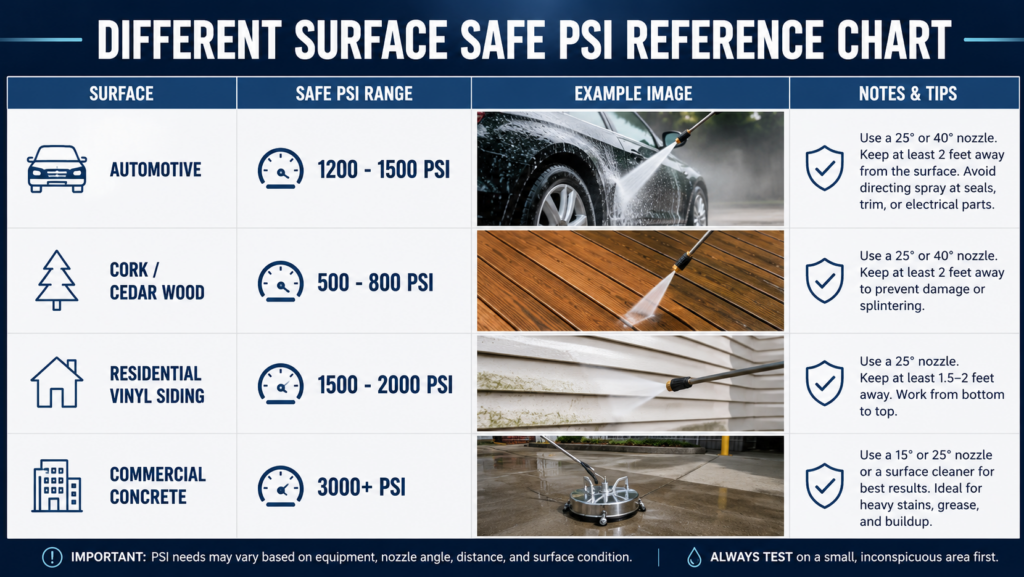
Laminate wood flooring such as Trex is an expensive investment for modern homes. A stern warning from maintenance experts is that it is strictly forbidden to use more than 3100 PSI on the Trex deck. In fact, to be on the safe side, the industry recommends controlling the pressure below 1500 PSI and keeping the nozzle at least 8 inches from the surface.
If the red (0 degree) nozzle is used to flush the composite wood at close range, the water flow will permanently damage the protective layer and texture of the surface. This damage is irreversible and usually leads to the owner claiming thousands of dollars in replacement costs.
Cleaning Cars & Windows: The “Soft Wash” Technique
For glass, car paint and fine wood, professionals use “soft wash” (Soft Wash) technology. It’s not just about lowering the pressure, but breaking down the dirt through specific chemicals.
Operating logic: Use a black soap nozzle (low pressure) to spray the diluted detergent on the surface, use a chemical reaction to peel off the biofilm and dust, and finally use a wide-angle nozzle (40 degrees, white) for high-flow flushing. This method not only protects the paint surface, but also improves the safety of the operation by reducing mechanical friction.
How To Use A Pressure Washer Safely & Effectively (Step-By-Step)
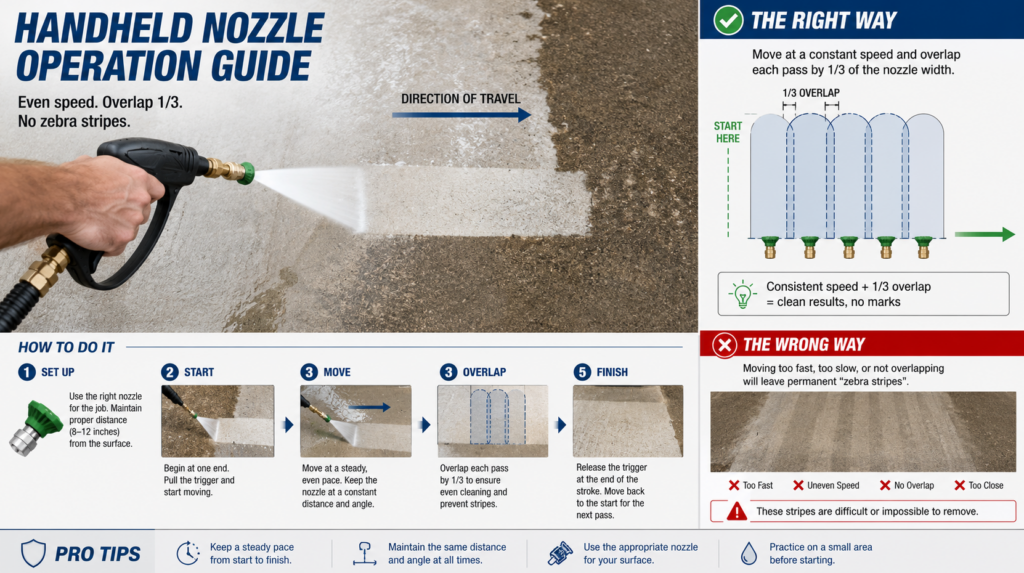
To prevent your expensive pump from being damaged within minutes, you must adhere to strict operating procedures.
Step-By-Step Guide For Pros
- Inlet water flow verification: Before starting the engine, first connect the water supply, then pull the spray gun trigger until all air is purged and a stable low-pressure flow is established. The water intake must be greater than the rated flow of the pump.
- Choose the right nozzle:
- Red (0°): Extremely hazardous; use only on localized, stubborn stains on concrete (such as chewing gum).
- Yellow (15 °): Strip mold and paint from concrete, bricks.
- Green (25 °): Universal, suitable for lanes and fences.
- White (40°): Delicate surfaces, glass, automobiles.
- Black (65°): For soap dispensing only.
- Prevent overheating: If you do not plan to spray water for more than 60 seconds, be sure to turn off the engine. When the pump operates in bypass mode, it continuously recirculates the same bucket of water, causing the water temperature to rapidly rise to its boiling point and melt the internal water seal.
The Financial Reality: Pressure Washing Costs & Rental Vs. Buying
From a financial point of view, every hour of operation is generating depreciation. Understanding the cost structure is a prerequisite for setting a reasonable offer.
Rental Vs. Buying Matrix
| Dimension | Daily rental ($) | Purchase an entry-level business machine ($1,200) | Purchase a top-of-the-line industrial machine ($5,500) |
| Initial investment | $50 – $100 | $1,200 | $5,500 |
| Maintenance responsibility | none | Regular oil changes and antifreeze treatment are required. | Requires meticulous and professional maintenance |
| Payback period | Clearing every order | Approximately 12-15 assignments | Approximately 40-60 large-scale operations |
| Long-term ROI | Low (money given to the rental shop) | High lifespan (500+ hours) | Extremely high (3000+ hours, major overhaul possible) |
If you can only take 2 orders per month, leasing may be more cost-effective because it eliminates the risk of winter storage and pump maintenance. But if you’re going professional, having a Honda/CAT machine that can be serviced is the only way to reduce long-term unit costs.
Estimated Costs For Common Jobs (2000 Sq Ft House)
Based on market data for 2026, for a 2000-square-foot standard home, the industry pricing logic is as follows:
- Exterior wall cleaning: $250 – $600 (based on material, vinyl is cheaper, stucco or brick is more expensive).
- Lane cleaning: $100 – $300 (depending on whether there are oil stains requiring chemical treatment).
- Roof cleaning: $450 – $1,000 + (high risk soft wash, highest profit margin).
Expert advice: Your quote should include equipment depreciation, chemicals, fuel, insurance, and your labor costs. The gross margin of commercial cleaning should normally be maintained above 30%-40%.
Frequently Asked Questions (FAQ)
- Will the pressure washer damage my driveway?
As long as the nozzle angle is correct (usually 25 degrees or 40 degrees is used) and not too close to the surface, concrete is very resistant. However, for new concrete within 1 year, high pressure may damage the sealing layer on its surface. - Do I really need soap/chemicals?
Yes. Soap is a chemical cleaner, not an option. It can significantly reduce the dependence on high pressure, thereby reducing mechanical damage to the surface, while making the cleaning effect more durable (killing mold spores, not just washing them away). - Electric or gas: which has a longer life span?
In a commercial environment, gas machines (especially the Honda GX series) have an absolute life advantage. Electric machines are silent, but most entry-level motors are not serviceable and cannot provide the 4.0 GPM flow required by commercial grade. - How to store in winter?
All the water in the pump must be drained and filled with special antifreeze pump (Pump Guard), otherwise the residual water will freeze and expand and crack the pump body manifold. - Why is my pump vibrating and making a loud impact?
This is usually a cavitation phenomenon (Cavitation), indicating insufficient water intake. Check whether the water inlet pipe is broken or the water inlet filter is blocked. - What is the difference between 3 piston pump and axial pump?
3 piston pump is driven by crankshaft, with slow running speed, low heat, long life and maintenance. The axial pump is directly connected to the motor shaft, which is fast, easy to heat, short life, and usually cannot be repaired. - Can I use hot water directly into the cold water cleaning machine?
Absolutely not. The seal ring of an ordinary pump can only withstand a temperature of about 140 °F (60°C). Unless your machine is labeled as a hot water cleaner (with a heated boiler), hot water will damage the seals immediately. - The trigger of the spray gun feels heavy. What is the reason?
This is usually due to the system pressure not being released. Before disconnecting the hose, turn off the water supply and turn off the engine, then pull the trigger to release the residual pressure. If the operation is heavy, the pressure relief valve (Unloader Valve) may be adjusted too high. - Why don’t commercial machines come with built-in soap boxes?
High-end commercial machines typically use downstream injectors (Downstream Injector). Because direct chemical flow through the pump will corrode internal seals and valves. The life of the pump can be greatly extended by injecting soap through a syringe at the end of the nozzle. - How long should I choose the hose?
50 feet is the standard configuration, but commercial operations usually require more than 100 feet to avoid frequent moving of heavy machines. Note that too long hose will cause a slight pressure drop due to frictional resistance.
Conclusion: Your ROI Starts With Equipment Choice
In the commercial cleaning industry, buying equipment is not to “save money”, but to “make money”. The real value of those expensive configurations at first glance (such as machines with Honda GX engines and CAT pumps) is reflected in the extremely low operating cost per hour and strong secondary sales value.
Immediate Action Guide (Actionable Advice):
If you are still hesitant between the two or three models, please do not click the buy button right away. Go to a local construction equipment rental shop and rent a 4.0 GPM commercial machine to 1 the whole day. When you experience the amazing flushing efficiency of 4.0 GPM and the stability of professional-grade machines after 4 hours of continuous operation, you will understand why senior operators will never look back at those $500 “supermarket goods. Your ROI has already started from the moment you choose the machine that can buy accessories even if it breaks down.
Author Information: Marcus
Senior Expert in High-Pressure Cleaning System Maintenance | 15 Years of Industry Experience as an Engineering and ROI Actuarial Consultant
Marcus is a seasoned veteran in the high-pressure cleaning industry. Over the past 15 years, he has risen from an on-site operator to a equipment maintenance specialist overseeing hundreds of industrial cleaning machines. He has personally disassembled countless pump heads that were scrapped due to cavitation, and holds nearly stringent standards for the durability of Honda GX-series engines as well as the precision maintenance of CAT, Comet, and triplex pumps.
Unlike simple device reviewers, Marcus’s perspective is always locked on “return on investment. He has guided numerous early-stage cleaning companies to more than triple the average lifespan of their equipment by implementing data-driven equipment selection—such as precisely matching PSI and GPM for cleaning units—and preventive maintenance protocols, including using oil‑color monitoring to prevent pump failures. His expert insights are not only grounded in laboratory data but also stem from the accumulated experience of thousands of real-world commercial cleaning operations conducted in Florida’s extreme humidity and Colorado’s high‑altitude, freezing climate.
Core belief: “In the commercial cleaning business, a true expert never places blind faith in the wattage figures on the packaging; what matters is this: if the equipment breaks down at a job site on Monday morning, can they obtain the necessary parts within 30 minutes and repair it themselves?”