
 Wingspan Tech


Can You Pressure Wash A Car
The answer is yes, you can wash the car with a high-pressure washer. In fact, if done properly, it is usually safer than using a regular garden hose.
However, there is a big premise here: in order not to damage the varnish layer, trim or body sticker, you must strictly observe specific safety parameters. To wash the car safely, set the pressure of the pressure washer between 1200 and 1900 PSI, and strictly limit the use of only white (40 degrees) or green (25 degrees) nozzles.
Never use a red (0 degree) nozzle.
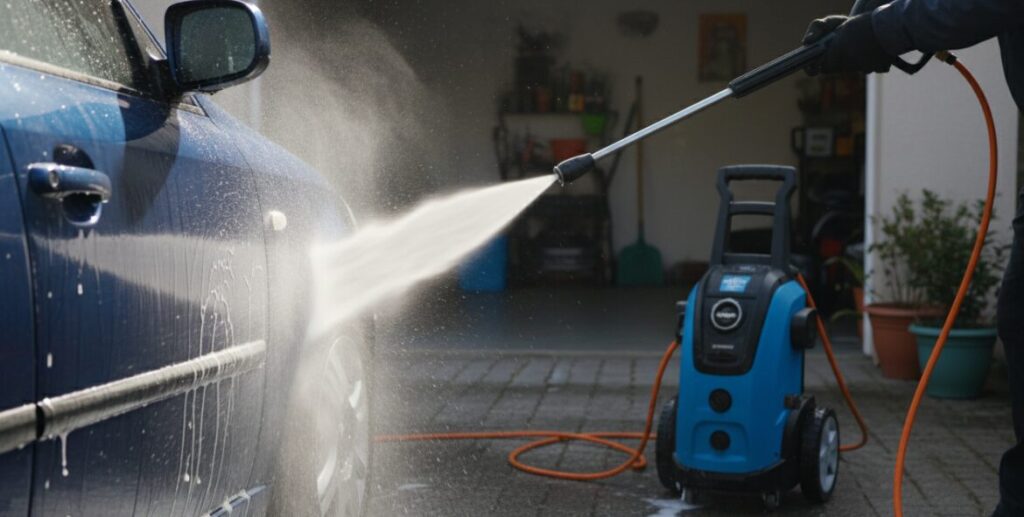
In addition, always maintain a distance of 12 to 18 inches (about 30-45cm) between the spray head and the paint surface. This distance ensures that the water pressure washes away the dirt without “peeling” the car wax or paint.
Why Is High-Pressure Cleaning Safer Than Garden Hoses?
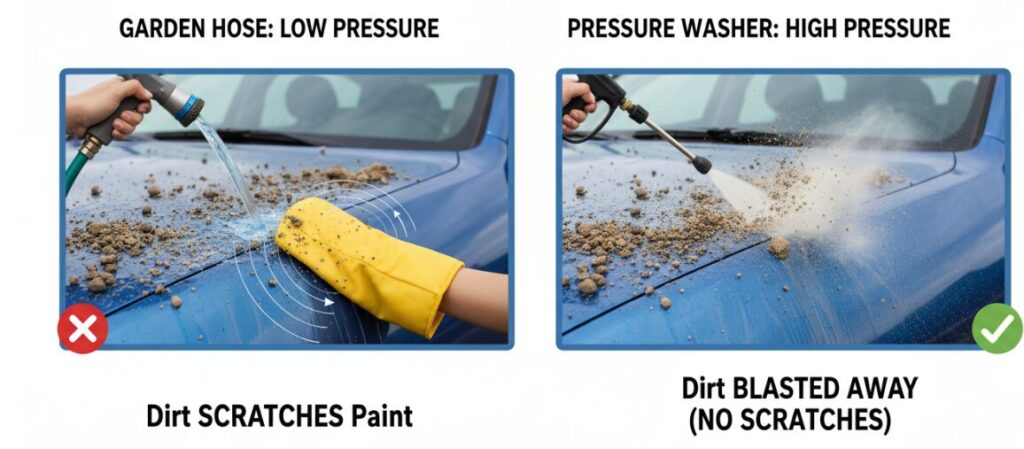
Many car owners have a misunderstanding that the long stream of water flowing out of the garden hose is the gentlest and safest way to wash the car. But the pressure washer is actually more friendly to car paint.
The core reason is that it can remove abrasive dirt without any physical contact.
When you use a low-pressure garden hose, the heavy dirt and gravel tend to stick stubbornly to the surface of the car. If you get started directly at this time and wipe it with a sponge or car wash gloves, you are basically grinding the car paint with sand. This is why many people have so many fine scratches and sun lines on their cars-all “wiped” out by themselves.
If you can control the pressure washer within the recommended 1200 to 1900 PSI range, you can “blow” away the heavy gravel and road oil film before the gloves touch the car paint. This pre-washing step, in my opinion, is the key to protecting the finish of the paint.
Critical PSI Range: 1200 To 1900 PSI
When answering the question “can you wash the car with a high-pressure water gun”, the most important parameter is the PSI (pounds per square inch) setting. You must have the device stuck in the “safe zone” of 1200 to 1900 PSI.
- Below 1200 PSI: The pressure is too weak. In the face of stubborn dirt, brake dust or insect corpse sticking to the front of the car, this pressure cannot be solved at all, and the significance of high-pressure cleaning is lost.
- Above 1900 PSI: This is the “danger zone.” The impact of the water flow may peel off the protective layer of the car wax, etch into the clear paint layer, or even burst the paint on the plastic bumper.
The equipment of most commercial car washes is set in this specific window, which is to find a balance between cleaning power and vehicle safety. If you are using a high-power gas pressure washer, even if it can soar above 2000 PSI, you have to turn the regulator down to make sure not to exceed the red line of 1900 PSI.
O-Series High Pressure Washer 220V
The durable ceramic pump and powerful four-stage motor provide high-performance cleaning power, with adjustable pressure, support for customized voltage and power.
380V 1500Bar Water Blaster
1450 RPM ultra-high pressure water jet pump, high cost performance, suitable for 50Hz voltage. It’s a great tool for removing rust and deburring in factories.
Diesel Power High Pressure Cleaner
The pump unit is the core component of a cleaning machine or water treatment system. Composed of a high-pressure plunger pump and an electric motor
Foam Cannon for car washing
Foam Cannon S V3.0 (Thicker Snow Foam Technology) with 1/4 Inch Quick Connector for Pressure Washer, 34 oz Bottle (V3.0 (1/4″ Quick Connector) + SOAP Sample)
Choosing The Right Nozzle
It is not enough to look at the PSI, the choice of nozzle determines the concentration of power. You should only consider the following two types when washing a car:
- White nozzle (40 degrees): This is the widest spray angle and the safest for the body. It distributes water pressure over a large area and is ideal for flushing foam and dust on relatively sensitive surfaces such as windows, door panels and hoods.
- Green nozzle (25 degrees): The water flow of this nozzle is slightly concentrated. It is very effective against wheel hubs, wheel arches and side skirts, which are prone to accumulation of road tar and mud.
- Warning about red: The red (0 degree) nozzles should never be used on vehicles. The red nozzle will concentrate the water like a laser in a column of water. With this stuff, almost 100% will cut through the varnish layer, cut the rubber sealing strip, and even cut marks on the plastic trim.
Follow The 12-18 Inch Distance Rule
The last safety parameter is the distance between the nozzle and the vehicle. No matter what PSI or nozzle you choose, water pressure decays quickly as it travels through the air.
Safe area (12-18 inches): Keep the spray gun 12 to 18 inches from the surface to ensure that the water hits the car just clean and not enough to cause damage. This creates a fan-shaped water surface that safely carries the dirt away.
Danger of getting too close: If you bring the nozzle to within 12 inches, the risk comes. You may “inject” water under the sticker, or force the water over the sealant strip, or even wash the repaired paint off.
One more thing, get the gun moving. Don’t knock at a point, especially if it’s less than 12 inches away, or you’ll leave permanent water spots on the varnish.
FAQ:
A: Always keep a distance of 12 to 18 inches. This distance ensures that the pressure is enough to wash away the dirt without being too violent and damaging the paint or decals.
A: Yes, it’s usually too high. I recommend keeping the pressure between 1200 and 1900 PSI. 2000 PSI is fine with cement, the risk of peeling wax and damaging varnish is too great when used on a car.
A: Strictly speaking, please use a white (40 degree) nozzle for regular cleaning of the car body, and a green (25 degree) nozzle can be used for a relatively resistant place such as the wheel hub. This distributes the pressure safely.
A: No. Never use red (0 degrees) nozzles on any part of the car, including the wheel hub. Its water flow is too concentrated, which will damage the surface coating of the wheel hub and even cut the rubber tire itself.
Author: Alex Miller
“With over a decade of experience in professional auto detailing and paint protection, I specialize in safe vehicle maintenance techniques. I wrote this guide to help you master the balance between cleaning power and paint safety. “