
 Wingspan Tech


Can You Power Wash Wood
Yes, you can indeed use a high-pressure cleaner to clean wood, but the premise of safe operation is that you must strictly abide by the red line of operation, otherwise the irreversible damage of wood cracking, fluffing or etching cannot be run away.
You need to strictly control the pressure between 500 and 1200 PSI (pounds per square inch), and only use 40 degree (white) or 60 degree wide-angle fan nozzles. During the cleaning process, the spray head should be kept at least 6 to 12 inches from the surface, and the spray must follow the direction of the wood grain to prevent the wood fibers from tearing.
To be honest, if you can’t lower the pressure of the machine, or have little experience on hand, I strongly recommend that you switch to “Soft Wash”—that is, low-pressure washing with special wood cleaners. This is a safer and more effective way to extend the life of your wood.
The PSI Limit (500 – 1200 PSI)
To judge whether high-pressure cleaning can be carried out without destroying wood, the core indicator is the output pressure. Wood is essentially a porous, soft material that simply cannot withstand the high pressures of cleaning concrete or vinyl siding.
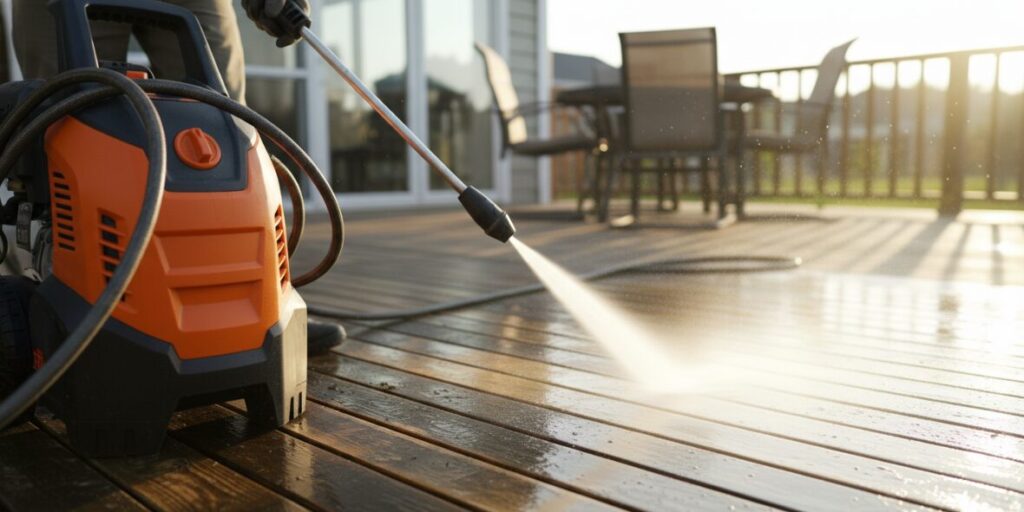
- Danger Zone: Most household pressure washers on the market have a preset pressure of 2500 to 3000 PSI. When this kind of strength is applied to wooden terraces or fences, the effect is no different from that of “liquid belt sanding machine”. Trenches can be dug out on the surface in an instant, resulting in deep etching.
- Security Zone: You must call back the machine to the range of 500 to 1200 PSI. This pressure is enough to carry away dirt, mold and ash-making fibers without cutting into the healthy wood layer below. If your machine doesn’t have a regulator, it’s probably too wild for the job.
Select The Right Nozzle: 40 Degrees Vs. 60 Degrees
Choosing the right gun head is as important as setting the PSI, because the nozzle determines the concentration of the water flow.
- 40 degrees (white nozzle): This is the industry standard for treating wooden surfaces. It can play a wide fan of water mist, the pressure spread to a larger area, to avoid a single point of force is too large.
- 60 degree nozzle: If found, the 60 degree nozzle can provide a wider and softer spray pattern. For softer woods like Cedar or Pine, it provides the highest safety redundancy.
- Absolutely forbidden: Never use a 0 degree (red) or 15 degree (yellow) nozzle on wood. These jets will converge the power into a “laser beam”, the end must be the wood cracking and “fluffing” (furring, the wood fiber is torn up, like fluff).
O-Series High Pressure Washer 220V
The durable ceramic pump and powerful four-stage motor provide high-performance cleaning power, with adjustable pressure, support for customized voltage and power.
380V 1500Bar Water Blaster
1450 RPM ultra-high pressure water jet pump, high cost performance, suitable for 50Hz voltage. It’s a great tool for removing rust and deburring in factories.
Diesel Power High Pressure Cleaner
The pump unit is the core component of a cleaning machine or water treatment system. Composed of a high-pressure plunger pump and an electric motor
Foam Cannon for car washing
Foam Cannon S V3.0 (Thicker Snow Foam Technology) with 1/4 Inch Quick Connector for Pressure Washer, 34 oz Bottle (V3.0 (1/4″ Quick Connector) + SOAP Sample)
Core Technique: Distance And Texture Trend
Even if PSI and nozzles are on the right track, it’s still a bad thing if you can’t do it. Operating distance and jet direction are two variables that cannot be compromised.
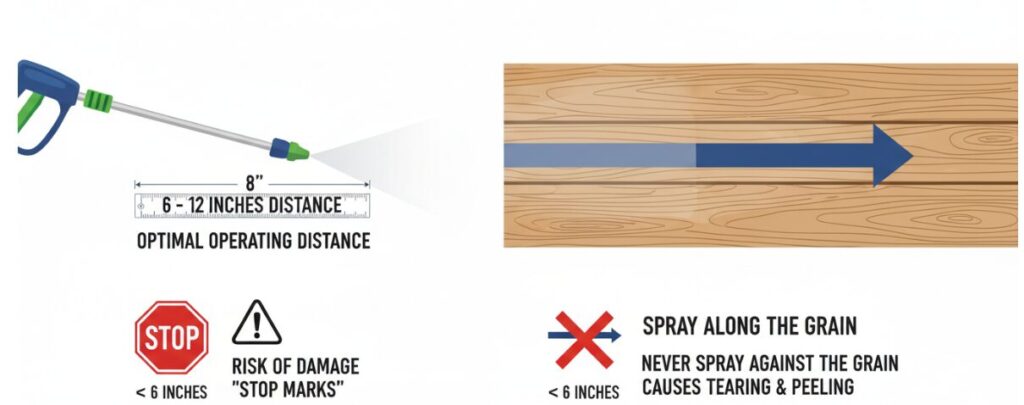
- Keep a distance of 6 to 12 inches: the farther the nozzle is from the surface, the faster the water pressure will decay. Controlling the tip of the gun to 6 to 12 inches away is to let the detergent and water flow go to work, rather than relying on the raw impact kinetic energy. Once the distance is less than 6 inches, you run the risk of leaving “stop marks” or obvious lines.
- Spray along the grain: the fibers of the wood have a specific direction. Your gun must always move parallel to these fibers. If you spray against the texture or sideways, the water will be pressed under the fibers, lifting them up, directly causing the surface to tear or peel.
“Soft Wash” Alternative
If you are inexperienced or unable to reduce the pressure washer to below 1200 PSI, the “soft washing method” is definitely the better solution to protect the life of the wood.
Chemical dissolution is better than physical impact: soft washing relies on special wood cleaners (usually oxygen-containing bleach or special detergents) to break down mold, moss and old scale through chemical reactions.
Low pressure flush: After the cleaner stays and “floats” the contaminants, you just need to flush it with the pressure of the garden hose or the very low pressure setting.
Eliminate irreversible damage: This method completely eliminates the mechanical risk of etching and fluffing, ensuring that the wood remains smooth and structurally sound.
Author:David Miller
” As a professional exterior cleaning specialist with over 16 years of experience, I dedicate my career to wood restoration. I write to help homeowners master safe pressure washing techniques, ensuring your decks and fences are cleaned effectively without risking structural damage.”