
 Wingspan Tech


can you power wash in the winter
The answer is yes, of course, high-pressure cleaning can be carried out in winter. But there is a hard precondition: the ambient temperature must remain stable above 38 °F (about 3°C) to prevent the water from freezing instantly.
Although it is very important to remove dirt and corrosive road snow melting salt in winter for house maintenance, to successfully complete the cleaning in winter, you must strictly follow a set of safety operation procedures: only work during the warmest time of the day (usually 11: 00 a.m. to 2: 00 p.m.), leaving time for the surface to dry before dark; Special winter cleaners that can work in cold water must be used. The most important thing is, after use, the water in the pump of the high-pressure cleaner must be drained immediately and the pump protection agent (antifreeze) must be injected, otherwise the internal manifold will be frozen and the machine will be discarded.
If the weather forecast shows that the temperature will drop below freezing within 4 hours of cleaning, don’t take the risk. The resulting invisible “black ice” can make walkways extremely dangerous, and the internal components of your equipment can explode. In this case, if there is no professional hot water cleaning equipment, this job is too dangerous.
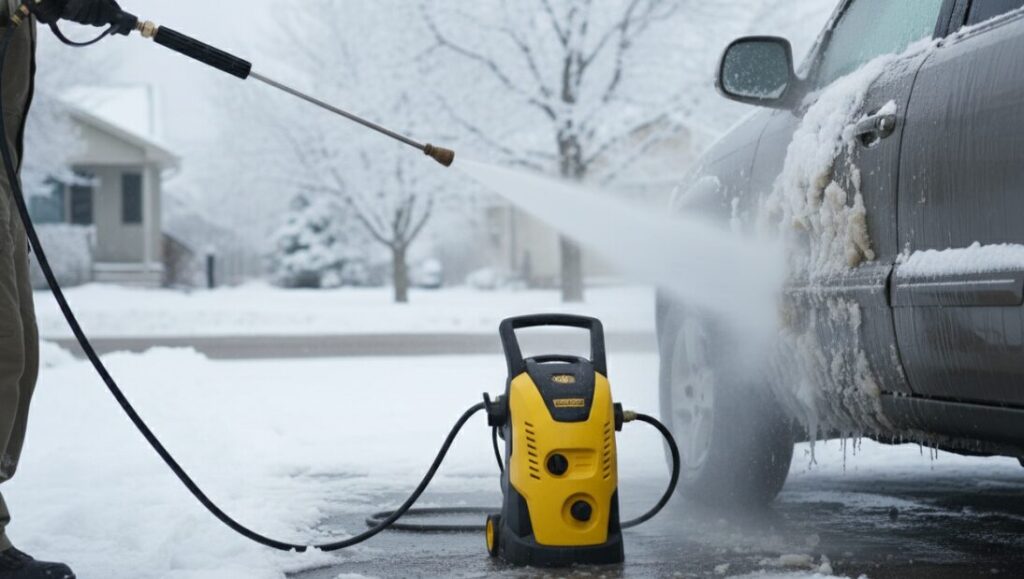
The Key To High Pressure Cleaning
You must ensure that the temperature stays above 38 °F (about 3°C). The reason for leaving this buffer zone is that:
- The surface temperature tends to be lower than the air temperature: the air is warm, but the concrete floor may still be frozen through.
- Wind chill effect: Wind blowing on wet surfaces can cause water mist to freeze quickly.
- Drainage time: This temperature ensures that the water stays liquid and flows away, rather than turning into a shell of ice the moment it touches your exterior wall or driveway.
Why Is Winter Cleaning More Necessary?
Although the weather is so cold that people don’t want to move, from a professional point of view, it is very necessary to wash the house in winter. This is not only to look good, but also to “save your life”-to protect the life of your house. Some specific pollutants brought by winter can seriously corrode the external materials of the house:
- Corrosive road snow melting salt: Salt scattered on the road will splash on the bottom of your driveway, sidewalk and exterior walls. If not cleaned up in time, these salts will slowly “eat” your concrete and metal components.
- Winter-specific dirt: The smoke from the heating system and the mud common in winter can build up. Timely removal of these things can prevent long-term material damage, of course, provided you follow these safety procedures.
O-Series High Pressure Washer 220V
The durable ceramic pump and powerful four-stage motor provide high-performance cleaning power, with adjustable pressure, support for customized voltage and power.
380V 1500Bar Water Blaster
1450 RPM ultra-high pressure water jet pump, high cost performance, suitable for 50Hz voltage. It’s a great tool for removing rust and deburring in factories.
Diesel Power High Pressure Cleaner
The pump unit is the core component of a cleaning machine or water treatment system. Composed of a high-pressure plunger pump and an electric motor
Foam Cannon for car washing
Foam Cannon S V3.0 (Thicker Snow Foam Technology) with 1/4 Inch Quick Connector for Pressure Washer, 34 oz Bottle (V3.0 (1/4″ Quick Connector) + SOAP Sample)
Seize The Golden Window: 11 A.M. To 2 P.M.
You must strictly limit your work to the warmest part of the day, usually between 11 a.m. and 2 p.m.
The card has two purposes in this time period:
- Use maximum heat: Use midday sunlight to ensure that the surface temperature is maintained above freezing during cleaning.
- Set aside drying time: Capped at 2 pm, giving your house a few hours of sunshine to allow the water to evaporate. If the surface is still wet when it is dark and cold, they will freeze immediately, not only damaging the material, but also turning their yard into an ice rink.
Select The Right Chemical
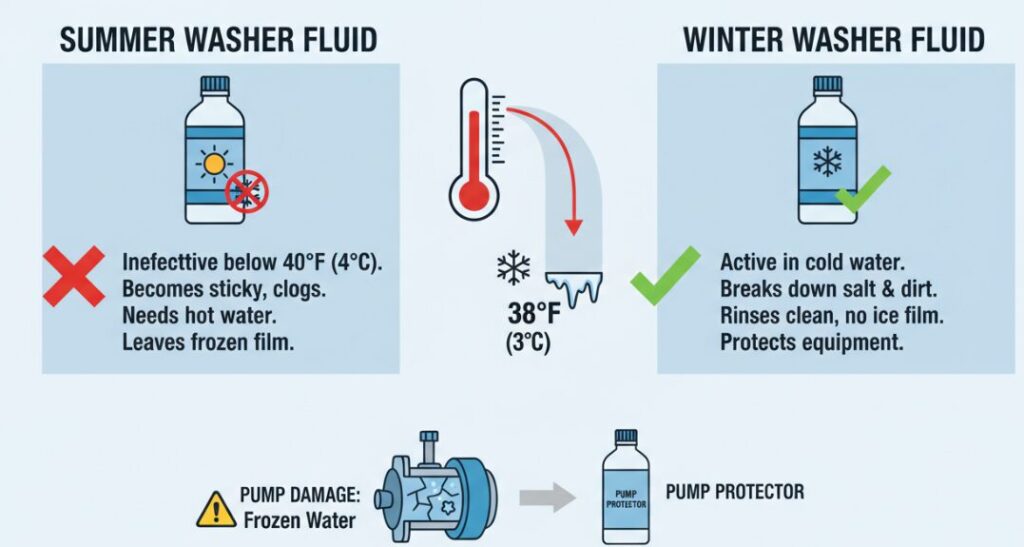
Don’t make do with the ordinary high-pressure washer fluid you use in summer. Those formulations are usually designed for warm weather or hot water activation.
When you try to use ordinary soap liquids at a temperature of about 38 °F, you will find that they become sticky, insoluble, or even completely lose their cleaning power. To get rid of winter dirt, you have to use special winter-grade cleaners. The chemical formulations of these products have been adjusted:
It remains active in cold water.
It does not require high temperatures to break down heavy salt and dirt.
Rinse cleanly without leaving a frozen film.
Protect Your Equipment: Pump Protector Protocol
Owners wash their own cars or houses in winter, the biggest economic risk is not to wash clean, but to break the high-pressure washer. Even if there is only a little water left in the pump, the internal manifold can be directly cracked after freezing and expansion, and the machine is basically scrapped.
In order to avoid this tragedy, the following process must be performed immediately after using the machine:
- Empty the pump body: remove the hose, pull the recoil starting rope (or short idling motor) several times, and drain the water as much as possible.
- Use pump protection agent : this step is not negotiable. You must circulate a special pump protector or antifreeze into the system. This not only lubricates the seals, but more importantly prevents the residual moisture in the pump from freezing, thus preserving your core components.
Beware Of “Black Ice” And Speed Cooling
Safety always comes first. Before starting work, don’t just look at the current weather, look at the forecast for the next few hours.
If the forecast shows that the temperature will drop below freezing within 4 hours after the end of the cleaning, do not dry. Ignoring this rule carries an extremely high risk:
- Black Ice: Wet walkways and driveways form a very thin layer of ice that is hard to see. This is a serious slip and liability accident for you, your family or the little brother who delivers the express.
- Damage to equipment: If you’re working or finishing up with a sudden drop in temperature, your pipes and pumps may freeze hard within minutes.
Author: Mark Dawson
With over 16 years of experience in exterior property maintenance and professional pressure washing, I specialize in helping homeowners navigate complex DIY challenges safely. I hope to provide you with precise, technical advice—like the critical 38°F rule—to ensure you protect your home and equipment, even during the toughest winter months.